Categories
Guides

Sarakiniko Beach, Milos: The Moonscape by Land and by Boat

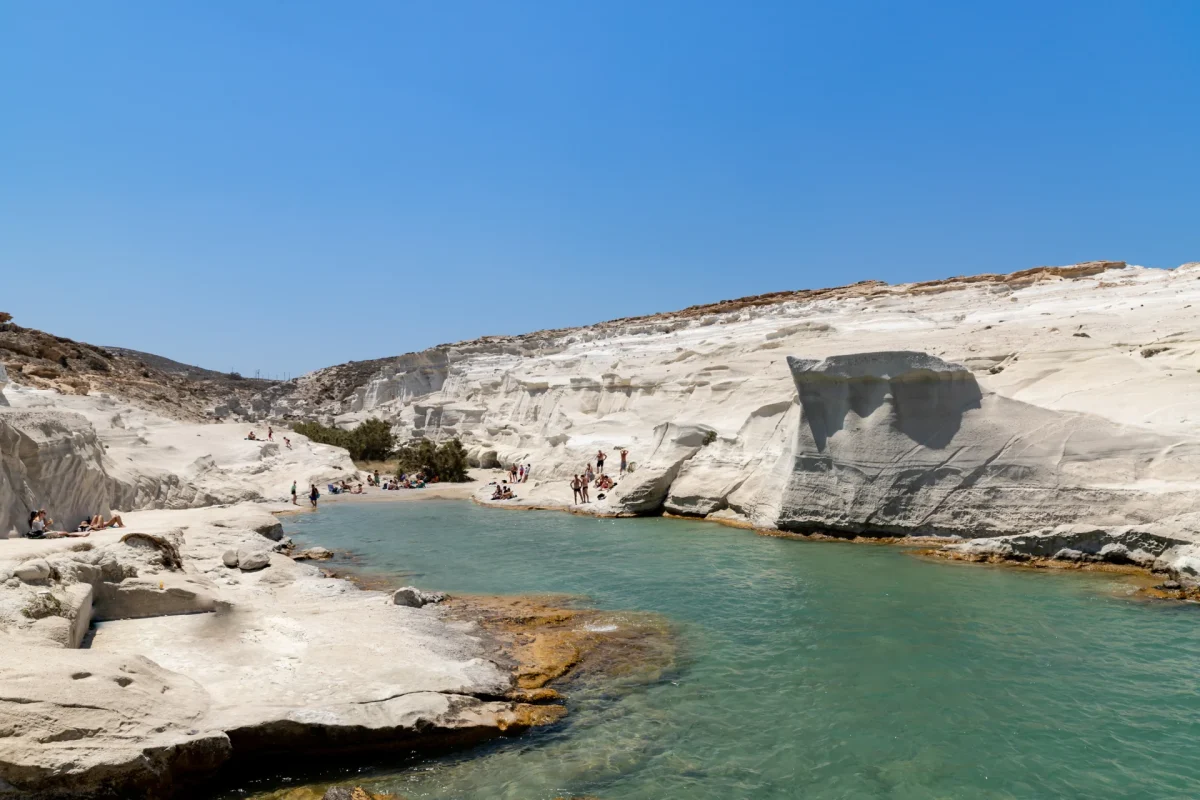
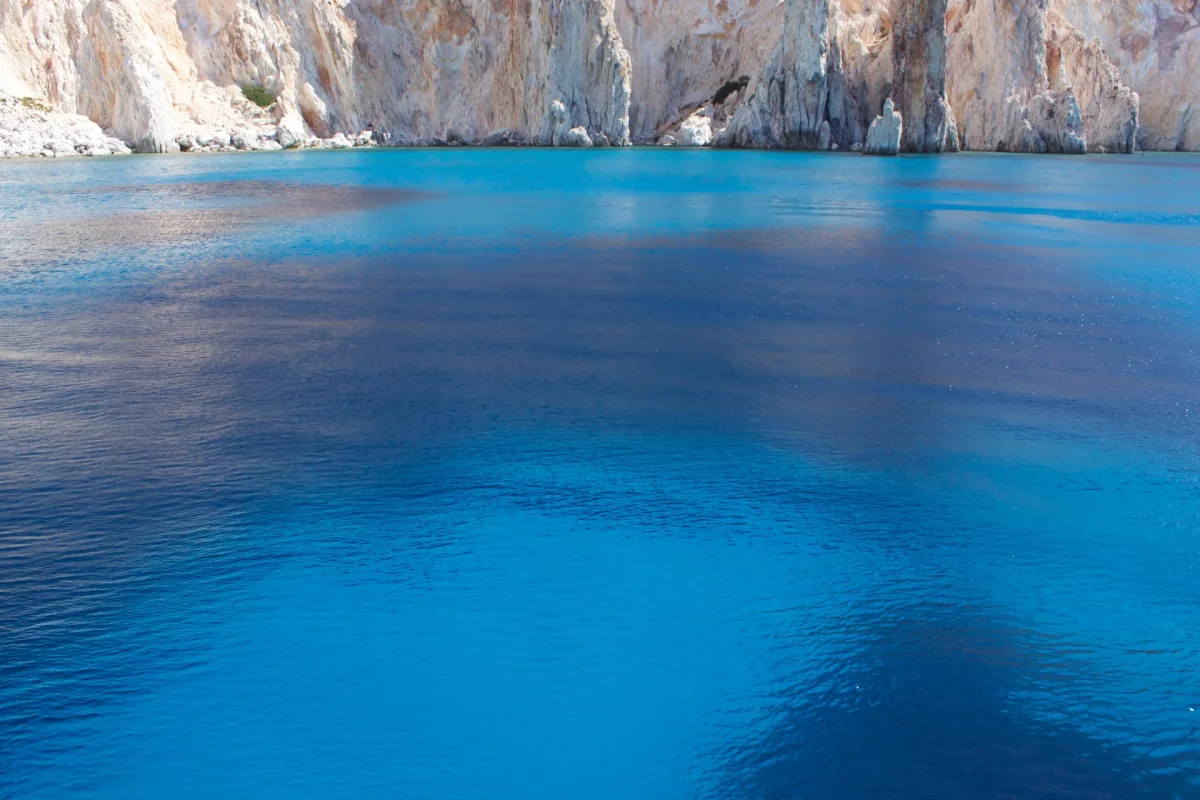
Sarakiniko is the photograph that sells Milos: bone-white rock rolling down to a slot of turquoise water, no plants, no sand, no colour except the sea. It is the most visited place on the island and, unusually for Milos, one of the easiest to reach, a few kilometres from Adamas on a paved road. This guide covers what the rock is, how to get there, where to swim, when to go to avoid the crowd, and something most guides skip: what Sarakiniko looks like from the water, and when a boat day along the north coast makes sense.

Key Takeaways

  • Sarakiniko is on the north coast of Milos, about 3.5 to 5 km from Adamas and 5 km from Plaka, on a paved road with a bus in summer. It is free, open all day, and has no sunbeds; parking is limited.
  • The white “moonscape” is soft volcanic rock, ash and pumice laid down by the island’s volcano and polished by north-wind waves, which is why it is bright white and smooth.
  • Swimming is in the narrow sheltered inlet at the centre and off the flat rocks around it. On a calm day you can snorkel past the inlet to the small cargo ship wreck on the rocks to the east.
  • It is exposed to the meltemi: on a strong north-wind day the inlet is fine but the open rocks are rough. Go at sunrise or after 17:00 for empty rock and soft light; midday in July and August is crowded and shadeless.
  • From the sea, Sarakiniko is part of our north coast route with Papafragas and the basalt columns of Glaronisia, a full day from Agia Kiriaki in the Compass 165cc or 7s, or a shorter run with a Pollonia pick-up. On a meltemi day, choose the south coast instead.

What Sarakiniko is and why it is white

Sarakiniko is not a beach in the usual sense. It is a stretch of the north shore where the volcanic bedrock, a pale mix of ash, pumice and silica-rich deposits from the eruptions that built Milos, reaches the sea with almost no soil on top. Nothing grows on it, so nothing hides the colour. Wind and waves from the north have rounded every edge into domes, gullies and ledges, and the sun bleaches the surface until it reads as white against the blue. The name comes from the Saracen pirates who are said to have used the inlets along this coast as a hideout.

The result is the most photographed landscape on Milos and one of the most unusual shorelines in Greece. At the centre a narrow inlet cuts inland, with a small patch of sand at its head, which is where most people swim. Either side the rock spreads out in flat terraces you can walk across for a few hundred metres, with small caves and overhangs at the waterline.

How to get to Sarakiniko

  • By car, scooter or ATV. From Adamas follow the road north towards Plaka and take the signed turn to Sarakiniko; it is a short drive on asphalt. The parking area at the end is small and fills by mid-morning in July and August, with cars then lining the approach road.
  • By bus. In summer the local bus connects Adamas with Sarakiniko, Plaka and Pollonia. Timetables change by month, so check the current one at the port.
  • On foot. From the car park it is a two-minute walk down to the inlet. The rock is smooth and can be slippery when wet, so shoes with grip are better than flip-flops if you plan to explore the terraces.
  • By boat. Sarakiniko is on the north coast, opposite side of the island from our base at Agia Kiriaki, so from the sea it is part of a north coast route rather than a quick stop. Details below.

For where to stay so that Sarakiniko, Plaka and the port are all close, see our guide to where to stay in Milos.

Swimming, the inlet and the wreck

The inlet is the place to swim. It is narrow, sheltered from most wind, shallow at its head and deep and clear towards the mouth, with white rock on both sides that makes the water glow. It is popular, so early and late are calmer. Around the inlet the flat rocks drop straight into deeper water; people swim and jump from them on calm days, but there are no ladders or steps, so pick a spot where you can climb out.

Snorkelling is better than you would expect from a landscape with no seagrass. The white bottom makes the water exceptionally clear, and on a calm day you can swim out of the inlet and along the rocks to the east, where the rusting remains of a small cargo ship sit on the shore; it is a favourite spot with a mask. Our snorkelling in Milos guide covers the conditions and the other north coast spots.

There are no sunbeds, umbrellas or showers on the rock. The shade is whatever you carry.

Best time of day and wind

Sarakiniko faces north, which decides everything. In a meltemi, the north wind that blows most July and August afternoons, waves break over the outer rocks and the open sea is rough; the inlet usually stays swimmable but the walk on the terraces is windy and spray-soaked. On those days the south coast beaches are flat and warm.

Timing matters as much as wind. Sunrise at Sarakiniko is famous for a reason: the rock is pink and gold, the car park is empty, and you can photograph the inlet with nobody in it. By 11:00 in high season the terraces are busy and the white rock throws the heat back at you; there is no shade at all. Late afternoon after 17:00 the crowd thins and the light softens again. Our best time to visit Milos guide covers the months; June and September give you Sarakiniko with a fraction of August’s numbers.

Sarakiniko from a boat

From the water Sarakiniko is a white wall with the inlet as a dark slot in the middle, and it is one of the sights of our north coast route: out of Pollonia or around from Agia Kiriaki, past the mining jetties at Thiorichia, Sarakiniko, then the narrow inlet of Papafragas and the basalt columns of Glaronisia. On a calm day you can anchor off the rocks and snorkel where the day visitors cannot reach.

Two things to know:

  • It is a full day from our base, or a short run from Pollonia. Agia Kiriaki is on the south coast, so the north coast circuit is a full day in the Compass 165cc (licence or our skipper, 450 €) or the skippered, all-inclusive Compass 7s (950 €). With a pick-up at Pollonia arranged in advance and subject to availability, Sarakiniko and Papafragas become a half-day trip. The no-licence Compass 150cc stays on the south coast.
  • It needs a calm or southerly day. In a meltemi the north coast is the exposed side and we route boats to the south coast and Kleftiko instead. Ask us the evening before; the forecast picks the coast.

Half-day versus full-day timings for every route are in Milos boat trips: half day vs full day, and the three ways of seeing the coast are compared in Milos boat tours.

What to bring and what to avoid

  • Water, a hat and reef-safe sunscreen: white rock, no shade, strong reflection.
  • Shoes with grip for the terraces; the rock is smooth and slippery near the water.
  • Mask and snorkel for the inlet and the wreck.
  • A rash vest if you plan a long swim in the reflected sun.
  • Do not jump without checking the depth and an exit, do not carve or paint the rock, and take everything back with you; there are no bins on the terraces.

Sarakiniko and the rest of Milos

Sarakiniko is the land highlight of Milos; the sea highlights are on the other coasts. Kleftiko, the white arches and caves of the south-west, is reached only by boat and is 20 to 30 minutes from our base. Tsigrado, the tiny cove between cliffs on the south coast, is famous for its ladder and simple from the sea. The collapsed roof of Sykia and the other sea caves of Milos complete the set. A good Milos plan has Sarakiniko at sunrise on a land day and Kleftiko on a boat day; our 3, 5 and 7-day itinerary shows how they fit.

Ready for the boat day? Tell us your dates and group and we will match the coast to the forecast. See our Milos boat tours and prices, or contact us.

FAQs

How can I get to Sarakiniko Beach on Milos?

By road: it is a few kilometres north of Adamas on a paved road, signposted off the Plaka road, with a small car park and a two-minute walk to the inlet. In summer the local bus from Adamas stops there. By sea it is on the north coast, part of our north coast boat route from Pollonia or, as a full day, from Agia Kiriaki on calm days.

Can you swim at Sarakiniko Beach?

Yes. The narrow inlet at the centre is sheltered, shallow at its head and clear towards the mouth, and it is where most people swim. Around it the flat rocks drop into deep water for swimming and snorkelling on calm days. There are no ladders, so choose a spot with an easy way out, and avoid the open rocks when a strong north wind is blowing.

Why is Sarakiniko beach so white?

The rock is volcanic: pale ash, pumice and silica-rich deposits from the eruptions that formed Milos, with almost no soil or vegetation on top to hide the colour. Waves driven by the north wind have rounded it into smooth domes and terraces, and the sun bleaches the surface, so the whole shoreline reads as brilliant white against the blue sea.

Why is Sarakiniko Beach so unique?

Few places in Europe have a bare white volcanic shoreline you can walk across, with a swimmable turquoise inlet cut into it and no sand, plants or buildings in sight. The combination of the lunar landscape, the clear water and the easy access from Adamas makes it the most photographed spot on Milos and one of the most recognisable beaches in Greece.

Is there a fee to visit Sarakiniko beach?

No. Sarakiniko is a free public beach, open all day, with no entrance ticket and no organised sunbeds or umbrellas to rent. Parking in the small car park is free as well. What you save in fees you should spend on water, a hat and sunscreen, because there is no shade and nothing to buy on the rock itself.

Is there parking at Sarakiniko beach in Milos?

Yes, a small free car park at the end of the access road, a two-minute walk from the inlet. It fills by mid-morning in July and August, after which cars park along the approach road. Arriving at sunrise or after 17:00 avoids the problem, and the summer bus from Adamas is a good alternative on peak days.

Can you go cliff jumping at Sarakiniko beach?

People do jump from the lower rocks around the inlet on calm days, but there are no marked spots, no lifeguard and no ladders back out. Check the depth and the exit before every jump, never jump in a north wind or swell, and skip it entirely if you are unsure. From a boat, a swim ladder makes the same water far safer to enjoy.

Sources

Categories
Guides

Polyaigos: How to Visit the Largest Uninhabited Island in the Aegean by Boat

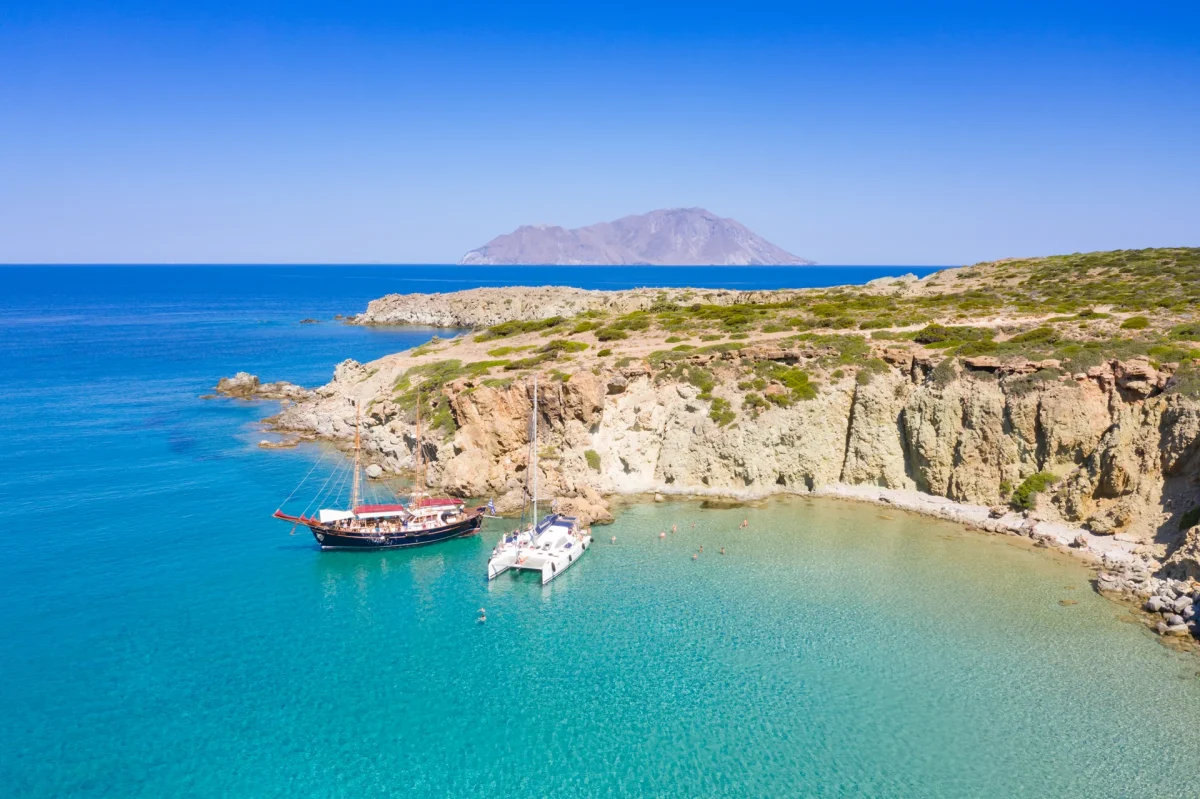
Polyaigos has no port, no road, no taverna and no ferry. It has eighteen square kilometres of cliffs, goats and some of the clearest water in Greece, and it sits just across the channel from Kimolos, within a day’s reach of Milos. That combination, spectacular and empty, is exactly why it is worth the trip, and also why the only way to see it is from a boat. This guide covers what is there, when to go, and how we get you there from Milos.

Key Takeaways

  • Polyaigos (“many goats”) is the largest uninhabited island of the Aegean, about 18 km² of cliffs, coves and sea caves, 1.1 nautical miles south-east of Kimolos and part of the Milos group. It is a Natura 2000 site and a refuge for the Mediterranean monk seal.
  • There is no ferry, no accommodation and nothing to buy. You reach it only by boat: from Pollonia on Milos or Psathi on Kimolos in about 15 minutes by fast boat, or from our base at Agia Kiriaki in 60 to 75 minutes.
  • The highlights are Blue Bay with its white seabed and turquoise water, the rust and yellow cliffs of the south coast, the sea caves, the 1898 lighthouse at Cape Maskoula and the ruined 17th-century monastery.
  • It is a full-day trip in the Compass 165cc (licence or our skipper) or the skippered, all-inclusive Compass 7s. The no-licence Compass 150cc does not have the range. A Pollonia pick-up, arranged in advance, turns it into a half day.
  • Calm days only: the channel is exposed to the meltemi. Go in the morning, carry everything you need, and keep clear of the caves where seals rest.

What Polyaigos is

Polyaigos (also written Poliegos or Polyegos) is an uninhabited island of the Western Cyclades, administratively part of the community of Kimolos. With about 18 km² and roughly 17 km of coastline it is the largest island in the Aegean with no permanent residents. The name means “many goats”, and goats are still the only inhabitants, along with the wild birds and the Mediterranean monk seals that use its sea caves. The island is protected under the Natura 2000 network and in 2025 was declared an archaeological site to safeguard its prehistoric and Classical remains.

What draws boats is the coast. The north and west shores are pale limestone and white pebble coves over a sandy floor, which is why the water looks Caribbean; the south and east are volcanic, with cliffs in rust, ochre and yellow, carved into caves at sea level. Because nobody lives there, there is no light at night, no music, no sunbeds and, on a weekday morning, often no other boat.

How to get to Polyaigos

There is no scheduled ferry to Polyaigos and no place to land a car. Every visitor arrives by private or chartered boat.

  • From Pollonia (Milos) or Psathi (Kimolos): the closest departure points. Polyaigos is about 15 minutes by fast boat from either, across the Kimolos channel. Day-cruise operators leave from both harbours in summer.
  • From our base at Agia Kiriaki (south coast of Milos): 60 to 75 minutes by fast boat around the east of the island, usually combined with a circuit of Kimolos. This is the full-day version.
  • With a pick-up at Pollonia or Psathi: on request and subject to availability, we can deliver the boat to Pollonia port or to Psathi so that Polyaigos becomes a half-day trip. Ask when you book and we will confirm for your date.

From Milos the classic combination is a full day: Kimolos in the morning, the crossing to Polyaigos at midday, and home in the afternoon. Our Kimolos island guide covers the first half of that day in detail.

What to see: beaches, caves and the lighthouse

  • Blue Bay (Galazia Nera). The famous anchorage on the north-west coast: a wide bay over white sand where the water shades from pale green to deep turquoise. The main swim stop on almost every visit.
  • Mersini. A sheltered cove on the north side with a small pebble beach, the usual lunch anchorage and the calmest water on a north-wind day.
  • Ammoura, Vromolimnos and Panagia. Smaller coves on the northern and western shores, empty even in August. Panagia takes its name from the ruined Monastery of the Dormition, built in 1622 on the north-western side of the island.
  • The coloured cliffs and sea caves. Along the south and east coast the volcanic rock rises straight from the sea in bands of red, orange and yellow, cut with caves you can look into from the boat. Some of these caves are monk seal resting places, so we look from a distance and do not enter. Our guide to the sea caves of Milos puts them in context with Kleftiko and Sykia.
  • Cape Maskoula lighthouse. On the southern tip, a stone lighthouse built in 1898, still standing above the cliffs. A landmark on the circuit and a good photograph from the water.
  • Snorkelling. The shallows off Blue Bay and the rocky edges of the coves have the best visibility in the Milos group; see snorkelling in Milos for what you will see and how to do it safely.

A day around Kimolos and Polyaigos

A typical full day in the Compass 7s with our captain, or the Compass 165cc with a licence:

TimeWhereNotes
09:00Agia KiriakiBriefing and departure from the platform
10:00Kimolos south coastGoupa boat garages, Karras sea cave, first swim
11:00Prassa, KimolosWhite sand and turquoise water, coffee at the beach bar
12:00Crossing to Polyaigos15 minutes across the channel
12:30Blue BayThe main swim and snorkel stop
13:30MersiniLunch at anchor, calm water
14:30South and east coastColoured cliffs, caves from a distance, the lighthouse
15:30ReturnAlong the east of Milos, back at Agia Kiriaki around 17:00

With a Pollonia pick-up the day shrinks to a half day slot with the same Polyaigos stops and less driving. Timings for every route are in Milos boat trips: half day vs full day.

Which boat

  • Compass 7s, 250 hp, up to 7 passengers, always with our captain, all inclusive: 950 € for the full day. The right boat for Polyaigos: the range, the speed for the crossing, snorkelling gear and drinks on board, and someone else reading the sea. Details on the Compass 7s page.
  • Compass 165cc, 115 hp, up to 6 people, boat licence or one of our skippers: 450 € for the full day, fuel extra. Reaches Polyaigos from Agia Kiriaki in 60 to 75 minutes on a calm day, or in minutes with a Pollonia pick-up. See the Compass 165cc.
  • Compass 150cc, the no-licence boat: not for this trip. Its 30 hp and 50-litre tank are sized for the south coast coves, not for the crossing to Polyaigos.

The full comparison is in which boat to rent in Milos, and the three ways of seeing the islands, shared cruise, private skippered boat or self-drive, in our guide to Milos boat tours.

Weather, seals and rules

  • Wind. The Kimolos channel and the west side of Polyaigos are open to the meltemi. On a strong north-wind day the crossing is uncomfortable and Blue Bay loses its shelter; that is the day for the south coast of Milos instead. Check the marine forecast the evening before and let us advise on the morning.
  • Seals. Polyaigos is one of the most important refuges of the Mediterranean monk seal in the Cyclades. If you see one, keep the boat at a distance, do not follow it and stay out of the caves. It is a legal protection, and the seals are why the island is still wild.
  • No facilities. There is no water, no shade beyond the cliffs and no bin. Whatever you bring comes back with you.
  • Anchoring. Sand at Blue Bay and Mersini, not seagrass. We show you where on the briefing.

Polyaigos or Kleftiko?

The question we hear most. Kleftiko is 20 to 30 minutes from our base, has the white arches and tunnels, and fits into a half day. Polyaigos is a full day, further and wilder, with fewer boats and clearer water. If you have one boat day, take Kleftiko. If you have two, the second is Polyaigos, and it is the one people describe afterwards as the best swim of their holiday. Our Milos itinerary shows where each fits in a 3, 5 or 7-day trip.

What to bring

  • Water, food and everything you would normally buy at a beach bar; there is none.
  • Reef-safe sunscreen, hat and a rash vest for long snorkelling sessions.
  • Mask and snorkel, or use the gear on board the Compass 7s.
  • A windbreaker for the crossing home in the afternoon breeze.
  • A dry bag for phones and cameras.

Ready for Polyaigos? Tell us your dates and group and we will suggest the boat, the pick-up point and the best day of your week for the crossing. See our Milos boat tours and prices, or contact us.

FAQs

Is Poliegos worth visiting?

Yes, if you have more than one boat day on Milos. Kleftiko is closer and more dramatic; Polyaigos is wilder, emptier and has the clearest water in the group, with Blue Bay, coloured cliffs, sea caves and a good chance of having an anchorage to yourselves. Most guests who do both name Polyaigos as the best swim of their holiday.

How to get to Polyaigos island?

Only by boat. From Pollonia on Milos or Psathi on Kimolos it is about 15 minutes by fast boat across the channel. From our base at Agia Kiriaki on the south coast it is 60 to 75 minutes in the Compass 165cc or the skippered Compass 7s, usually as a full day with a circuit of Kimolos. A pick-up at Pollonia, arranged in advance, makes it a half day.

Is there a ferry to Polyaigos island?

No. Polyaigos has no port, no residents and no scheduled service of any kind. Ferries connect Milos with Kimolos, whose harbour at Psathi is the nearest to Polyaigos, but the last stretch across the channel is always by private or chartered boat, either a day cruise or a rental boat like ours.

Are there hotels on Polyaigos island?

No. The island is uninhabited and protected under Natura 2000, so there are no hotels, rooms, campsites or tavernas. Visitors stay on Milos or Kimolos and come for the day by boat. Pollonia on Milos and the village on Kimolos are the closest bases; our guide to Kimolos covers both.

What is the best Polyaigos beach?

Blue Bay on the north-west coast, a wide anchorage over white sand where the water is turquoise and shallow enough to see the bottom from the deck. Mersini, a small pebble cove on the north side, is the calmest lunch stop, and Ammoura, Vromolimnos and Panagia are smaller coves along the same shore. All of them are reached only by boat.

Why are there goats on Polyaigos?

The name means “many goats” and the island has been grazed for centuries; when the last inhabitants left, the goats stayed. They are the only land animals of any size on the island and you will see them on the cliffs above the coves. Along with the monk seals and the nesting seabirds they are part of why Polyaigos is protected.

Is there food on Polyaigos?

No. There is no taverna, no kiosk and no water on the island. Bring everything you need for the day, including water, food and shade, and take your rubbish back with you. On the Compass 7s drinks and snorkelling gear are included; on the self-drive Compass 165cc you provision yourselves before leaving Agia Kiriaki or Pollonia.

Sources

Categories
Guides

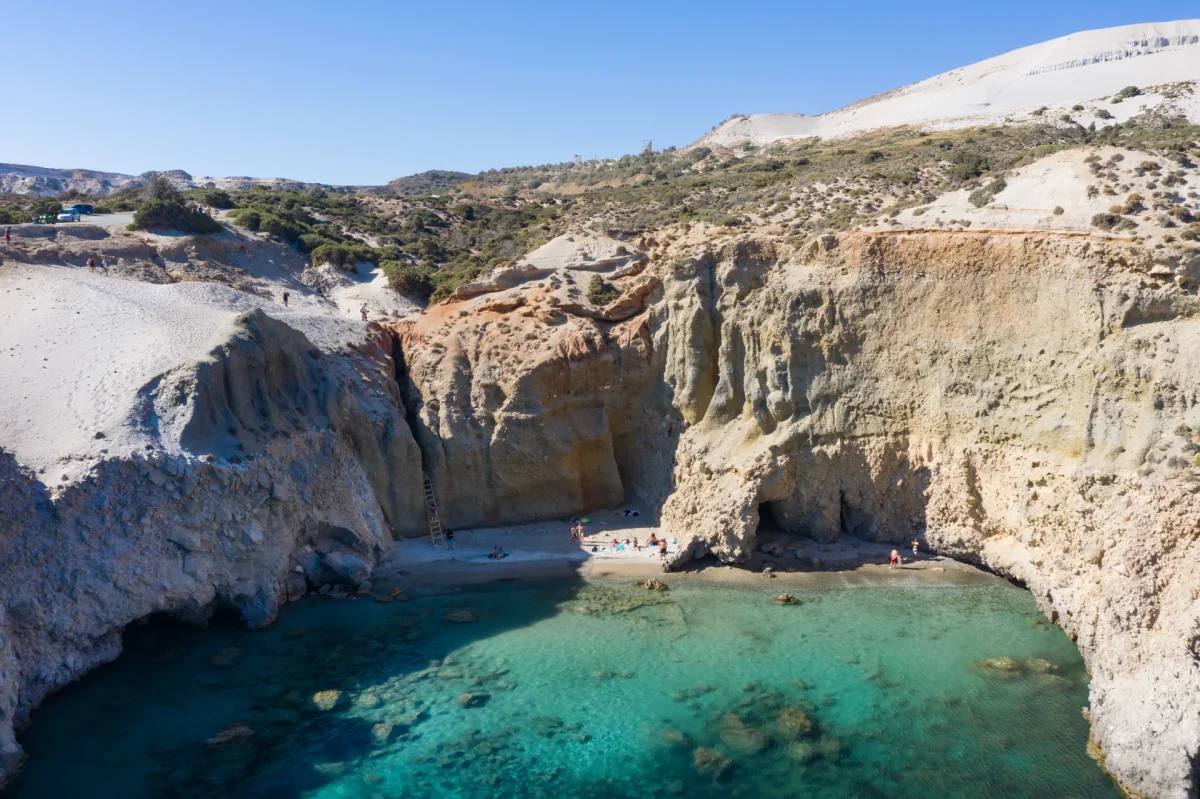
Tsigrado Beach, Milos: The Ladder, the Boat Way In and What to Expect

Tsigrado is the beach everyone has seen on a reel: a slot of turquoise water between white cliffs, reached by squeezing down a crack in the rock on two wooden ladders and a rope. It is tiny, it is beautiful, and the descent stops a lot of people at the top. What the videos rarely mention is that Tsigrado sits on the south coast of Milos, five to ten minutes by boat from our base at Agia Kiriaki, and from the water you simply drop anchor and swim in. This guide covers both ways in, honestly.

Key Takeaways

  • Tsigrado is a small sandy cove on the south coast of Milos, about 11 km from Adamas, next to Firiplaka. There are no facilities, no sunbeds and no shade, so bring water, snacks and a hat.
  • By land: park at the top, walk five minutes, then descend a narrow crevice on two wooden ladders and a rope. Good shoes, free hands and no vertigo required. Queues form on the ladders in July and August.
  • By sea: five to ten minutes from Agia Kiriaki in any of our boats, including the no-licence Compass 150cc (180 € half day). Anchor off the beach and swim in, no ladder involved.
  • The cove faces south and is sheltered from the meltemi, which makes it one of the best beaches on Milos on a windy north-wind day.
  • Mornings are shaded by the cliffs; the sun reaches the sand late morning and the water is clearest before the ladder crowd arrives around midday.

Where Tsigrado is and why it looks like that

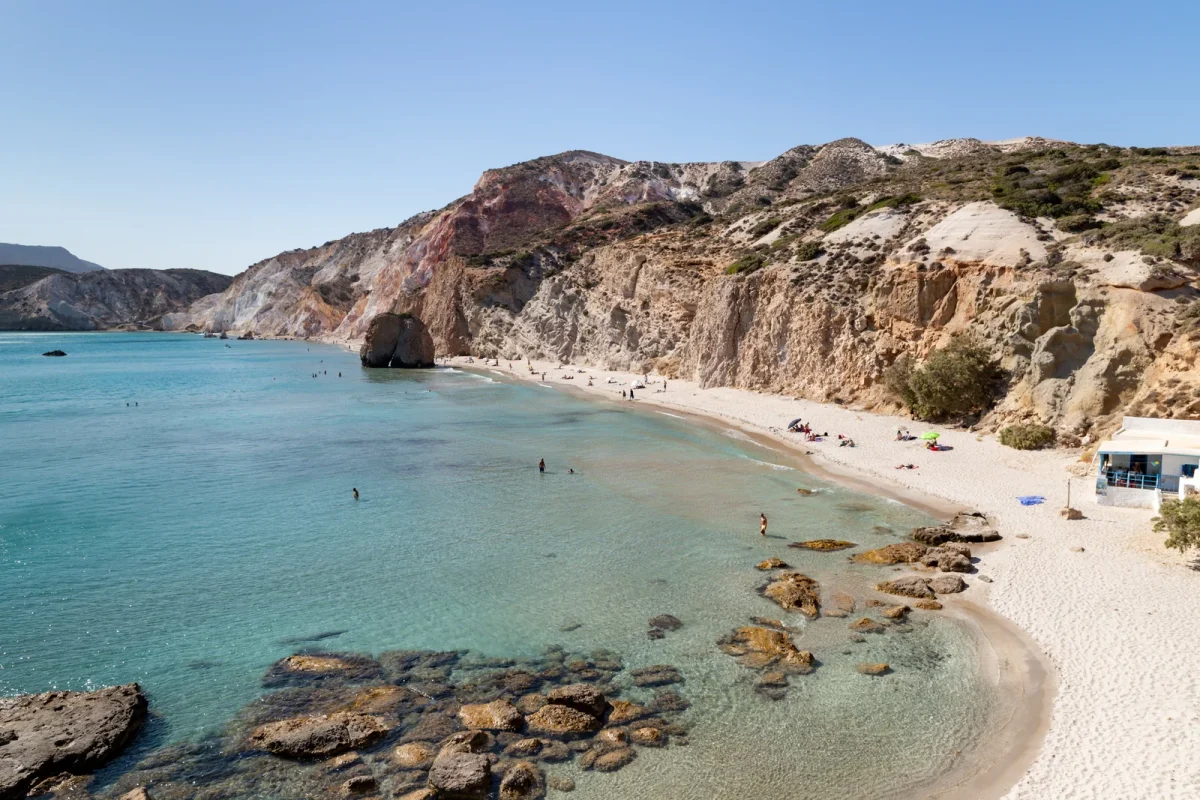
Tsigrado lies on the southern coast of Milos, roughly 11 km from Adamas by road, tucked into the cliffs immediately east of Firiplaka beach. Milos is a volcanic island, and this stretch of coast is made of soft white and cream tuff that the sea has carved into overhangs, small caves and one very narrow gully. The gully is Tsigrado’s front door. At the bottom of it the cliffs open into a small pocket of fine sand with water that shades from pale green at the shore to deep blue beyond the rocks. Because the cove is enclosed on three sides, the sea inside is usually flat even when the north coast is white with meltemi.

Getting there by land: parking, path and ladder

From Adamas, follow the road south towards Provatas and Firiplaka; the turn for Tsigrado is signposted just past Firiplaka and ends at a dirt parking area on top of the cliff. From the car park it is about a five-minute walk to the edge.

The descent is the famous part. A crack in the cliff, barely a shoulder wide in places, drops to the beach in three stages: a short wooden ladder, a steeper second ladder, and a rope for the last few metres of sloping rock. It takes most people two to four minutes going down and a little longer coming up. In practice:

  • Wear shoes with grip, not flip-flops, and keep both hands free. A small backpack is fine, a cool box is not.
  • It is one way at a time. In July and August a queue builds at the top by late morning and the wait can be longer than the climb.
  • Skip it with small children, with anyone unsteady on ladders, or after rain when the rock is slick.
  • There is nothing at the bottom: no bar, no sunbeds, no shade until the sun is high. Carry down everything you need and carry it back up.

The drive from Adamas takes about 20 minutes; the last stretch is a rough track that an ATV or small 4×4 handles better than a city car.

Getting there by boat: the easy way

From the water, Tsigrado is just a pretty cove. Our boats leave from the floating platform at Agia Kiriaki on the south coast, and Tsigrado is the second or third stop east: five to ten minutes at a relaxed speed, past Provatas and the coloured cliffs of Firiplaka. You anchor a few boat lengths off the sand in clear water, swim or wade in, and have the beach without touching a ladder.

Any of our three boats does it:

  • Compass 150cc, 30 hp, up to 5 people, no licence needed: 180 € for a half day, 250 € for a full day. The natural choice for the south coast coves. Read more in renting a boat in Milos without a licence.
  • Compass 165cc, 115 hp, up to 6 people, boat licence or one of our skippers: 250 € and 450 €. Adds Kleftiko in 20 to 30 minutes for the same day.
  • Compass 7s, 250 hp, up to 7 passengers, always with our captain, all inclusive: 550 € and 950 €.

Fuel is extra on the self-drive boats. We brief every crew on the coast before departure, including where to anchor at Tsigrado so the boat sits clear of the swimmers. For the full comparison see which boat to rent in Milos.

The boat also solves the two things the land route cannot: you are not limited to what you can carry down a ladder, and when the cove fills up at midday you move on to Gerontas or Kleftiko instead of queuing to leave.

What the beach is like

Tsigrado is small. On a quiet morning it feels like a private pool; by 13:00 in August it can hold more towels than sand. The bottom is fine sand near the shore with rocks and small overhangs on both sides, which is where the snorkelling is: sea bream and wrasse in the shallows, and light shafts under the ledges. Bring a mask, it is one of the better spots on the south coast and appears in our guide to snorkelling in Milos. The water stays calm in almost any wind except a direct southerly.

There are no facilities of any kind. The nearest tavernas and parking with shade are at Firiplaka and Provatas, a few minutes west.

Best time of day and wind

The cliffs are high, so the sand is in shade until mid-morning and again from late afternoon. For photographs and the clearest water, arrive early. By boat that means leaving Agia Kiriaki at 09:00 and having Tsigrado to yourselves before the first ladder groups appear.

Wind matters more than the calendar. When the meltemi blows from the north, which is most July and August afternoons, the north coast beaches close down and the south coast, Tsigrado included, stays flat and swimmable. On the rarer days of a southerly, swell enters the cove and the beach loses its charm; that is the day to go north instead. Our best time to visit Milos guide covers the months and the wind pattern in detail.

Firiplaka, Provatas and the rest of the south coast

Tsigrado is one beach on a coast full of them, all within 15 minutes of Agia Kiriaki by boat:

  • Firiplaka, next door to the west: a long strip of pale sand under red, ochre and white cliffs, with a beach bar and sunbeds. Busier than Tsigrado but with far more room.
  • Provatas: sandy, shallow and family-friendly, with tavernas, just east of our base.
  • Gerontas, ten minutes west: a wild cove with a natural rock arch and the best snorkelling on this coast, reached far more easily by boat than by the rough track.
  • Paleochori, 10 to 15 minutes east: a long beach with hot springs bubbling through the sand and tavernas on the shore.

For the whole coastline in one place, see Milos beaches by boat, and for the west end, the white arches and caves of Kleftiko and the sea caves of Milos.

A half day built around Tsigrado

A typical morning slot, 09:00 to 14:00, in the no-licence Compass 150cc:

TimeStopNotes
09:00Agia KiriakiBriefing on the pontoon, leave the platform
09:15ProvatasFirst dip in shallow water, five minutes east
09:45FiriplakaAnchor under the coloured cliffs, swim ashore
10:30TsigradoThe main stop: swim in, snorkel the ledges, an hour or more
12:00GerontasThe rock arch and the clearest water of the morning
13:30Agia KiriakiBack to the platform, tavernas on the beach for lunch

In the Compass 165cc or the skippered 7s, the same morning stretches to Kleftiko and Sykia after Gerontas. Half-day versus full-day timings for every route are in Milos boat trips: half day vs full day, and the three ways to see the coast are compared in our guide to Milos boat tours.

What to bring

  • Water and snacks: there is nothing to buy at Tsigrado.
  • Hat and reef-safe sunscreen; shade only exists under the cliffs early and late.
  • Mask and snorkel, or use the gear on board the Compass 7s.
  • Swim shoes for the rocks at the edges of the cove.
  • By land: shoes with grip and a small backpack only. By boat: whatever fits, including the cool box.

Ready to see Tsigrado from the water? Tell us your date and group size and we will match you to a boat. See our Milos boat tours and prices, or contact us.

FAQs

How do I get to Tsigrado Beach?

Two ways. By land, drive south from Adamas towards Firiplaka, about 20 minutes, park at the top of the cliff and walk five minutes to the crevice, then climb down two ladders and a rope. By sea, it is five to ten minutes from Agia Kiriaki in a rental boat; you anchor off the sand and swim in, with no ladder at all.

How do I get down to Tsigrado Beach?

Through a narrow crack in the cliff: a short wooden ladder, a second steeper ladder and a rope on the last sloping rock. It takes two to four minutes with free hands and shoes that grip. It is one person at a time, so expect a queue in July and August. Anyone unsure on ladders, or with small children, is better off arriving by boat and swimming ashore.

Is there parking at Tsigrado beach?

Yes, a dirt parking area on top of the cliff at the end of the track past Firiplaka, about a five-minute walk from the ladder. It fills by late morning in high season and the final stretch of road is rough, so an ATV or a small 4×4 is easier than a city car. There is no parking or road at beach level; the sand is reached only by the ladder or by boat.

Are there restaurants at Tsigrado beach?

No. Tsigrado has no taverna, no beach bar, no sunbeds and no shade, so bring your own water and food. The nearest places to eat are at Firiplaka, immediately to the west, and at Provatas and Agia Kiriaki, both a few minutes further along the coast, where there are tavernas on the sand.

What is the most attractive beach on Milos?

Ask ten visitors and you get four answers: Sarakiniko for the white lunar rock, Kleftiko for the arches and caves, Tsigrado for the postcard cove between cliffs, and Firiplaka for the coloured cliffs and long sand. Tsigrado wins on intimacy, Kleftiko on drama. Both are on the south and west coasts and both are easiest, or only possible, by boat.

What are some hidden gems in Milos?

On the coast: Gerontas beach with its rock arch, the collapsed sea cave of Sykia beyond Kleftiko, the coves of Polyaigos across the channel from Kimolos, and Tsigrado itself before 10:30 in the morning. All are reached far more easily by boat from the south coast than by road, and none has a bar or a sunbed.

Is Firiplaka Beach near Tsigrado?

Yes, Firiplaka is the next beach west, a few minutes apart by boat and next to each other by road. Firiplaka is long and sandy with a beach bar, sunbeds and coloured cliffs behind it; Tsigrado is the tiny enclosed cove just to its east. Most visitors combine the two in one morning, by land with the ladder or by boat with a swim between them.

Sources

Categories
Guides

Milos Boat Tours: Private, Self-Drive or Shared Cruise? How to Choose in 2026

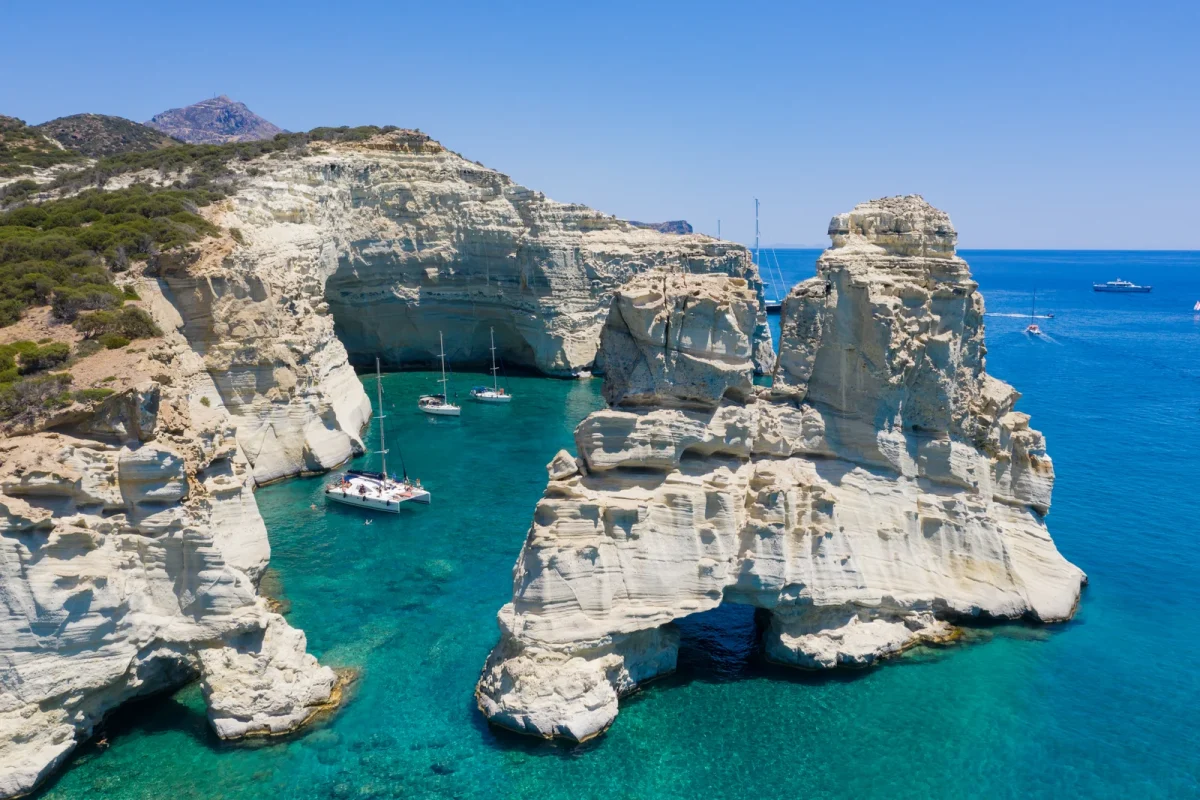
Every Milos boat tour promises Kleftiko, turquoise water and a swim in a sea cave. What the listings do not tell you is that there are three very different ways to get there, and the right one depends on your group, your budget and the wind on the day. We run boats from Agia Kiriaki on the south coast, so this guide is written from the dock, with the honest trade-offs between a shared cruise, a private skippered boat and renting your own.

Key Takeaways

  • Milos boat tours come in three formats: shared cruises from Adamas (80 to 150 € per person), private skippered boats (from 550 € for the boat) and self-drive rentals (from 180 € per half day, no licence needed for the Compass 150cc).
  • A private or self-drive boat from Agia Kiriaki reaches Kleftiko in 20 to 30 minutes. Shared cruises from Adamas need 1.5 to 2 hours each way, which is why they run as full days.
  • For four to seven people, a private boat usually costs the same or less per head than a shared cruise, and you set the stops and the pace.
  • The best sunset on Milos is seen from the water, not the harbour: a late afternoon slot (14:30 to 19:30) puts you off Gerontas or Kleftiko as the light turns gold.
  • Book early for July and August, check the meltemi forecast the day before, and let the wind choose the coast, not the brochure.

The three kinds of Milos boat tour

Search for a boat tour in Milos and you will find catamarans with lunch, speedboats with a captain and small motorboats you drive yourself. They all reach the same coastline, but the experience is not the same at all.

  • Shared cruise. A sailing boat or catamaran leaves Adamas around 10:00 with 15 to 40 guests, sails the west coast to Kleftiko and Sykia, often continues to Polyaigos, and returns around 18:00 or 19:00. Lunch and drinks are usually included.
  • Private skippered boat. A fast boat with a captain, just for your group. You choose the route and the stops, the skipper handles the sea. Our version is the Compass 7s, an all-inclusive powerboat for up to 7 passengers.
  • Self-drive rental. You take the wheel. In Greece a 30 hp boat can be driven without any licence, so the Compass 150cc is open to everyone, while the 115 hp Compass 165cc needs a licence or one of our skippers.

The rest of this guide looks at each in turn, then puts them side by side. If you already know you want to drive, our guide to renting a boat in Milos without a licence covers the rules in detail.

Shared cruises from Adamas

This is the classic Milos boat tour, the one on every booking platform. You share a catamaran or a traditional sailing boat with other travellers, the crew does everything, and a lunch of Greek dishes is served on deck. Prices in 2026 run from about 80 € per person for a half-day speedboat to 150 € or more for the full-day catamaran with meals.

What works: no planning, no navigation, and a long day on the water for a fixed price. Solo travellers and couples get the best value here, because there is no boat to fill.

What does not: the schedule belongs to the boat, not to you. Adamas sits inside the bay on the north, so reaching Kleftiko takes 1.5 to 2 hours each way. Swim stops are timed, and the popular anchorages get busy between 12:00 and 15:00 when a dozen boats arrive together. Most cruises also cancel in a strong meltemi, and a refund does not give you the day back.

Private skippered boat

A private tour puts a captain and a fast boat at your group’s disposal. You still do nothing but swim and eat, but the route is built around you: leave at 09:00 to have Kleftiko before the fleet, linger where the water is clearest, skip what does not interest you.

Our skippered option is the Compass 7s: a 250 hp powerboat for up to 7 passengers, all inclusive, at 550 € for a half day and 950 € for a full day. Because we leave from Agia Kiriaki on the south coast, Kleftiko is 20 to 30 minutes away, Sykia another 10 minutes, and even Polyaigos is a comfortable full-day return. Snorkelling gear is on board, and the skipper knows which cave has the light at which hour.

For six people the maths is simple: 950 € for a private full day is about 158 € each, roughly what a shared catamaran charges, with none of the crowd.

Self-drive: rent your own boat

The third option is the one most visitors do not know exists: hire a small boat and captain it yourself. It is the cheapest way onto the water for a group, and the most flexible.

  • Compass 150cc, no licence needed. 30 hp, up to 5 people, 180 € for a half day and 250 € for a full day. Perfect for the south coast coves (Firiplaka, Tsigrado, Gerontas) and, on a calm morning, Kleftiko in 40 to 50 minutes.
  • Compass 165cc, licence or skipper. 115 hp, up to 6 people, 250 € half day and 450 € full day. Kleftiko in 20 to 30 minutes, Kimolos in 45 to 60, Polyaigos in 60 to 75. Fuel is extra on both.

We give a full briefing on the pontoon: the boat, the coast, the safe anchorages, where to stop and what to avoid. Compare the two boats in detail in which boat to rent in Milos.

Side by side: price, time and freedom

CompareShared cruisePrivate with skipperSelf-drive rental
Price80 to 150 € per person550 € half day, 950 € full day, all inclusive180 to 250 € half day, 250 to 450 € full day, plus fuel
Cost for 6 people480 to 900 €550 to 950 €250 to 450 €
DepartureAdamasAgia Kiriaki (south coast)Agia Kiriaki (south coast)
Time to Kleftiko1.5 to 2 hours20 to 30 minutes20 to 50 minutes
Who sets the routeThe crewYou, with the skipper’s adviceYou
Lunch and drinksUsually includedIncludedBring your own
LicenceNoneNoneNone for the 150cc, licence or skipper for the 165cc
Best forSolo travellers, couples, first visitFamilies, groups, special daysGroups on a budget, independent travellers

Routes worth a full tour

Whatever the format, these are the stretches of coast a Milos boat tour is built around.

  • Kleftiko. White cliffs, arches and sea caves with no road access. The reason most people book a boat at all. See our Kleftiko guide for the caves and the best time of day.
  • Sykia cave. A collapsed sea cave with a beach inside, 10 minutes beyond Kleftiko. Covered in Milos sea caves by boat.
  • The south coast coves. Firiplaka, Tsigrado, Gerontas and Paleochori, all within 5 to 15 minutes of Agia Kiriaki and sheltered in a north wind. The natural half-day route for a self-drive boat, described in Milos beaches by boat.
  • Kimolos and Polyaigos. The blue-water islands to the north-east: Prassa and Rema on Kimolos, then the empty coves of uninhabited Polyaigos. A full day, or a half day with a Pollonia pick-up. Start with the Kimolos island guide.
  • Snorkelling stops. Gerontas arch, the Kleftiko caves and the Polyaigos shallows are the clearest water on the island. Our snorkelling in Milos guide lists them by boat.

For the half-day versus full-day decision, with timings for every route, read Milos boat trips: half day vs full day.

Sunset from your own boat

Plaka’s castle and Klima’s syrmata are the famous sunset spots on land, and they are crowded for a reason. From the water it is a different evening: the afternoon slot on our boats runs 14:30 to 19:30, which in July and August means the last hour is spent off the south coast as the cliffs turn from white to gold and the wind usually eases.

A few practical notes. Gerontas and Firiplaka face south-west and catch the last light; Kleftiko is at its calmest and emptiest after 17:00 once the cruise fleet has left for Adamas. The 150cc is fine for the coves, the 165cc or the skippered 7s for a Kleftiko sunset. Sunset in Milos is around 20:45 in late June and 19:45 in early September, so an afternoon rental sees the golden hour and returns with the light. There is no need to book a separate sunset cruise: an afternoon boat is the sunset tour.

Boat tours from Pollonia and Kimolos

Our base is Agia Kiriaki, but for the north-east routes we can arrange a pick-up at Pollonia or at Psathi on Kimolos, by prior agreement and subject to availability. From Pollonia the Kimolos channel, Prassa and the south of Polyaigos become a half-day trip rather than a full one, and a north wind is behind you on the way home. If you are staying in Pollonia or on Kimolos, say so when you book and we will tell you whether the pick-up works for your date.

How to choose in one minute

  • Travelling alone or as a couple, first time on Milos, want lunch made for you: a shared cruise from Adamas.
  • Family or group of four to seven, want Kleftiko without the crowd and someone else at the wheel: the private skippered Compass 7s.
  • Group on a budget, happy to captain a small boat, want to stop wherever you like: self-drive Compass 150cc (no licence) or 165cc (licence or skipper).
  • Only a half day free: self-drive or private from Agia Kiriaki, because the shared cruises need a full day to reach Kleftiko from Adamas.
  • Want the sunset: the 14:30 to 19:30 slot on any of our boats.

Booking and weather tips

  • Book ahead in high season. July and August sell out for both cruises and rentals; June and September have space and calmer seas. Our best time to visit Milos guide covers the months in detail.
  • Watch the meltemi. The north wind blows hardest in July and August afternoons. It closes the north coast but leaves the south coast and the Kimolos channel sheltered, which is exactly where we start from. Check the Hellenic National Meteorological Service marine forecast the evening before.
  • Go early or go late. Mornings are calmer and the anchorages are empty before 11:00; late afternoons are golden and empty again after 17:00.
  • Bring the basics. Reef-safe sunscreen, hat, water, swim shoes, a windbreaker for the ride back and a dry bag. Life vests in all sizes and snorkelling gear on the 7s are on board.
  • Ask about the new boat. A new addition, the Scorpion, is joining the Polaris fleet; contact us for availability and specifications.

Ready to get on the water? Tell us your dates, your group and what you want to see, and we will suggest the boat and the route. See our Milos boat tours and prices, or contact us.

FAQs

Can you hire your own boat in Milos?

Yes. We rent self-drive boats from Agia Kiriaki on the south coast. The Compass 150cc (30 hp, up to 5 people) needs no licence at all, from 180 € for a half day. The Compass 165cc (115 hp, up to 6 people) needs a boat licence or one of our skippers, from 250 € for a half day. Fuel is extra and we brief every crew on the coast before departure.

What are the best private boat tours in Milos?

The classic private day is Kleftiko and Sykia with swim stops on the south coast, followed by Kimolos and Polyaigos on a calm day. From our base at Agia Kiriaki the skippered Compass 7s reaches Kleftiko in 20 to 30 minutes, so you arrive before the cruise fleet and can stay as long as you like. The boat, skipper, drinks and snorkelling gear are all included.

Can you island hop from Milos?

Yes, in two ways. Ferries connect Milos with Kimolos, Sifnos, Serifos, Folegandros, Paros and Santorini. For the nearest islands you can also go by rental boat: Kimolos is 45 to 60 minutes from Agia Kiriaki in the Compass 165cc or 7s, and Polyaigos 60 to 75 minutes, which makes a full-day circuit with swim stops on both.

What is a half-day boat rental?

A five-hour slot with the boat all to yourselves, either 09:00 to 14:00 or 14:30 to 19:30. It is long enough for the south coast coves, or for Kleftiko and Sykia in the Compass 165cc or 7s, with two or three swim stops. Half-day prices are 180 € for the 150cc, 250 € for the 165cc and 550 € for the skippered 7s.

Which village on Milos is considered the most beautiful?

Most visitors pick Klima for its painted syrmata boat houses at the water’s edge, with Plaka’s castle a close second for its sunset. Both are worth an evening on land. From the sea, though, the most beautiful stretch is the south-west coast between Gerontas and Kleftiko, where the white cliffs and caves have no road at all and can only be seen by boat.

Is there a Milos boat tour from Pollonia?

Our boats are based at Agia Kiriaki, but for the Kimolos and Polyaigos routes we can arrange a pick-up at Pollonia, or at Psathi on Kimolos, by prior agreement and depending on availability. From Pollonia the Kimolos channel and Prassa beach become a half-day trip. Ask when you book and we will confirm whether it works for your date.

Can I get a Milos boat rental with skipper?

Yes. The Compass 7s always comes with a skipper and is all inclusive: 550 € for a half day and 950 € for a full day for up to 7 passengers. The Compass 165cc can also be rented with one of our skippers if you do not hold a boat licence, so you get the faster boat and the longer range without taking the wheel.

Sources

Categories
Guides

Milos vs Paros vs Santorini: Which Greek Island Should You Choose?

Short version: Santorini for the view, Paros for the all-rounder, Milos for the sea. Santorini is the caldera, the sunsets and the crowds that come with them. Paros is the easy island: good beaches, two lively towns, great ferry links and something for everyone. Milos is the volcanic coastline, 70-plus beaches, sea caves you can swim through and the best boat days in the Cyclades, with fewer people and less nightlife. We run boats on Milos, so we are not neutral, but we have tried to be fair: below is each island by category, a comparison table, and a straight answer for each kind of trip.

Key Takeaways

  • Beaches and swimming: Milos wins clearly. Paros is good. Santorini’s volcanic beaches are the weakest of the three.
  • Scenery and “wow”: Santorini’s caldera is unmatched for a view. Milos has the most varied landscape. Paros is pretty rather than dramatic.
  • Boat trips: Milos, without a contest. A third of its coastline is boat-only, and from our base Kleftiko is 20 minutes away.
  • Nightlife and buzz: Paros (Naoussa), then Santorini. Milos is quiet after dinner.
  • Crowds and prices: Santorini is the most crowded and most expensive. Paros is busy in August. Milos is the calmest and, outside August, the best value.
  • Getting there: Paros is the ferry hub. Santorini has the most flights. Milos has an airport with Athens flights and 2.5 to 7-hour ferries.
  • Combine them: Milos and Paros pair well (direct ferries). Santorini works as a two-night add-on to either.

The three islands in one paragraph each

Santorini is a crescent of cliff around a flooded volcanic caldera, with Fira and Oia perched on the rim. The view is the reason to come, and it is genuinely one of the great views of the world. The beaches are black or red volcanic sand below the cliffs on the other side of the island, the towns are crowded with cruise passengers by day, the hotels are the most expensive in Greece, and the sunset in Oia is a shared experience with several thousand people.

Paros is the well-balanced island: a big pretty harbour town (Parikia), a gorgeous fishing-village-turned-nightlife-hub (Naoussa), long sandy beaches on the east coast (Golden Beach, Santa Maria), the famous rock-pools of Kolymbithres, a mountain village (Lefkes), windsurfing, and ferries to everywhere. It does nothing badly. In August it is very busy.

Milos is a volcanic island shaped like a horseshoe, with a coastline that changes colour every kilometre: white at Sarakiniko and Kleftiko, red and ochre at Paleochori and Firiplaka, grey at Gerontas. It has the most beaches in the Cyclades, the early Christian catacombs, fishing villages with painted boat garages, a hilltop capital with a castle sunset, and a western third with no roads at all, which is why the boat is the main event here rather than an optional extra. It is quieter, less polished and, after dinner, asleep.

Beaches

Milos. More than 70, the most varied in Greece. Long sand at Provatas, Agia Kiriaki, Paleochori and Firiplaka; the lunar white rock of Sarakiniko; cliff-backed coves at Tsigrado and Gerontas; and the boat-only icons, Kleftiko and Sykia cave. Water clarity is exceptional because there are no rivers. The south coast stays calm in the meltemi. Our guide to the beaches of Milos you can only reach by boat covers the best of them.

Paros. Good, sandy and well organised. Golden Beach and New Golden Beach (windsurfing), Santa Maria, Kolymbithres with its sculpted granite, Monastiri, and the short hop to Antiparos for more. Busier and more built-up than Milos, but with sunbeds, tavernas and water sports everywhere.

Santorini. The weak point. Black-sand Perissa, Perivolos and Kamari are long and organised but hot underfoot and grey; Red Beach is a photo stop; the water is deep and the coast is exposed. People do not come to Santorini for the beach, and they are right not to.

Verdict: Milos, then Paros, then Santorini, by a distance.

Scenery and villages

Santorini. The caldera. Whitewashed Oia and Fira stacked on a 300-metre cliff above a sea-filled volcano. Nothing else in Greece looks like it. The villages themselves are beautiful but overwhelmed, and much of Oia is hotels and jewellery shops.

Milos. Variety rather than one view: Plaka’s castle sunset over the gulf, the syrmata of Klima with their painted doors, Sarakiniko’s moonscape, the coloured cliffs, Pollonia’s harbour. Real villages where people live.

Paros. Classic Cycladic: Naoussa’s harbour and lanes, Parikia’s old town and Frankish castle, Lefkes in the hills. Pretty, lived-in, less dramatic than the other two.

Verdict: Santorini for the single view, Milos for the most to see, Paros for the prettiest everyday Cycladic feel.

Boat trips and the sea

This is where the three islands separate most.

Milos. A third of the coastline, including Kleftiko, has no road access. A boat is not a tour, it is how you see the island. Self-drive rentals without a licence (30 hp), skippered powerboats, sailing cruises, and the uninhabited island of Polyaigos next door with the clearest water in the group. From our base at Agia Kiriaki, Kleftiko is 20 to 30 minutes away; see the complete Kleftiko guide and half-day vs full-day routes. Snorkeling is the best of the three islands.

Paros. Good boat trips to Antiparos, Despotiko and the south coast sea caves, and the best windsurfing and kitesurfing in the Cyclades. The boat is a pleasant day out, not the point of the trip.

Santorini. Caldera cruises to the volcano and hot springs, and sunset catamaran trips, all excellent and all crowded. Swimming from the boat is the best swimming on Santorini.

Verdict: Milos by a wide margin for beaches, caves and self-drive freedom; Santorini for the sunset cruise; Paros for water sports.

Things to do beyond the beach

Milos: the catacombs at Tripiti (the largest early Christian catacombs in Greece), the ancient theatre and the spot where the Venus de Milo was found, the Mining Museum, the villages, the Kimolos day trip (guide). See our 3, 5 and 7-day itinerary.

Paros: the Byzantine church of Ekatontapiliani, the marble quarries that supplied ancient sculptors, Lefkes and the Byzantine path, the Antiparos cave, the Naoussa evening.

Santorini: Akrotiri, the Minoan town buried by the eruption (the best archaeological site of the three), the wineries on the volcanic slopes, the Fira to Oia cliff walk, the museum of prehistoric Thera.

Verdict: Santorini for archaeology and wine, Milos for geology and sea, Paros for a balanced mix.

Food and nightlife

Paros has the best nightlife of the three by far: Naoussa’s harbour bars and clubs, Parikia’s waterfront, beach bars at Punda and Santa Maria. Food is good everywhere.

Santorini has the most high-end restaurants, caldera-view dining at caldera-view prices, and a wine scene. Nightlife is in Fira, lively but not Mykonos.

Milos has excellent simple food, fish in Pollonia, tavernas in Plaka and Adamas, a beach taverna at Paleochori that cooks in the volcanic sand. Nightlife is a drink on the waterfront. If you want to dance, this is the wrong island.

Verdict: Paros for nightlife, Santorini for fine dining, Milos for honest tavernas and early nights.

Crowds, prices and season

Santorini is the most visited island in Greece: 2 million plus visitors a year on 76 square kilometres, cruise ships disgorging thousands a day into Fira, the highest hotel prices in the country, and a sunset in Oia that has to be queued for. Outside the caldera towns it calms down.

Paros is busy in July and August, especially Naoussa, and relaxed the rest of the season. Prices are mid-range, with budget options.

Milos is the quietest of the three, though it has been discovered: August is full and Sarakiniko gets crowded at midday. Prices are mid-range and good value in June and September. There are no large resorts, so it sells out rather than overflows. Our guide to the best time to visit Milos covers the seasons in detail.

Verdict: Milos for the fewest people, Paros in the middle, Santorini for the most.

Getting there and around

Santorini: international airport with direct flights from across Europe in season, plus 5 to 8-hour ferries from Piraeus and 2-hour fast ferries from Milos, Paros and Naxos. Getting around: buses are crowded, car hire is expensive, and the roads are jammed in August.

Paros: the ferry hub of the Cyclades, 3 to 4 hours from Piraeus, connections to everywhere, plus a small airport with Athens flights. Getting around is easy: good buses, cheap car and scooter hire.

Milos: airport with Athens flights (about 40 minutes), ferries from Piraeus in 2.5 to 7 hours depending on the boat, direct fast ferries to Santorini, Paros and Sifnos in season. Getting around: you want a car or ATV; buses cover the main villages and beaches. Everything is within 30 minutes. See where to stay in Milos.

Verdict: Paros easiest to reach and move around; Santorini easiest to fly to, hardest to move around; Milos in between.

Comparison table

Compare Milos Paros Santorini
Beaches Best: 70+, varied, clear water Good, sandy, organised Weak: black sand, exposed
Signature sight Kleftiko, Sarakiniko Naoussa, Kolymbithres The caldera, Oia
Boat trips The main event, self-drive, boat-only coast Good day trips, water sports Caldera and sunset cruises
Villages Plaka, Klima, Pollonia, authentic Naoussa, Parikia, Lefkes, pretty Oia, Fira, spectacular and crowded
Culture Catacombs, Venus de Milo, mining Ekatontapiliani, marble, Antiparos cave Akrotiri, wineries
Nightlife Quiet Best of the three Lively in Fira
Crowds Lowest Medium Highest
Prices Mid, good value off-peak Mid, budget options Highest in Greece
Flights Athens only Athens only International
Ferry from Piraeus 2.5 to 7 h 3 to 4 h 5 to 8 h
Best for Sea, beaches, boats, couples, families All-rounders, groups, first Greek island The view, honeymoons, short stays

The straight answer

  • First Greek island, want a bit of everything: Paros.
  • Honeymoon with the famous view: Santorini for two or three nights, then Milos for the sea.
  • Beaches, swimming and snorkeling above all: Milos.
  • A boat day is the highlight of your holiday: Milos, and rent your own; the no-licence Compass 150cc makes anyone a captain, see renting a boat in Milos without a licence.
  • Families with children: Milos (calm south coast beaches, boat days, no traffic) or Paros (organised beaches, easy logistics). Not Santorini.
  • Nightlife and a group of friends: Paros.
  • Only three nights, want the photo: Santorini.
  • Ten days and want the Cyclades properly: Milos and Paros, with Santorini as a two-night detour if you must.

Combining islands

  • Milos and Paros: direct ferries in season, about 2 to 3 hours. Five nights Milos, four Paros is a classic ten-day Cyclades trip.
  • Milos and Santorini: direct fast ferries in season, about 2 hours. Four or five nights on Milos for the sea, two on Santorini for the caldera.
  • Milos and Kimolos: 20 minutes by ferry from Pollonia, a day trip or an overnight; see the Kimolos island guide.
  • Milos and Sifnos: one hour by ferry, the quiet gastronomic island, a good pairing for food-minded travellers.

If the sea is the point, come to Milos

And when you do, the best way to see it is from the water. Rent the no-licence Compass 150cc for the south coast coves, or book the Compass 7s with our captain for Kleftiko and Sykia. Contact us with your dates.

FAQs

Which is nicer, Paros or Milos?

For beaches, swimming, scenery and boat days, Milos. For nightlife, easy logistics, a lively harbour town and a balanced first visit to the Cyclades, Paros. They are two to three hours apart by ferry and combine well.

Which is better, Milos or Santorini?

Santorini for the caldera view and a short, photogenic stay. Milos for beaches, clear water, sea caves, boat trips and a calmer, cheaper, more authentic island. Many people do two nights on Santorini and four or five on Milos.

Is Milos less crowded than Santorini?

Much less. Santorini receives more than two million visitors a year and daily cruise ships; Milos has no cruise port and no large resorts. August on Milos is busy, but nothing like Fira or Oia at midday.

Is Milos worth the hype?

Yes, if your idea of a Greek island is the sea: the coastline, the beaches and the boat days are genuinely the best in the Cyclades. If you want nightlife, shopping or a caldera view, it will disappoint.

Which is better for me, Naxos, Paros, or Milos?

Naxos for long sandy beaches, mountain villages and the cheapest prices; Paros for the lively all-rounder; Milos for dramatic coastline, boat-only beaches and clear water. Naxos and Paros are 30 minutes apart and often combined; Milos pairs with either.

Which Greek island is as beautiful as Santorini?

Nothing has Santorini’s caldera. For a different kind of beauty, Milos’s coastline, Kleftiko and Sarakiniko, is the usual answer; Folegandros has cliff-top villages on a smaller scale; Amorgos has the dramatic monastery.

Is Paros the best island in the world?

It has topped travel-magazine polls, and it is an excellent, easy, beautiful island. “Best” depends on what you want: for the sea itself, most people who have been to both would give Milos the edge.

Sources

Categories
Guides

Best Time to Visit Milos: Month by Month, Sea Temperature and the Meltemi

The best time to visit Milos is late May to early July and September to mid-October: the sea is warm (22 to 25 °C), the weather is settled, the meltemi wind is at its gentlest, and the island is busy without being full. July and August are hotter, windier and crowded but still wonderful if you plan around the wind. May and late October are quiet, cheaper and beautiful, with cooler water and a few closed tavernas. This guide goes month by month with real numbers, then explains the one factor most guides skip: the meltemi, and what it means for beach days and boat days.

Key Takeaways

  • Sweet spots: June and September. Air 27 to 29 °C, sea 22 to 24 °C, long days, calm mornings, rooms and boats available.
  • Peak: July and August. Sea at its warmest (24 to 25 °C), but the meltemi blows hardest, prices peak and Milos sells out. Book months ahead.
  • Shoulder: May and October. Air 23 to 24 °C, sea 18 to 22 °C, quiet beaches, lower prices. Some tavernas and boat operators open late May and close mid-October.
  • The meltemi is a dry north wind that blows June to September, strongest in July and August, building through the afternoon. It decides which beaches are calm (south coast) and which boat routes are on (Kleftiko in the morning, south coast coves after lunch).
  • Rain is essentially zero from June to September and light in May and October.
  • For Kleftiko by boat, pick June, September or early October, and go in the morning.

Milos weather month by month

Month Air min / max °C Sea °C Rain days Sun hours / day Wind
January 9 / 13 16 7 4 Winter storms
February 9 / 14 15.5 7 5 Winter storms
March 10 / 16 15.5 5 6.5 Variable
April 12 / 19 16.5 4 8.5 Variable, first northerlies
May 16 / 24 18.5 2 9.5 Light, meltemi begins late month
June 20 / 29 22 0 11 Meltemi, moderate
July 23 / 30 24 0 12 Meltemi, strongest
August 23 / 30 25 0 11.5 Meltemi, strong
September 21 / 27 24 1 9.5 Meltemi fading
October 17 / 23 22 2 7.5 Calm spells, first southerlies
November 13 / 19 19.5 6 5.5 Autumn lows
December 10 / 15 17.5 10 4 Winter storms

Figures are long-term monthly averages for Milos; individual days vary. Sea temperature lags the air by about a month, which is why September water is warmer than June’s.

Spring: April and May

April is green, wild-flowered and quiet, with warm days and cool nights. Swimming is for the brave (16 to 17 °C) and most beach tavernas are shut. Easter, when it falls in April, is the exception: Greek families come, the villages fill, and it is a wonderful time to be in Plaka.

May is the first real month. Days reach 24 °C, the sea climbs towards 19 °C by the end of the month, the wind is light, and you share Sarakiniko with a handful of people. Rooms are cheap, cars are easy. Boat rentals and most tavernas open through the month; ask before you book. The first light meltemi days arrive in the last week.

Early summer: June

June is, for many locals, the best month. The air is 28 to 29 °C, the sea 22 to 23 °C, the days are the longest of the year and the meltemi, though present, is moderate and mostly an afternoon affair. Everything is open, nothing is full. Kleftiko in the morning is glassy more often than not. Prices are high-season from mid-month but rooms are still findable a few weeks out. The only drawback is that June has become known, and the last two weeks are noticeably busier than the first.

High summer: July and August

The hottest, windiest and busiest months. Air around 30 °C, sea at its peak of 24 to 25 °C, zero rain, 12 hours of sun. Milos sells out: rooms, cars, boats, restaurant tables in Pollonia. August 15 is the busiest week of the year.

The meltemi is the defining feature. It blows most days, hardest from mid-July to late August, building from late morning to a peak in the afternoon and easing at night. On strong days it roughs up the north coast beaches (Sarakiniko, Pollonia, Papafragas) and the exposed west, while the south coast (Agia Kiriaki, Provatas, Firiplaka, Paleochori) stays swimmable. It also dries the heat, which is why 30 °C on Milos feels better than 30 °C in Athens.

July and August work if you plan around it: beaches and boats in the morning, villages and shade in the afternoon, a south-coast base, and everything booked in advance. Our guide to where to stay in Milos covers which areas stay calm.

Late summer: September

September is June with warmer water and fewer people. The sea is 24 °C, the air 27 °C, the meltemi fades through the month, and from the second week onward the island exhales. Rooms reappear, the beaches empty out, and the light turns golden. For boat days it is the best month of the year: warm water, calm mornings that stay calm into the afternoon, and Kleftiko with half the boats of August. Everything stays open until the end of the month.

Autumn: October and November

Early October is still summer by most standards: 23 to 24 °C, sea 22 °C, calm seas and the clearest water of the year for snorkeling. The first autumn rain usually comes mid-month, tavernas and boat operators start closing from around the 15th, and ferry schedules thin. Late October is quiet and lovely if you are self-sufficient. November is off-season: mild, showery, most things shut, the island to yourself.

Winter: December to March

Mild, wet and windy by Aegean standards, 13 to 15 °C by day. Milos is a working island (mining, fishing, a year-round population of about 5,000) so Adamas and Plaka never fully close, but tourism does. Ferries from Piraeus run year-round, reduced. Come for walking, the catacombs without queues and empty Sarakiniko; not for swimming or boats.

The meltemi explained

The meltemi is the dry north to north-east wind that blows across the Aegean in summer, created by the pressure difference between the high over the Balkans and the low over Turkey. On Milos:

  • Season: late May to late September, strongest mid-July to late August.
  • Daily pattern: calm at dawn, building from late morning, peaking mid-afternoon (often force 5 to 6, sometimes 7 on a strong day), easing after sunset.
  • Duration: it blows in episodes of two to five days, with calmer days between. A strong episode can last a week in August.
  • What it means for beaches: the north coast takes the wind and the waves, the south coast is sheltered. On a meltemi day go south: Agia Kiriaki, Provatas, Firiplaka, Tsigrado, Paleochori.
  • What it means for boats: mornings are for distance (Kleftiko, Sykia), afternoons for the sheltered coves. Our base at Agia Kiriaki is on the sheltered side, which is why the south coast routes run on most days even in August. We check the forecast every morning and tell you plainly which routes are on; see half-day vs full-day boat trips.
  • What it means for ferries: high-speed boats occasionally cancel on force 7 or 8 days; the big conventional ferries almost never do.

Best time for boat days and Kleftiko

For a self-drive boat or a skippered day to Kleftiko, the ranking is clear:

  1. September: warmest calm water, fading wind, fewer boats. The best month.
  2. June: long days, moderate wind, everything open.
  3. Early October: calm and clear, slightly cooler water, quiet.
  4. Late May: calm but the sea is still cool (18 to 19 °C) and some operators are just opening.
  5. July and August: superb mornings, windy afternoons. Book the morning slot, leave early, expect some days to switch to the south coast coves.

From our platform at Agia Kiriaki, Kleftiko is 20 to 30 minutes by fast boat, which is why it fits a calm morning even in high season; see the complete Kleftiko guide. On days when it is off, the south coast coves and, with a Pollonia pick-up, the Kimolos channel are the alternatives; see the Kimolos island guide.

Crowds, prices and what is open

Compare May June July to August September October
Crowds Low Medium, rising Full Medium, falling Low
Room prices Low High from mid-month Peak High, falling Low
Tavernas and beach bars Opening through the month All open All open All open Closing from mid-month
Boat rentals From mid or late May Yes Yes, book ahead Yes To mid-month
Ferries Daily, fewer Full schedule Full schedule Full schedule Reduced from mid-month
Sea for swimming Cool Warm Warmest Warm Still warm early

Our boat prices are the same from May to October, 180 € for a half day in the no-licence Compass 150cc to 950 € for a full all-inclusive day on the skippered Compass 7s; see which boat to rent in Milos. What changes is availability.

Pick your month, then pick your morning

Whenever you come, the calmest hours are before noon. Contact us with your dates and we will tell you what the season usually brings and which boat and route fit it.

FAQs

What is the best time to visit Milos?

June and September, for warm sea (22 to 24 °C), settled weather, moderate wind and manageable crowds. Early October is a close third with the clearest water of the year. July and August are hotter, windier and fully booked but still excellent with morning beach and boat plans.

Is Milos too windy?

In July and August the meltemi blows most afternoons, sometimes hard. It is not a reason to avoid the island, but it is a reason to stay on or visit the south coast on windy days, do beaches and boats in the morning, and book accommodation that is sheltered. June, September and October are much calmer.

Is Milos as windy as Mykonos?

No. Both get the meltemi, but Mykonos sits in the windiest part of the Cyclades and is famous for it. Milos is further south and west, and its long south coast is sheltered, so there is almost always a calm beach somewhere on the island.

Does it rain in Milos, Greece?

Almost never from June to September, and only a day or two in May and October. Most of the year’s rain falls between November and February.

Is it too cold to swim in the Greek islands in October?

Not in early October on Milos: the sea is still around 22 °C, warmer than in May. By the end of the month it drops towards 20 °C, still fine for a swim on a sunny day.

Is it too hot to visit Greece in June?

Milos in June averages 28 to 29 °C with a sea breeze, which most people find ideal. The real heat comes in late July and August, and even then the meltemi keeps the island more comfortable than the mainland.

How many days is enough for Milos?

Three full days minimum, five ideally, with at least one boat day; see our 3, 5 and 7-day itinerary. In high season add a buffer day for wind.

Sources

Categories
Guides

Where to Stay in Milos: Adamas, Plaka, Pollonia or the South Coast?

Milos is small enough that nowhere is more than 30 minutes from anywhere else, and different enough from village to village that where you sleep changes your holiday. Adamas is the port and the practical hub. Plaka is the hilltop village with the sunsets. Pollonia is the quiet fishing harbour with the best tavernas and the Kimolos ferry. Tripiti and Klima sit between them with the catacombs and the painted boat garages. And the south coast, where our boats are based at Agia Kiriaki beach, is where you wake up next to the sea. This guide compares them honestly, area by area, and ends with a straight answer for each kind of traveller.

Key Takeaways

  • Adamas for convenience: ferries, buses, supermarkets, car hire, day cruises, the widest choice of rooms, and 15 minutes to everything including our boat base.
  • Plaka and Tripiti for atmosphere: whitewashed lanes, the castle sunset, the best evenings. Parking is hard and you will drive to every beach.
  • Pollonia for calm: a fishing harbour with excellent seafood, a small beach, the Kimolos ferry, and the spot where we can deliver a boat on request.
  • The south coast (Agia Kiriaki, Provatas, Paleochori) for the sea: sandy beaches, rooms a few steps from the water, and our floating platform at Agia Kiriaki where boat days start.
  • Klima and the syrmata for one unforgettable night in a converted boat garage at the waterline. Book months ahead.
  • Milos has no mega-resorts and sells out in July and August. Book early, and book a car or ATV with the room.

How Milos is laid out

Milos is a horseshoe wrapped around a huge natural gulf. Adamas sits at the head of the gulf; Plaka, Tripiti and Klima are on the hill and the shore just north-west of it; Pollonia is on the far north-east tip; the airport is on the flat land south of Adamas; and the south coast beaches, from Agia Kiriaki east to Paleochori, face the open sea on the other side of that flat land. The western half of the island is roadless mountain. Almost everything you will visit is in the eastern half, and almost everything is within 15 to 25 minutes by car.

That matters for one reason: you do not need to stay “near the beaches”, because the beaches are near everything. Choose by atmosphere and by what you want outside your door in the morning and the evening.

Adamas: the port and the hub

Adamas (Adamantas) is where the ferries dock, the buses leave, the car-hire offices line the front and the day cruises tie up. It has the most rooms at every price, the most restaurants, the supermarkets, the pharmacies and the Mining Museum. It is not the prettiest place on the island, but it is pleasant, the waterfront is lively in the evening, and it is central: 10 minutes to Plaka, 15 to our boat base at Agia Kiriaki, 20 to Pollonia, 5 to the airport.

Stay here if you arrive late or leave early by ferry, want to walk to dinner with choice, are travelling without a car, or want the easiest logistics for several boat days. Skip it if you came for a postcard village outside your window.

Plaka and Tripiti: the hilltop villages

Plaka is the capital, a maze of whitewashed lanes on a hill above the gulf, with the ruined Venetian kastro on top and the most famous sunset on the island from its edge. Tripiti is its neighbour down the ridge, with windmills, the catacombs and the ancient theatre below it, and a quieter feel. Both have boutique rooms, good restaurants and the best evenings on Milos.

The cost is practical. Cars are banned from the lanes, so you park on the edge (tight in August) and walk with your bags. There is no beach; the nearest swim is Plathiena, 10 minutes down the hill. Every beach and our boat base are a drive away, 15 to 20 minutes. If evenings matter more to you than mornings, this is the trade you want.

Pollonia: the quiet harbour

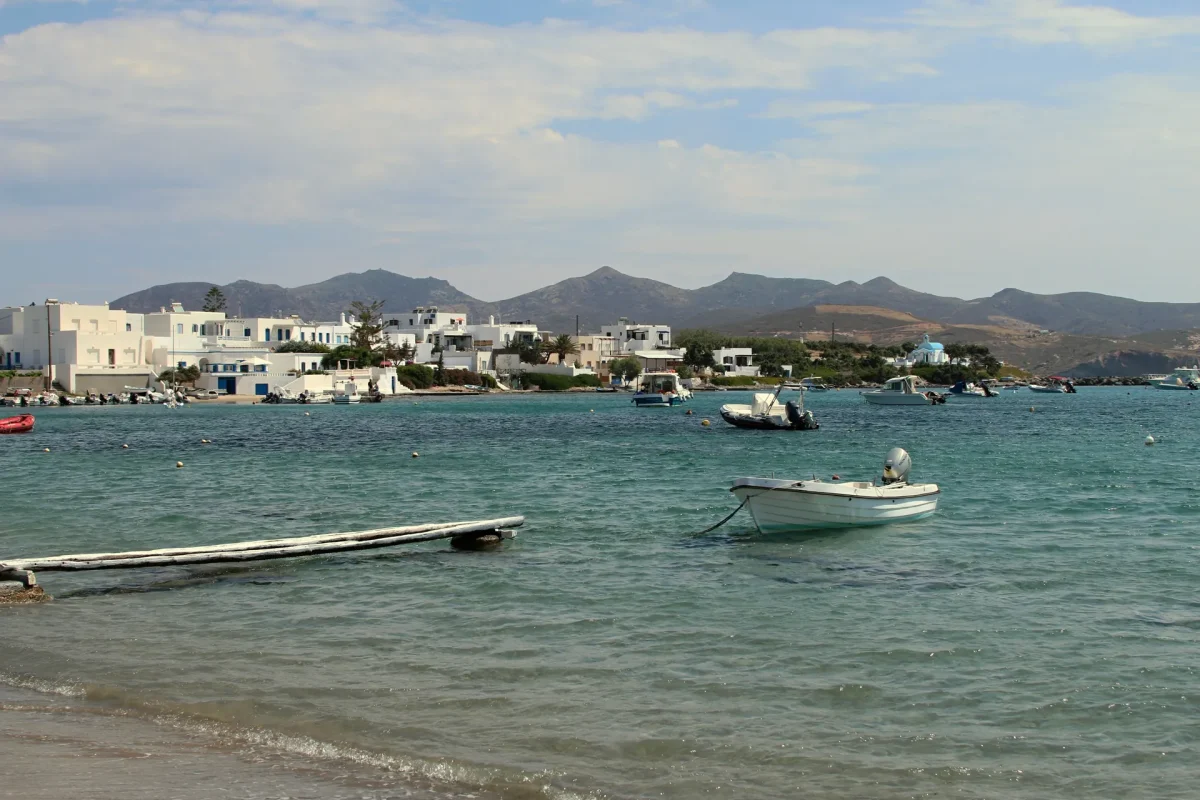
Pollonia (Apollonia) is the fishing village on the north-east tip: a curve of tavernas on the water, a small sandy beach with tamarisk trees, boutique hotels behind it, and the little ferry to Kimolos, 20 minutes across the channel. It is the calmest base on the island, popular with couples and families, and the food, fish straight off the boats, is the best on Milos.

Distances are the catch: 20 minutes to Adamas, 25 to Plaka, 30 to the south coast beaches. For boat days, Pollonia is the natural gateway to Kimolos and Polyaigos, and on request and subject to availability we can deliver a boat to Pollonia port; see our Kimolos island guide. For Kleftiko and the south coast, you drive to Agia Kiriaki in the morning.

The south coast: Agia Kiriaki, Provatas, Paleochori

The south coast is where Milos keeps its long sandy beaches, and it is the only part of the island where you can stay with the sea outside the door. It is also where our boats live.

  • Agia Kiriaki: a long sandy beach with a beach bar, a few rooms and studios behind it, and our floating platform where every rental starts. From here Kleftiko is 20 to 30 minutes by fast boat and the coves of Firiplaka, Tsigrado and Gerontas are minutes away. The quietest base on the island; you need a car for dinner choices.
  • Provatas: the neighbouring bay, sandy and shallow, family-friendly, with tavernas and rooms on the beach. Five minutes from Agia Kiriaki.
  • Paleochori: further east, a long beach backed by coloured cliffs, hot springs bubbling in the shallows, a handful of tavernas (one cooks in the hot sand) and rooms above the beach.

Stay here if the sea is the point of the holiday, if you are doing more than one boat day, or if you want children on a sandy beach without a car journey. Dinner means driving 15 minutes to Adamas or Plaka, or eating at the beach tavernas.

Klima, Firopotamos and the syrmata

Syrmata are the fishermen’s boat garages cut into the rock at the waterline, with brightly painted doors and living space above. At Klima, below Tripiti, a row of them has been converted into tiny waterfront studios where you sleep with the sea lapping at the door. Firopotamos and Mandrakia have a few more. There are no shops, no restaurants (Klima has one taverna), and the road is steep; but one night in a syrma is the most memorable stay on the island. Book months ahead, and combine it with a base elsewhere.

Where to stay for boat days

Our base is on the south coast at Agia Kiriaki beach, on our own floating platform. That changes the usual “stay in the port” advice:

  • From Adamas or Plaka: 15 minutes by car to the platform. Easy, and you keep the evenings in town.
  • From the south coast: walk or drive five minutes. The best option for two or three boat days, and for an early start to Kleftiko before the cruise boats.
  • From Pollonia: 30 minutes to Agia Kiriaki, or ask us in advance about delivering the boat to Pollonia port for a Kimolos and Polyaigos day.

Our half-day vs full-day routes and which boat to rent guides cover what each base makes easy. If you have never driven a boat, the no-licence Compass 150cc is the one; see renting a boat in Milos without a licence.

Area comparison table

Area Best for Beach on the doorstep Restaurants Car needed To our boat base To ferry
Adamas Logistics, no-car trips, choice Town beaches, average Many No 15 min 0
Plaka / Tripiti Atmosphere, sunsets, couples No Good Yes 15 to 20 min 10 min
Pollonia Calm, food, families, Kimolos Small sandy beach Excellent Yes 30 min (or boat delivery on request) 20 min
Agia Kiriaki / Provatas Sea, boat days, families Long sandy beaches A few beach tavernas Yes 0 to 5 min 15 min
Paleochori Beach, hot springs, quiet Long beach A few Yes 15 min 20 min
Klima (syrmata) One special night Sea at the door One taverna Yes 20 min 10 min

The straight answer, by traveller

  • First time in Milos, three to five days: Adamas for ease, or Plaka if evenings matter more than logistics. Both are 15 minutes from the boats.
  • Couples and honeymooners: Plaka or Tripiti for the evenings, with one night in a Klima syrma.
  • Families with small children: Provatas or Agia Kiriaki for a sandy beach without a car journey, or Pollonia for calm water and good food.
  • Boat-first holiday (two or more boat days): Agia Kiriaki or Provatas. Walk to the platform, leave before the wind, swim at your beach in the evening.
  • Food-first holiday: Pollonia, without a contest.
  • Without a car: Adamas, full stop. Buses to Plaka, Pollonia, Sarakiniko, Paleochori and Provatas, and a short taxi to Agia Kiriaki for a boat day.
  • Budget: Adamas has the widest range of rooms; Tripiti is cheaper than Plaka; the south coast studios are good value outside August.

Our 3, 5 and 7-day Milos itinerary shows how the days fit around each base, and best time to visit Milos covers when each area is at its best.

Booking tips

  • Book early. Milos has no large hotels and far fewer beds than Santorini or Paros. July and August sell out by spring; June and September fill by early summer.
  • Book the car with the room. Cars and ATVs also run out in high season. The south coast beach tracks are rough, so an ATV or small 4×4 is more useful than a city car.
  • Check the wind side. In the meltemi months (June to September) the north coast, including Pollonia’s beach, gets choppy in the afternoon; the south coast stays calmer.
  • Ask about parking if you choose Plaka, and about stairs if you choose Klima or a cliff-top room in Tripiti.
  • Two bases beat one for a week: three or four nights in Plaka or Adamas, then three on the south coast or in Pollonia.

Plan the boat day before the room

Wherever you sleep, the boats leave from Agia Kiriaki. Contact us with your dates and we will tell you which days look calm enough for Kleftiko, or book the Compass 7s for the all-inclusive version and let our captain do the planning.

FAQs

Which part of Milos is the best to stay?

It depends on what you want outside the door. Adamas for logistics and choice, Plaka for atmosphere and sunsets, Pollonia for calm and food, the south coast (Agia Kiriaki, Provatas) for sandy beaches and boat days. Everything is within 15 to 30 minutes, so choose by mood rather than distance.

Where to stay in Milos for the first time?

Adamas or Plaka. Adamas is the port with the most rooms, restaurants and buses, 15 minutes from everything. Plaka is prettier with the famous sunset but needs a car and has no beach. Both are 15 minutes from our boat base at Agia Kiriaki.

Is it better to stay in Plaka or Adamas?

Plaka for evenings, views and romance; Adamas for practicality, walking to dinner with choice, ferries and no-car trips. They are 10 minutes apart, so many people split a week between them.

Which is better to stay in Milos, Plaka or Pollonia?

Plaka if you want a village on a hill with sunsets and a short drive to everything. Pollonia if you want the sea at your table, the best seafood on the island, a small beach and the Kimolos ferry, and do not mind being 20 to 30 minutes from the rest.

Is Pollonia a good area to stay in Milos?

Yes, especially for couples and families who want calm. Excellent tavernas, a sheltered sandy beach, boutique hotels and the ferry to Kimolos. The trade-off is distance: 20 minutes to Adamas and 30 to the south coast beaches and our boat base.

Where to stay in Milos without a car?

Adamas. Buses connect it with Plaka, Pollonia, Sarakiniko, Paleochori and Provatas in summer, the ferry and day cruises are on the doorstep, and a taxi to our platform at Agia Kiriaki for a boat day takes 15 minutes.

Where to stay in Milos with kids?

Provatas or Agia Kiriaki on the south coast, for sandy shallow beaches a few steps from the room and the boat base next door, or Pollonia for calm water and easy tavernas. Plaka’s lanes and stairs are harder with pushchairs.

Sources

Categories
Guides

Things to Do in Milos: A 3, 5 and 7-Day Itinerary Built Around the Sea

Three full days is the minimum for Milos, five is comfortable, seven lets you see Kimolos and Poliegos without rushing. Whatever the length, the structure is the same: the island’s best sights are on or in the sea, so the itinerary is built around boat days, with the villages, the catacombs and the drive-to beaches filling the days in between. This guide gives you the complete list of things to do in Milos, then arranges them into day-by-day plans for 3, 5 and 7 days, with honest notes on where to stay, how to get around and what it costs.

Key Takeaways

  • Milos has over 70 beaches on a coastline of about 125 km, and most of the famous ones (Kleftiko, Sykia, Gerontas) are reachable only by boat. Plan at least one boat day per three days on the island.
  • The must-sees on land are Sarakiniko, Plaka and its castle at sunset, the fishing villages of Klima and Mandrakia with their painted boat garages, the early Christian catacombs, and the ancient theatre where the Venus de Milo was found.
  • Stay in Adamas or the south coast if boats are the priority (our base at Agia Kiriaki beach is 15 minutes from Adamas and Plaka), Plaka or Pollonia for atmosphere.
  • The summer meltemi wind blows from the north in the afternoons; do boat days and north coast beaches in the morning, villages and south coast beaches in the afternoon.
  • Budget roughly 50 € per person for a day on a self-drive boat shared by five, far less than two seats on a group cruise.

How many days do you need in Milos?

  • 2 days: you can see Sarakiniko, Plaka and one boat trip to Kleftiko. It works, but you will leave wanting more.
  • 3 days: the realistic minimum. One full boat day, one land day for the villages and catacombs, one beach day.
  • 5 days: the sweet spot. Two boat days (south-west caves and Kimolos), two land days, one spare for weather or a second visit to a favourite.
  • 7 days: room for Poliegos, a Pollonia day, slow mornings and a rest day. Not too much; people who say seven days is too long have not rented a boat.

The deciding factor is the wind. Build in one flexible day so a meltemi afternoon does not cost you Kleftiko.

The 15 best things to do in Milos

1. Sail to Kleftiko. White cliffs, arches and swim-through tunnels on the south-west tip, reachable only by boat. The single best thing on the island. Our complete Kleftiko guide has timings.

2. Swim inside Sykia cave. A sea cave with a collapsed roof three miles from Kleftiko, lit from above. Covered in our guide to the sea caves of Milos.

3. Walk on the moon at Sarakiniko. Smooth white volcanic rock sculpted into a lunar landscape on the north coast, with a narrow inlet for swimming. Go at sunrise or after 6 pm to avoid the heat and the crowds.

4. Watch sunset from Plaka. The hilltop capital, a maze of white lanes, with the ruined Venetian castle above it giving a 360-degree view. Arrive an hour before sunset, climb, then eat in the village.

5. See the syrmata at Klima. Fishermen’s boat garages cut into the rock at the waterline, with brightly painted doors, now mostly holiday lets. Klima is the most photographed; Mandrakia, Firopotamos and Fourkovouni have the same thing with fewer people.

6. Go underground in the catacombs. Near Tripiti, the largest early Christian catacombs in Greece, dating from the 1st to 5th century, with around 290 tombs in tunnels carved into the volcanic rock. Guided visits, small groups, closed Mondays in some seasons, check ahead.

7. Stand where the Venus de Milo was found. A marked spot next to the ancient theatre at Tripiti marks where a farmer unearthed the statue in 1820. The Roman-era marble theatre above Klima is free and rarely busy.

8. Rent a boat for the south coast coves. Gerontas, Firiplaka, Tsigrado and Provatas in one half day on a no-licence Compass 150cc. Our list of beaches you can only reach by boat ranks them.

9. Snorkel the rocky reefs. Octopus, moray eels and schools of bream along the walls at Gerontas and Kleftiko, with visibility often beyond 20 metres. See our guide to snorkeling in Milos.

10. Feel the volcano at Paleochori. Hot springs bubble through the sand in the shallows, and a taverna cooks food in the hot volcanic sand on the beach.

11. Cross to Kimolos. The quiet neighbour, 20 minutes by ferry from Pollonia or an easy run by boat: Prassa beach, the chora, and almost no one else. Our Kimolos island guide covers it.

12. Circle Poliegos. The largest uninhabited island in the Aegean, with the Blue Bay, coloured cliffs and sea caves that shelter monk seals. Boat only, best from Pollonia.

13. Visit the Mining Museum in Adamas. Milos has been mined since the Neolithic period for obsidian, and still is today for bentonite and perlite. The museum explains why the island looks the way it does.

14. Eat in Pollonia. The north-east fishing village has the best waterfront tavernas on the island and the calmest evening atmosphere.

15. Explore Phylakopi and Papafragas. A Bronze Age city, one of the most important in the Cyclades, next to the narrow cave inlet of Papafragas on the north coast.

3-day Milos itinerary

Day 1, land: north coast and Plaka. Morning at Sarakiniko before the heat. Late morning Mandrakia and Firopotamos for a swim and the syrmata. Lunch in Pollonia. Afternoon the catacombs and ancient theatre at Tripiti. Sunset from Plaka castle, dinner in Plaka.

Day 2, boat: Kleftiko and Sykia. From our base at Agia Kiriaki beach, Kleftiko is only 20 to 30 minutes west by fast boat. Compass 7s with captain for the all-inclusive version, Compass 165cc with a licence, or the no-licence 150cc on a calm morning. Stops at Gerontas on the way out, Kleftiko tunnels and arch, Sykia cave, then the south coast coves on the way back. A half day covers it; a full day lets you linger. This is the day you came for.

Day 3, beach day: south coast. Morning at Firiplaka and Tsigrado (or a half-day Compass 150cc to reach them from the sea, no licence needed, see renting a boat without a licence). Afternoon Paleochori for the hot springs and a sand-baked lunch. Evening in Adamas.

5-day Milos itinerary

Days 1 to 3 as above, then:

Day 4, boat: Kimolos and Prassa. Full day on the Compass 165cc or 7s. From Agia Kiriaki it is 45 to 60 minutes around the east coast; ask us in advance about pick-up at Pollonia, which puts Kimolos 15 minutes away. Swim at Prassa, circle the south coast of Kimolos and its caves, lunch at Psathi harbour or on board.

Day 5, flexible. The weather day. If the meltemi took a boat day earlier, this is when you make it up. Otherwise: Pollonia morning, Phylakopi and Papafragas, Mining Museum in Adamas, and a second sunset from a different village (Klima from the waterline is the alternative to Plaka from above).

7-day Milos itinerary

Days 1 to 5 as above, then:

Day 6, boat: north coast and Poliegos. Full day on the Compass 7s, or a boat rented from Pollonia. Papafragas from the sea, the basalt columns of Glaronisia, then across to Poliegos: Blue Bay, the coloured cliffs, the sea caves from a respectful distance, Mersini for lunch and a swim.

Day 7, slow day. Rest. A half-day Compass 150cc to whichever cove you liked best, or nothing at all. Ferry the next morning.

The half-day vs full-day comparison shows what each boat slot covers, and which boat to rent in Milos matches boats to the routes above.

Where to stay

  • Adamas: the port. Ferries, day cruises, the bus hub and most of the supermarkets. Not the prettiest, but central: our base at Agia Kiriaki beach on the south coast is a 15-minute drive, and so is Plaka.
  • Agia Kiriaki and the south coast: a long sandy beach with a beach bar and rooms, and our floating platform where the boats leave from. Quiet, and you walk to your boat in the morning.
  • Plaka and Tripiti: the hilltop villages. Best views, best evenings, 10 minutes by car from the port. Parking is tight.
  • Pollonia: the north-east fishing village. Quiet, good tavernas, the ferry to Kimolos, and the natural base for Kimolos and Poliegos trips; we can arrange boat pick-up here on request. 20 minutes from Adamas.
  • Klima and the syrmata: sleeping in a converted boat garage at the waterline is the most memorable stay on the island. Book months ahead.

Getting around

  • Car or ATV: the most practical. Distances are short (Adamas to Pollonia 12 km) but the south coast beach tracks are rough; an ATV or small 4×4 handles Tsigrado and Gerontas better than a city car.
  • Bus: connects Adamas with Plaka, Pollonia, Sarakiniko, Paleochori and Provatas in summer. Fine for a car-free trip if you combine it with boat days.
  • Boat: for a third of the island there is no other way. A self-drive rental gives you the coastline on your own schedule; see which boat to rent in Milos.
  • Ferry to Kimolos: from Pollonia, about 20 minutes, several times a day in summer.

What it costs

Rough 2026 figures per day, excluding accommodation:

  • Self-drive boat, Compass 150cc: 180 € half day, 250 € full day plus fuel, shared by up to five. Around 50 € per person for a private boat all day.
  • Skippered Compass 165cc: 250 € half day, 450 € full day plus fuel and skipper, up to six.
  • All-inclusive Compass 7s: 550 € half day, 950 € full day plus fuel and VAT, seven guests, drinks, food, snorkelling gear and GoPro footage included.
  • Group day cruise to Kleftiko: typically 80 to 150 € per person depending on the boat and whether lunch is included.
  • Car or ATV rental: 30 to 60 € per day in season.
  • Catacombs entry: a few euros, guided.
  • Taverna dinner: 20 to 35 € per person with wine.

Milos is not a cheap island in August, but a shared self-drive boat is one of the best-value things you can do in the Greek islands.

Plan the boat days first

The land days arrange themselves. The boat days depend on the wind and on booking the right boat early, especially in July and August. Compare the Compass 150cc, Compass 165cc and Compass 7s, or contact us with your dates and we will suggest which days to put on the water.

FAQs

How many days is enough for Milos?

Three full days minimum: one boat day to Kleftiko, one land day for Sarakiniko, Plaka and the catacombs, one beach day. Five days is ideal, adding a Kimolos boat day and a weather buffer. Seven days adds Poliegos and real rest.

Is 3 full days in Milos enough?

Yes, if you plan it tightly: land day, Kleftiko boat day, south coast beach day. You will miss Kimolos and Poliegos, and a windy afternoon can cost you the boat day, so keep the order flexible.

Is 2 full days in Milos enough?

Enough for a taste: Sarakiniko and Plaka on day one, a Kleftiko boat trip on day two. It is the minimum that justifies the ferry, not a proper visit.

Is 7 days in Milos too much?

Not if you use the sea. Seven days gives you three boat days (Kleftiko, Kimolos, Poliegos), all the villages, the catacombs, the south coast beaches and a rest day. People who find it long are usually the ones who stayed on land.

What not to miss in Milos, Greece?

Kleftiko by boat, Sarakiniko at sunrise, sunset from Plaka castle, the painted boat garages at Klima, the catacombs, and a swim inside Sykia cave. If you only do one thing, make it the boat day to Kleftiko and Sykia.

Is Milos, Greece worth visiting?

Yes, and more so than the famous islands if your priority is coastline over nightlife. It has the most varied beaches in the Cyclades, sea caves you can swim in, real villages, and far fewer crowds than Santorini or Mykonos, though it is no longer a secret in August.

What is Milos best known for?

The Venus de Milo, found here in 1820 and now in the Louvre; the lunar white rocks of Sarakiniko; the pirate coves of Kleftiko; the painted syrmata of Klima; and a volcanic coastline with more than 70 beaches, many of them reachable only by boat.

Sources

Categories
Guides

Which Boat to Rent in Milos? Compass 150cc vs 165cc vs 7s Compared

The right boat in Milos depends on three things: how many of you there are, whether anyone holds a speedboat licence, and how far you want to go. A couple who want a relaxed day in the coves near our base at Agia Kiriaki need a completely different boat from a group of eight who want Kleftiko, Sykia and lunch on board. This guide compares the three boats in our fleet side by side, with honest notes on what each one can and cannot do, what the price includes, and how to choose in under five minutes.

Key Takeaways

  • Compass 150cc (30 hp, 5 people): no licence needed, 180 € half day, 250 € full day. The easy choice for beginners and the south coast coves.
  • Compass 165cc (115 hp, 6 people): needs a speedboat licence or one of our skippers, 250 € half day, 450 € full day. Fast enough for Kleftiko and Kimolos.
  • Compass 7s (250 hp, 8 people): always with our captain, 550 € half day, 950 € full day, all-inclusive with drinks, snacks, wine, snorkelling gear and GoPro footage. The boat for long routes and special occasions.
  • Fuel is extra on every boat. Prices are the same from May to October.
  • Rule of thumb: south coast half day, take the 150cc. Kleftiko or Kimolos, take the 165cc with a licence or skipper. Anything with more than six people, more than one destination, or a celebration, take the 7s.

The fleet at a glance

Compare Compass 150cc Compass 165cc Compass 7s
Length 4.55 m 4.98 m 6.83 m
Engine Yamaha 30 hp Mercury 115 hp 250 hp (up to 55 knots)
Capacity 5 people 6 people 8 people (7 guests + captain)
Licence Not required Speedboat licence, or our skipper Always skippered
Fuel tank 50 L 90 L 190 L
Half day (09:00 to 14:00 or 14:30 to 19:30) 180 € 250 € 550 €
Full day (10:00 to 19:00) 250 € 450 € 950 €
Included Cooler, sunshade Cooler, sunshade Captain, drinks, snacks, fruit, local or sparkling wine, snorkelling gear, towels, GoPro photos and video
Fuel Extra Extra Extra (plus VAT 24%)
Best for Beginners, couples, families, south coast coves Licensed drivers, Kleftiko, Kimolos Groups, long routes, celebrations

Full specifications and booking on each boat page: Compass 150cc, Compass 165cc, Compass 7s.

Compass 150cc: the no-licence boat

The 150cc is a 4.55-metre open boat with a 30 hp Yamaha, the largest engine Greek law allows without a licence. It is the boat most first-time visitors should rent, and the one most of them do. It takes five people comfortably, has a sunshade and a cooler, and is forgiving to drive: the throttle is gentle, it turns slowly, and it sits flat in the water.

Where it shines: the south coast within 5 to 15 minutes of our base at Agia Kiriaki beach. Gerontas, Firiplaka, Tsigrado, Provatas, Paleochori. You anchor in a bay, swim, move to the next one, repeat. A half day is enough for two or three coves; a full day lets you go further east or linger.

Where it has limits: range and wind. Kleftiko is 40 to 50 minutes west at the 150cc’s cruising speed, fine on a calm morning (ask us on the day), not on a windy afternoon. Kimolos, Poliegos and the north coast are too far for it from the south coast, and the 50-litre tank is not sized for a round-island attempt. If those are the goal, step up.

Our full guide on renting a boat in Milos without a licence covers the rules, the briefing and what to expect on your first day at the wheel.

Compass 165cc: speed and range

The 165cc looks similar from the quay, half a metre longer, but the 115 hp Mercury makes it a different animal. It planes quickly, cruises at three times the speed of the 150cc, and carries 90 litres of fuel. Six people fit with room for bags and a cooler.

That speed changes the map. Kleftiko and Sykia become a comfortable full day with time to swim rather than a race. Kimolos, Prassa beach and the coast towards Poliegos are in range. On a calm morning an experienced driver can run the south-west coast, see the caves, and be back on the sheltered side by early afternoon.

The trade-off is the licence. Greek law requires a speedboat licence for anything over 30 hp. If you hold one (most EU and many non-EU licences are accepted, bring the physical document), you drive. If not, we provide a skipper for the day, which also means someone who knows the cave entrances and the wind.

Compass 7s: the all-inclusive day

The 7s is a 6.83-metre powerboat with a 250 hp engine and a top speed around 55 knots. It is always skippered by our captain, carries seven guests, and comes as a package rather than a bare rental: drinks, snacks, fruit salad, local or sparkling wine, snorkelling equipment, towels, and photos and video shot on a GoPro during the day.

This is the boat that turns “rent a boat” into “private boat tour”. The captain plans the route for the day’s wind, takes you into Sykia, positions the boat under the Kleftiko arch for photos, and handles anchoring while you swim. Full-day trips to the north coast and Poliegos, or the complete circuit of Kleftiko, Sykia and the south coast, are what it is built for. It is also the boat for proposals, birthdays, bachelor parties and weddings, available for special events on request.

At 950 € for a full day it is the most expensive option, but divided by seven guests with everything included, it is often the best value for a group that would otherwise pay per head on an organised cruise.

Licence rules in Greece, explained

  • Up to 30 hp: no licence. You get a safety briefing, sign the rental agreement, and go. This is the Compass 150cc.
  • Over 30 hp: speedboat licence required. Greek, EU and most international speedboat or powerboat licences are accepted. You need the original document, not a photo. This is the Compass 165cc bareboat.
  • No licence, want the bigger boat? Rent the 165cc with our skipper, or take the 7s which is always skippered.
  • Age: the person signing and driving must be an adult with ID or passport.

The rules are enforced by the Hellenic Coast Guard, who do check boats at popular anchorages. Do not let anyone talk you into a bigger engine without the paperwork.

Which boat for which route

Route Duration 150cc 165cc 7s
South coast coves (Gerontas, Firiplaka, Tsigrado, Paleochori) Half or full day Ideal Yes Yes
Kleftiko and Sykia Half or full day Calm morning only, ask us Yes Ideal
Kimolos and Prassa Full day, or half day with Pollonia pick-up No Yes Yes
North coast, Papafragas, Glaronisia, Poliegos Full day, or with Pollonia pick-up No With skipper Ideal
Round-island Full day, calm weather only No Only with skipper Yes

Route details are in our guides to the sea caves of Milos, Kleftiko, the beaches you can only reach by boat and Kimolos.

Which boat for which group

  • Couple or family of four, no boating experience: 150cc. Simple, safe, cheap, and the south coast is more than enough for a first day.
  • Two couples with a licence holder who want Kleftiko: 165cc bareboat. Share the fuel, leave early.
  • Five or six friends, no licence, want the caves: 165cc with skipper, or the 7s if the budget stretches. The skipper is worth it for Kleftiko.
  • Seven or eight people, or a celebration: 7s. Nothing else fits eight, and the all-inclusive service removes the logistics.
  • Photographers: 7s. The captain holds position under arches and inside caves while you shoot, and the GoPro footage is included.
  • Families with small children: 150cc for the calm coves, or the 7s where the captain handles everything and the kids get snacks and a shaded deck.

What the price includes, and what it does not

Included on all boats: the boat for the agreed hours, safety equipment and life vests, a briefing, a sunshade and a cooler. On the 7s, everything listed above plus the captain.

Not included: fuel, on any boat. The 150cc burns little; a south coast half day is typically a small top-up. The 165cc and 7s use more, and a Kleftiko run is a full refuel. You pay for what you use at the end. On the 7s, VAT at 24% is added to the listed price.

Also worth knowing: prices are flat from May to October, there is no high-season surcharge. Half days are the same price morning or afternoon. The morning slot (09:00 to 14:00) gets the calmer sea; the afternoon slot (14:30 to 19:30) gets the sunset.

Half day or full day?

Half day if you want the south coast coves and a relaxed pace, or Kleftiko and Sykia in the 165cc or 7s (20 to 30 minutes from our base). Full day if Kimolos or Poliegos is on the list, if you want Kleftiko plus the west coast, or if you simply do not want to watch the clock. We break down the two formats stop by stop in half-day vs full-day boat trips in Milos.

Questions to ask before you book any boat in Milos

Whether you book with us or anyone else, these separate a good rental from a bad one:

  1. Is fuel included, and how is it charged? (Ours: not included, pay for what you use.)
  2. What is the exact engine power, and does it need a licence? (30 hp is the legal line.)
  3. What happens if the wind is too strong? (We reschedule or refund; nobody should send you out in a meltemi.)
  4. Where do I leave from, and is there parking? (Our floating platform at Agia Kiriaki beach, south coast, 15 minutes from Adamas. Pick-up at Pollonia or Psathi on Kimolos can be arranged in advance.)
  5. Is there a deposit, and what does it cover?
  6. What safety gear is on board, and is there a VHF or phone contact?
  7. Can I get a skipper if I change my mind?

Still not sure?

Contact us with your dates, group size and whether anyone holds a licence, and we will tell you which boat fits and what the forecast looks like for your day.

FAQs

How much does it cost to rent a boat in Milos?

With Polaris Rent, from 180 € for a half day on the Compass 150cc (no licence) to 950 € for a full all-inclusive day on the skippered Compass 7s. The Compass 165cc is 250 € half day and 450 € full day. Fuel is extra on all boats, and prices are the same all season.

Can I rent a self-drive boat in Milos?

Yes. The Compass 150cc (30 hp) can be driven by anyone over 18 without a licence after a safety briefing. The Compass 165cc (115 hp) is self-drive for holders of a speedboat licence, or skippered if you do not have one.

What boats can you rent without a license?

In Greece, boats with engines up to 30 hp. In our fleet that is the Compass 150cc, a 4.55-metre boat for five people, ideal for the south coast coves within minutes of our base at Agia Kiriaki, and Kleftiko on a calm morning.

Do you need a boat license to rent a boat in Greece?

Only for engines over 30 hp. Below that, no licence is required. Above it, you need a valid speedboat or powerboat licence (original document), or you rent with a skipper.

Where to rent a boat on Milos?

Our boats are based at Agia Kiriaki beach on the south coast, on our own floating platform, a 15-minute drive from Adamas and Plaka. From there Kleftiko is 20 to 30 minutes west and the south coast coves are minutes away. On request we also deliver boats to Pollonia port or Psathi port on Kimolos. Many other rentals and all the day cruises are based in Adamas, the main port.

What is the 12 person rule on a yacht?

Under international maritime rules, a vessel carrying more than 12 passengers is classed as a passenger ship and must meet far stricter safety and certification standards. That is why private charters and rental boats, including our 8-person Compass 7s, stay under 12 guests.

Are boats expensive to rent?

Less than most people expect when you divide by the group. A full day on the Compass 150cc for five people is 250 € plus fuel, about 50 € per person for a private boat. The all-inclusive 7s at 950 € for seven guests works out close to the price of a seat on a group cruise, with none of the crowd.

Sources

Categories
Guides

Snorkeling in Milos: The Best Spots You Can Reach by Boat

Milos has some of the clearest water in the Cyclades. Volcanic rock, almost no rivers carrying sediment, and a coastline of white cliffs that reflect light down into the sea: on a calm day visibility of 20 to 30 metres is normal, and locals will tell you about days of 40. The catch is that the best snorkeling is not at the beaches you can drive to. It is under the arches of Kleftiko, inside Sykia cave, along the walls of Gerontas and around the uninhabited island of Poliegos, all of which you reach by boat. This guide ranks the spots, tells you what lives there, when the water is warm enough, and which boat from our fleet gets you to each one.

Key Takeaways

  • The top three snorkeling spots in Milos, Kleftiko, Sykia and Poliegos, are boat-only. Gerontas and Tsigrado are reachable on foot in theory but far easier by sea.
  • Expect rocky reefs, walls, arches and caves rather than coral. You will see octopus, moray eels, bream, wrasse, damselfish, occasionally a turtle, and at Paleochori volcanic gas bubbling from the sand.
  • Season runs May to October. Water is 19 to 21 °C in May, peaks at 25 to 26 °C in August, and is still 22 to 23 °C in October with the best visibility of the year.
  • From our base at Agia Kiriaki a half-day rental covers the south coast coves and, in the 165cc or 7s, Kleftiko and Sykia (20 to 30 minutes west). Poliegos and Kimolos need a full day, or a pick-up at Pollonia arranged in advance.
  • The summer meltemi makes the north and west coasts choppy in the afternoon. Snorkel early, and on windy days stay on the south coast.

Why Milos is good for snorkeling

Three things line up here. First, geology: Milos is volcanic, so the seabed near the coast is rock, not sand. Rock means structure, and structure means fish. Walls, boulders, overhangs and caves hold octopus, moray eels and schools of bream that an empty sandy bottom never will. Second, clarity: there are no rivers on Milos, very little run-off, and the pale rock bounces light around underwater, so visibility is exceptional for the Mediterranean. Third, variety within a small area: within a one-day boat trip you can snorkel inside a collapsed cave, through a natural arch, over a hot spring and along the cliffs of an island nobody lives on.

What you will not find is coral or tropical colour. This is Aegean snorkeling: clear blue water, dramatic rock, and a steady supply of curious fish.

The best snorkeling spots, ranked

1. Kleftiko (south-west coast, boat only)

The obvious number one. White volcanic cliffs drop straight into water so clear that the boat looks like it is floating in air. The swim-through tunnels and the big arch are the highlights; the walls around them are covered in small fish and the sandy patches between boulders are octopus territory. Depth goes from 2 metres at the edges to 15 metres or more off the arches, so confident swimmers get the most out of it. Read our complete Kleftiko guide for timings: it is 20 to 30 minutes west of our base at Agia Kiriaki by fast boat.

2. Sykia cave (south-west coast, boat only)

About 3 nautical miles north of Kleftiko, Sykia is a circular cave whose roof has collapsed, leaving an open skylight. Snorkeling inside is unlike anything else on the island: sunlight shafts down through the hole, the water glows emerald green, and the pebble beach at the back lets you stand up and look around. The water is noticeably colder than outside. Enter only when the sea at the entrance is flat. More on the cave itself in our guide to the sea caves of Milos.

3. Poliegos (east of Kimolos, boat only)

The largest uninhabited island in the Aegean, and the wildest water in the group. The Blue Bay on the north side is a shallow, sandy cove with turquoise water that beginners love; the cliffs around it and the south coast near Mersini are where the bigger fish are. The island is a Natura 2000 site and its sea caves shelter Mediterranean monk seals, so admire them from a distance. Poliegos is around 15 minutes by fast boat from Pollonia and pairs naturally with a circuit of Kimolos, covered in our Kimolos island guide.

4. Gerontas (south coast)

A wide bay with white cliffs, deep clear water and a natural stone arch standing just off the western end. Snorkel the rocky walls either side of the beach for fish, then swim out to the arch. It is reachable on foot by a rough track, but by boat you anchor in the bay and step straight in. A good stop on the way to Kleftiko, or the main event of a south coast half-day.

5. Tsigrado and Firiplaka (south coast)

Neighbouring beaches below white cliffs. Firiplaka has the colour and the crowd; Tsigrado, reached on land by ropes and a ladder down a crevice, is tiny and spectacular. By boat both are easy: anchor off, snorkel the rocks on either side where the cliffs meet the water, and watch for octopus in the boulder fields.

6. Paleochori (south-east coast)

Volcanic activity is still going on under Milos, and Paleochori is where you can feel it. In the shallows off the eastern end of the beach, gas bubbles rise from the sand and the water is warm to the touch in patches. There is less fish life than at the rocky spots, but snorkeling over a seabed that fizzes is something to tell people about.

7. Prassa and the Kimolos south coast

Kimolos is the quieter neighbour, and Prassa is its best beach: blinding white sand, shallow turquoise water and rocky edges that hold fish. A Compass 165cc reaches it from Agia Kiriaki in about an hour, or in minutes if you arrange pick-up at Pollonia, and from there the caves at Mavrospilia and the coast down towards Poliegos are all snorkeling territory.

Spots you can reach from the beach

If you have a no-boat day, these are the coves worth the drive:

  • Firopotamos (north): sheltered, shallow, rocky edges with seagrass and small fish, good for children.
  • Mandrakia (north): a tiny fishing harbour with rocky sides, stays calm when the wind is up, taverna on the quay.
  • Papafragas (north): the narrow inlet with a tunnel cave; steep path down, clear water, needs calm seas.
  • Sarakiniko (north): the white moonscape, with a sheltered inlet for easy snorkeling and a cargo ship wreck on the rocks east of the main cove that you can snorkel around on a calm day.

None of these match the boat-only spots for clarity or drama, but they are a good warm-up.

What you will see underwater

Typical Aegean rocky-reef life, in good numbers because so much of the coast is inaccessible:

  • Octopus, usually tucked into holes in the boulder fields, spotted by the pile of shells outside the den.
  • Moray eels, heads poking out of cracks in the walls at Kleftiko and Gerontas.
  • Saddled bream, two-banded bream, salema in schools over the rocks; wrasse and damselfish along the walls; parrotfish (the Mediterranean species, arrived from the south) increasingly common.
  • Sea urchins on every rock at the waterline, which is why you wear fins or water shoes.
  • Loggerhead turtles occasionally, more often seen from the boat than underwater.
  • Monk seals at Poliegos, rarely, and always to be left alone.

Best time of year and water temperature

Month Sea temperature (approx.) Conditions
May 19 to 21 °C Clear, quiet, a shorty wetsuit helps
June 22 to 24 °C Warm enough for most, meltemi starts
July to August 25 to 26 °C Warmest water, strongest afternoon wind, busiest
September 24 to 25 °C The sweet spot: warm, calmer, fewer boats
October 22 to 23 °C Best visibility of the year, shorter days

Sea temperatures are typical ranges for the Milos coast; check a live reading before you travel. The meltemi, the dry north wind of the Aegean summer, is the factor that actually decides your day. It builds through the afternoon from June to early September, roughing up the north coast and the exposed west. The rule is simple: snorkel in the morning, be on the sheltered side by 2 pm, and ask our team at the dock which side that is today.

Snorkeling from a rental boat: how it works

A boat turns snorkeling from a beach activity into an island tour. The rhythm of a good day:

  1. Leave Agia Kiriaki early, at 9 or 10, while the sea is glassy.
  2. First stop within 10 to 15 minutes, usually Gerontas or Firiplaka, for the first swim.
  3. Main destination by late morning: Kleftiko and Sykia, 20 to 30 minutes further west, or a second south coast bay if you want to keep it short.
  4. Anchor on sand, never on seagrass (posidonia meadows are protected and the anchor drags on them anyway). Put the ladder down before anyone jumps.
  5. Snorkel in pairs, stay within sight of the boat, and keep one person aboard if the boat is not anchored in a fully enclosed cove.
  6. Start the return by early afternoon so you are on the sheltered side before the wind peaks.

Our comparison of half-day vs full-day boat trips in Milos shows exactly what fits into each format.

Which boat to rent for snorkeling

  • Compass 150cc (30 hp, 5 people, no licence needed): ideal for the south coast coves, Gerontas, Firiplaka, Tsigrado, Paleochori, all within 15 minutes of our base, and Kleftiko on a calm morning (40 to 50 minutes each way, ask us). If you have never driven a boat, this is the one; see renting a boat in Milos without a licence.
  • Compass 165cc (115 hp, 6 people, licence or our skipper): fast enough for Kleftiko and Sykia on a calm day, and for Kimolos and Prassa. Bring your own mask and fins or ask us at booking.
  • Compass 7s (250 hp, 8 people, always with our captain): the snorkeling boat. The all-inclusive package covers snorkeling equipment, towels, drinks, snacks, local wine and GoPro footage of your swims. The captain picks the spots for the day’s conditions, which on Milos is worth more than any guide.

Gear and safety

  • Mask, snorkel, fins. Fins matter more here than in most places because the best spots have no beach: you enter from the boat and swim over rock and urchins.
  • Rash vest or T-shirt. The Aegean sun on your back during an hour of floating is the most common injury on the island.
  • Reef-safe sunscreen, applied 20 minutes before you get in.
  • A surface marker or bright swim cap if you snorkel away from the boat; tour boats and other rentals pass through the same coves.
  • Life vests for children and weak swimmers, provided on every boat.
  • Never snorkel inside a cave with swell, and never under a boat that has its engine running.
  • Look, do not touch. Urchins hurt, morays bite when cornered, and octopus dens are more interesting left intact.

Ready to get in the water?

Pick the Compass 150cc for the south coast coves, the Compass 165cc for Kleftiko and Kimolos, or the Compass 7s for the full all-inclusive snorkeling day. Contact us with your dates and we will match the route to the forecast.

FAQs

Where can I go snorkeling in Milos?

The best spots are boat-only: Kleftiko, Sykia cave, Gerontas and the island of Poliegos. From the beach, Firopotamos, Mandrakia, Papafragas and the sheltered inlet at Sarakiniko are the best options, and Paleochori has volcanic gas bubbling through the sand.

Can you swim in Milos, Greece?

Yes, from May to October. The water reaches 25 to 26 °C in August and stays above 22 °C into October. Most beaches and all the boat-only coves are safe for swimming in calm weather; the north coast gets choppy when the meltemi blows in the afternoon.

Which Greek island is best for snorkelling?

Milos is consistently among the top choices because its volcanic rock gives exceptional clarity, often 20 to 30 metres of visibility, and a coastline of arches, caves and walls that hold far more fish than sandy islands. Crete and Zakynthos are the usual alternatives, but for variety within a single day by boat, Milos is hard to beat.

What is the best boat tour in Milos?

For snorkeling, a private full-day trip on the Compass 7s to Gerontas, Kleftiko and Sykia. It is all-inclusive, the captain chooses spots for the day’s wind, and snorkeling gear is on board. If you want the north coast and Poliegos instead, book the same boat in the other direction.

Is it better to stay in Plaka or Adamas?

For boat days with us, anywhere on the south or central part of the island: our base at Agia Kiriaki beach is a 15-minute drive from both Adamas and Plaka. Adamas is the port and the practical base with shops and the day cruises; Plaka is the prettier hilltop village for evenings and sunsets, about 10 minutes from Adamas by car.

Which is nicer, Paros or Milos?

For beaches, snorkeling and boat exploration, Milos. Paros has more nightlife, windsurfing and a larger town. Milos has the volcanic coastline, Kleftiko, the sea caves and far clearer water, which is why it attracts people who want to be in the sea rather than beside it.

Which is better, Milos or Mykonos?

They are opposites. Mykonos is beach clubs, nightlife and crowds; Milos is landscape, coves and quiet. If your idea of a good day is a boat, a mask and a cave, Milos wins without a contest.

Sources