
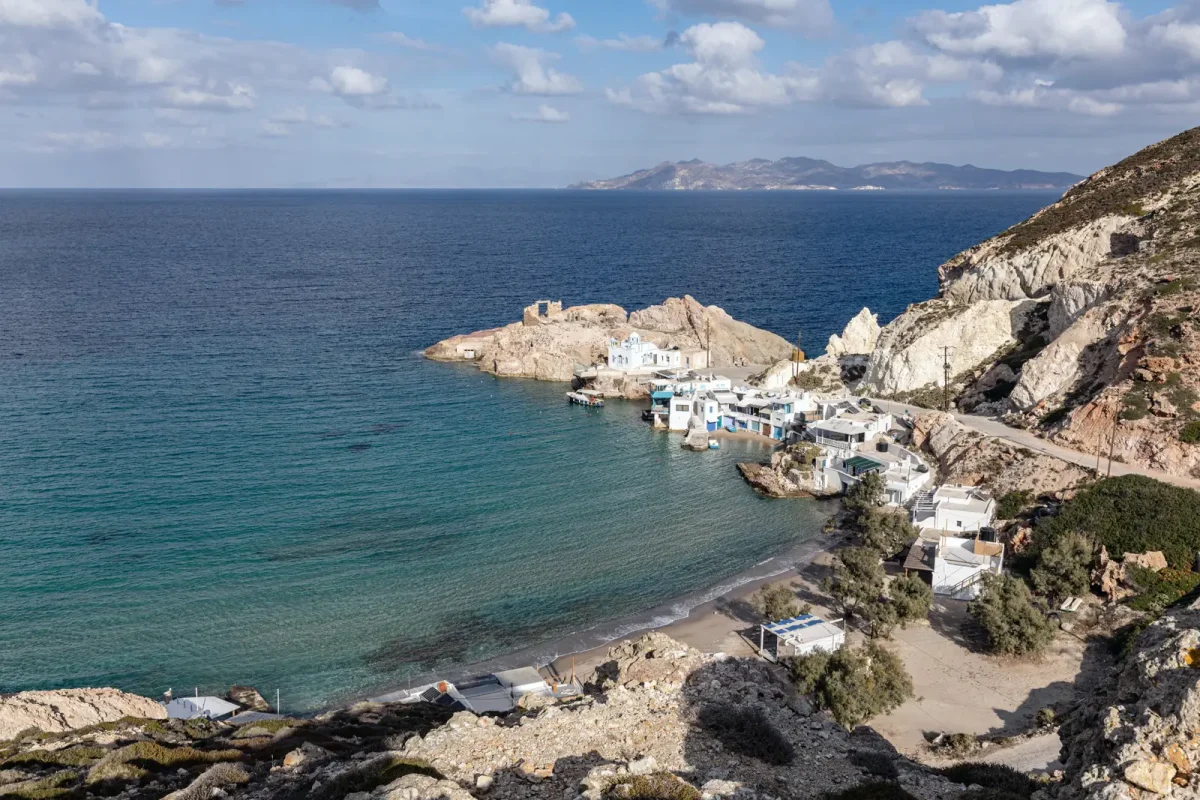
Firopotamos is the little fishing cove on the north coast of Milos that ends up on almost every postcard of the island: a horseshoe of turquoise water, a row of boat houses carved into the rock at the waterline, a tiny white chapel on the point and the ruins of an old mining building on the hill above. It has a small beach with calm, shallow water, a handful of houses and no village centre at all. This guide covers what makes Firopotamos special, how to get there and park, when the north coast is calm enough to swim, and how it fits into a Milos holiday built around the sea.
Key Takeaways
- Firopotamos is a tiny fishing settlement and beach on the north coast of Milos, about 4 km north east of Plaka, in a small natural bay.
- It is famous for its syrmata, the fishermen’s boat houses at the water’s edge, painted in bright colours, and for the white chapel of Agios Nikolaos on the rocks.
- The beach is a mix of sand and small pebbles, shaded by trees, semi organised with a few sunbeds and a small beach bar.
- A rocky point shelters the bay, so the water inside is usually calm, but on strong meltemi days the whole north coast becomes choppy.
- On those windy days the south coast is sheltered, and that is where our boats are based, at Agia Kiriaki, with the no licence Compass 150cc from 180 € for a half day.
Contents
Where Firopotamos is
Firopotamos lies on the north coast of Milos, about 4 km north east of Plaka, the hilltop capital of the island, at the end of a short road that winds down from the main road between Plaka and Adamas. The settlement is built around a small natural bay, and at the last census only a handful of people lived here all year round. In summer the few houses fill with families from Plaka, who have used Firopotamos as their summer seaside retreat for generations.
From the castle of Plaka you can see Firopotamos far below, which gives you an idea of how close it is. It is a good stop to combine with Plaka, the catacombs, the ancient theatre and the fishing village of Klima, all within a few kilometres of each other.
Why Firopotamos is so special
Firopotamos packs almost every classic image of the Cyclades into a few hundred metres of coast. In one view you see:
- Turquoise water over a sandy bottom, framed by rocks on both sides.
- The syrmata, the boat houses built into the rock at sea level, with their painted doors.
- The chapel of Agios Nikolaos, a small whitewashed church on the rocks at the entrance of the bay. It is dedicated to the patron saint of sailors, and is often described as a memorial to the fishermen of the island who were lost at sea.
- The old industrial ruin on the hill above the bay, the remains of a building from the island’s long mining history. Milos has been mined since prehistoric times, for obsidian, and in modern times for minerals such as bentonite and perlite, and ruins like this one are scattered around its coasts.
It is also unusually calm. A natural rocky point closes much of the bay, so the water inside stays flat on most days, even when the open sea beyond is moving. That is why it works so well for families and for simply floating in clear water.
The syrmata: boat houses in the rock
The word syrmata comes from the Greek verb for dragging, because fishermen used to drag their boats up into these shelters at the end of the season. They are small rooms dug into the soft volcanic rock at the waterline, closed with wooden doors, where the boats spent the winter safe from wind and waves. Upstairs, above many of them, the fishing families built simple rooms to live in.
Today most of the syrmata are painted in bright colours, and many have been turned into summer houses, some of them rented to visitors. They are private homes, so admire them from the beach or the road and do not walk onto the terraces.
The most famous syrmata on Milos are in Klima, the village of coloured houses on the bay of Adamas, but Firopotamos has its own smaller row, and together with the chapel they make it one of the most photographed coves on the island.
The beach and the swimming
The beach at Firopotamos is small, with a mix of sand and small pebbles and a sandy sea bed that slopes gently into the water. Large trees at the back of the beach give some natural shade, a rare luxury on Milos. It is semi organised: there are a few sunbeds and a small beach bar with snacks and drinks, but most people simply lay a towel under the trees.
The snorkelling is pleasant around the rocks at both sides of the bay, where you see small fish, sea urchins and the volcanic rock that forms the coast. Near the point by the chapel the water deepens quickly and turns a deep blue. For the best snorkelling spots on the island, most of them on the sheltered south coast, read our guide to snorkelling in Milos.
It gets busy in the middle of the day in July and August, when the small beach can feel crowded. Early morning and late afternoon are much quieter, and the evening light on the chapel is beautiful.
Getting there and parking
By car. From Adamas or Plaka, take the road towards Plaka and follow the signs for Firopotamos down to the coast. The road is paved but narrow and winding, and the last part is steep. There is limited parking near the beach, which fills quickly in high season, and cars often end up parked along the road above the bay. Arriving before 10:30 makes it much easier.
On foot. The last stretch down to the water is by a short walk and steps from the road. It is easy, but carry only what you need.
By bus or taxi. In high season the island’s buses serve Plaka, and from there it is a walk of about 4 km, mostly downhill on the way there and uphill on the way back. A taxi from Adamas or Plaka is a simpler option for most people.
Combining Firopotamos with Plaka, the catacombs and Klima in one morning is easy by car, since all of them are close together in the north west of the island.
The north wind and when to go
Firopotamos is on the north coast, and that matters in summer. The meltemi, the strong north wind of the Aegean, blows most often in July and August, frequently for several days in a row. The bay itself is well sheltered by its rocky point, but on strong meltemi days the whole north coast is rough, the sea beyond the point is white with waves, and the road and beach can be windy and dusty.
So the rule on Milos is simple:
- Calm days or light south wind: the north coast is at its best. Go to Firopotamos, Sarakiniko and Papafragas.
- Meltemi days: go south. The south coast, with Firiplaka, Tsigrado, Paleochori and the approach to Kleftiko, is sheltered and flat.
May, June and September usually have lighter winds and warm water, which makes them the best months to enjoy both sides of the island. Our guide to the best time to visit Milos explains the wind and sea temperature month by month.
Other fishing villages of Milos
Firopotamos is one of several fishing settlements on the coast of Milos, each with its own character:
- Klima, on the bay of Adamas below Plaka, is the most famous, with its long row of syrmata painted in every colour.
- Mandrakia, on the north coast east of Firopotamos, is a tiny inlet with a few syrmata and a fish taverna.
- Pollonia, on the north east tip of the island, is a real village with a harbour, fish tavernas and the ferry to Kimolos. Read our guide to Pollonia.
If you are choosing where to base yourself, our guide to where to stay in Milos compares Adamas, Plaka, Pollonia and the south coast, and our Milos itinerary shows how to fit the north coast villages into a 3, 5 or 7 day trip.
Seeing the rest of the coast by boat
Firopotamos is a land trip, and a lovely one. The part of Milos that you cannot reach by road is elsewhere: the south and west coasts, with beaches under coloured cliffs and sea caves that are only reachable by boat. That is where our boats are, at the floating platform of Agia Kiriaki beach on the south coast, and it is also the coast that stays calm when the meltemi makes the north unpleasant.
From our base, Kleftiko with its white arches and caves is 20 to 30 minutes away, and the beaches of Firiplaka, Tsigrado and Gerontas are a few minutes along the coast.
| Boat | Licence | People | Half day | Full day |
|---|---|---|---|---|
| Compass 150cc | Not required | 5 | 180 € | 300 € |
| Compass 165cc | Speedboat licence or our skipper | 6 | 250 € | 450 € |
| Compass 7s | Our captain on board | 7 passengers | 550 € | 950 € |
Fuel and taxes are extra. The Compass 150cc comes with a 30 minute training before you leave, and a skipper can join the 150cc or 165cc for 60 € for a half day or 120 € for a full day. Compare the boats in which boat to rent in Milos, or see all the beaches you can reach in Milos beaches by boat.
A good plan for a week on Milos is to spend the calm days on the north coast by car, Firopotamos included, and keep a boat day for the first meltemi day. Tell us your dates and we will help you pick the right day. Contact us.
FAQs
Why is Firopotamos beach so unique?
Because it combines almost every classic Cycladic image in one small bay: turquoise water over sand, colourful fishermen’s boat houses carved into the rock, a white chapel on the point and an old mining ruin on the hill. A rocky point shelters the bay, so the water is usually calm, and trees give rare natural shade on the beach.
What is the most famous fishing village on Milos?
Klima, on the bay of Adamas below Plaka, is the most famous, with its long row of colourful syrmata at the water’s edge. Firopotamos, on the north coast, is smaller but just as photogenic, with its chapel and beach. Pollonia is the largest working fishing village, with a harbour and fish tavernas.
Which villages in Milos are the most worth visiting?
Plaka for the castle and the views, Tripiti for the catacombs and the ancient theatre, Klima for its coloured boat houses, Firopotamos for the beach and chapel, Pollonia for its seaside atmosphere and fish tavernas, and Adamas as the lively main port. Plaka, Tripiti, Klima and Firopotamos are close enough to visit in one morning by car.
What are syrmata in Milos?
Syrmata are fishermen’s boat houses dug into the soft volcanic rock at the waterline, closed with wooden doors, where boats were dragged up to shelter for the winter. Many have living rooms built above them and colourful painted doors. The best known are in Klima, with smaller rows at Firopotamos, Mandrakia and other north coast coves.
How do you get to Firopotamos beach?
By car from Adamas or Plaka, following the signs down a narrow, winding paved road to the coast, then a short walk to the beach. Parking near the bay is limited and fills in high season, so arrive early. Without a car, take the bus to Plaka and walk about 4 km, or take a taxi.
Is there parking at Firopotamos?
There is limited parking near the beach and along the road above the bay. In July and August it fills by late morning and cars line the road, so arrive before 10:30 or late in the afternoon. The road down is narrow and steep, so a small car is easier to manoeuvre and park than a large one.
Is Firopotamos good for swimming?
Yes, on most days. The bay is sheltered by a rocky point, the sea bed is sandy and slopes gently, and the water is clear and calm, which suits families. On strong north wind days the open sea beyond the point is rough, and the south coast beaches such as Firiplaka and Paleochori are better choices.
Sources
- Polaris Rent boat pages, Compass 150cc, 165cc and 7s price lists and conditions
- Greeka, Firopotamos beach: https://www.greeka.com/cyclades/milos/beaches/firopotamos/
- Wikipedia (Greek), Φυροπόταμος Μήλου: https://el.wikipedia.org/wiki/Φυροπόταμος_Μήλου
- Unfolding Greece, a guide to Firopotamos: https://unfoldinggreece.com/a-guide-to-firopotamos-milos/
Ready to explore Milos by boat?
Rent the no-licence Compass 150cc or book a skippered boat, and discover Kleftiko, Polyaigos and the beaches only the sea can reach.
 by
