
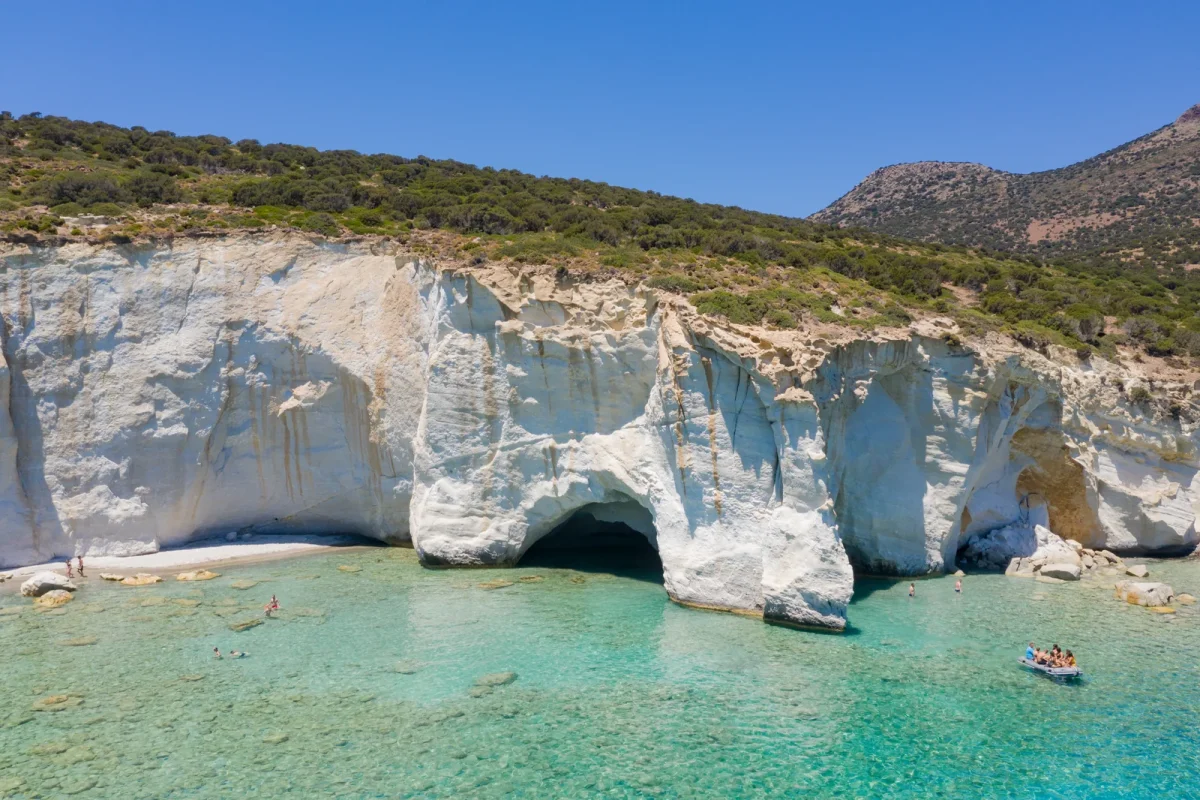
Milos has some of the clearest water in the Cyclades. Volcanic rock, almost no rivers carrying sediment, and a coastline of white cliffs that reflect light down into the sea: on a calm day visibility of 20 to 30 metres is normal, and locals will tell you about days of 40. The catch is that the best snorkeling is not at the beaches you can drive to. It is under the arches of Kleftiko, inside Sykia cave, along the walls of Gerontas and around the uninhabited island of Poliegos, all of which you reach by boat. This guide ranks the spots, tells you what lives there, when the water is warm enough, and which boat from our fleet gets you to each one.
Key Takeaways
- The top three snorkeling spots in Milos, Kleftiko, Sykia and Poliegos, are boat-only. Gerontas and Tsigrado are reachable on foot in theory but far easier by sea.
- Expect rocky reefs, walls, arches and caves rather than coral. You will see octopus, moray eels, bream, wrasse, damselfish, occasionally a turtle, and at Paleochori volcanic gas bubbling from the sand.
- Season runs May to October. Water is 19 to 21 °C in May, peaks at 25 to 26 °C in August, and is still 22 to 23 °C in October with the best visibility of the year.
- From our base at Agia Kiriaki a half-day rental covers the south coast coves and, in the 165cc or 7s, Kleftiko and Sykia (20 to 30 minutes west). Poliegos and Kimolos need a full day, or a pick-up at Pollonia arranged in advance.
- The summer meltemi makes the north and west coasts choppy in the afternoon. Snorkel early, and on windy days stay on the south coast.
Contents
Why Milos is good for snorkeling
Three things line up here. First, geology: Milos is volcanic, so the seabed near the coast is rock, not sand. Rock means structure, and structure means fish. Walls, boulders, overhangs and caves hold octopus, moray eels and schools of bream that an empty sandy bottom never will. Second, clarity: there are no rivers on Milos, very little run-off, and the pale rock bounces light around underwater, so visibility is exceptional for the Mediterranean. Third, variety within a small area: within a one-day boat trip you can snorkel inside a collapsed cave, through a natural arch, over a hot spring and along the cliffs of an island nobody lives on.
What you will not find is coral or tropical colour. This is Aegean snorkeling: clear blue water, dramatic rock, and a steady supply of curious fish.
The best snorkeling spots, ranked
1. Kleftiko (south-west coast, boat only)
The obvious number one. White volcanic cliffs drop straight into water so clear that the boat looks like it is floating in air. The swim-through tunnels and the big arch are the highlights; the walls around them are covered in small fish and the sandy patches between boulders are octopus territory. Depth goes from 2 metres at the edges to 15 metres or more off the arches, so confident swimmers get the most out of it. Read our complete Kleftiko guide for timings: it is 20 to 30 minutes west of our base at Agia Kiriaki by fast boat.
2. Sykia cave (south-west coast, boat only)
About 3 nautical miles north of Kleftiko, Sykia is a circular cave whose roof has collapsed, leaving an open skylight. Snorkeling inside is unlike anything else on the island: sunlight shafts down through the hole, the water glows emerald green, and the pebble beach at the back lets you stand up and look around. The water is noticeably colder than outside. Enter only when the sea at the entrance is flat. More on the cave itself in our guide to the sea caves of Milos.
3. Poliegos (east of Kimolos, boat only)
The largest uninhabited island in the Aegean, and the wildest water in the group. The Blue Bay on the north side is a shallow, sandy cove with turquoise water that beginners love; the cliffs around it and the south coast near Mersini are where the bigger fish are. The island is a Natura 2000 site and its sea caves shelter Mediterranean monk seals, so admire them from a distance. Poliegos is around 15 minutes by fast boat from Pollonia and pairs naturally with a circuit of Kimolos, covered in our Kimolos island guide.
4. Gerontas (south coast)
A wide bay with white cliffs, deep clear water and a natural stone arch standing just off the western end. Snorkel the rocky walls either side of the beach for fish, then swim out to the arch. It is reachable on foot by a rough track, but by boat you anchor in the bay and step straight in. A good stop on the way to Kleftiko, or the main event of a south coast half-day.
5. Tsigrado and Firiplaka (south coast)
Neighbouring beaches below white cliffs. Firiplaka has the colour and the crowd; Tsigrado, reached on land by ropes and a ladder down a crevice, is tiny and spectacular. By boat both are easy: anchor off, snorkel the rocks on either side where the cliffs meet the water, and watch for octopus in the boulder fields.
6. Paleochori (south-east coast)
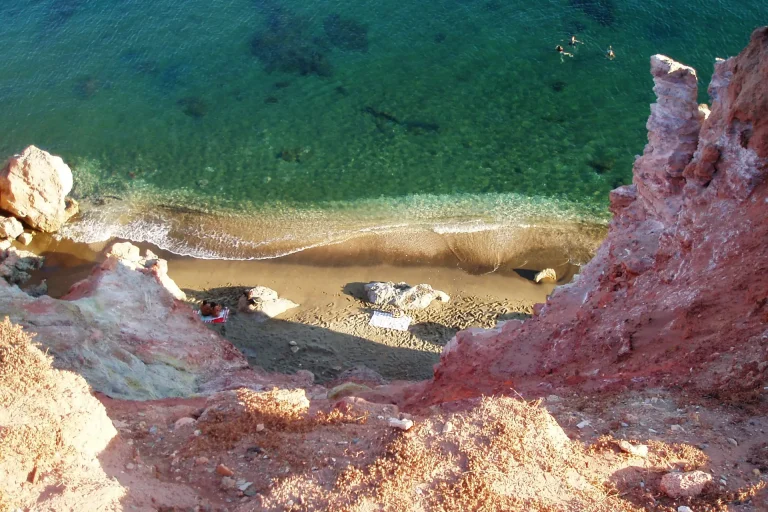
Volcanic activity is still going on under Milos, and Paleochori is where you can feel it. In the shallows off the eastern end of the beach, gas bubbles rise from the sand and the water is warm to the touch in patches. There is less fish life than at the rocky spots, but snorkeling over a seabed that fizzes is something to tell people about.
7. Prassa and the Kimolos south coast
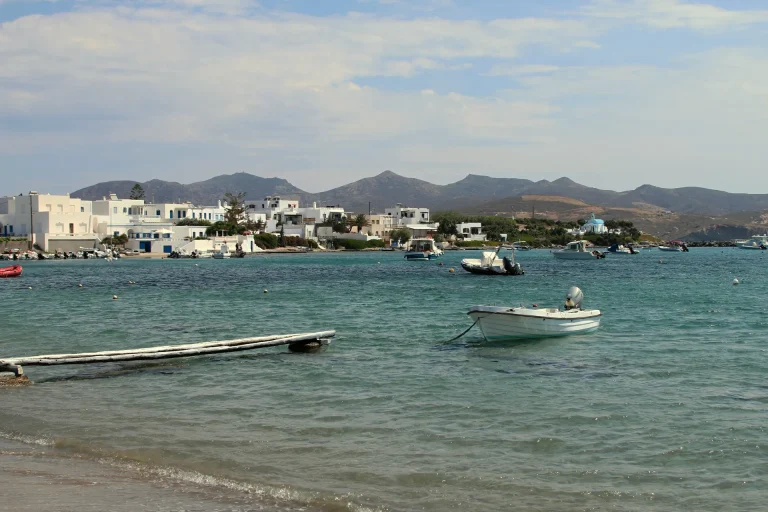
Kimolos is the quieter neighbour, and Prassa is its best beach: blinding white sand, shallow turquoise water and rocky edges that hold fish. A Compass 165cc reaches it from Agia Kiriaki in about an hour, or in minutes if you arrange pick-up at Pollonia, and from there the caves at Mavrospilia and the coast down towards Poliegos are all snorkeling territory.
Spots you can reach from the beach
If you have a no-boat day, these are the coves worth the drive:
- Firopotamos (north): sheltered, shallow, rocky edges with seagrass and small fish, good for children.
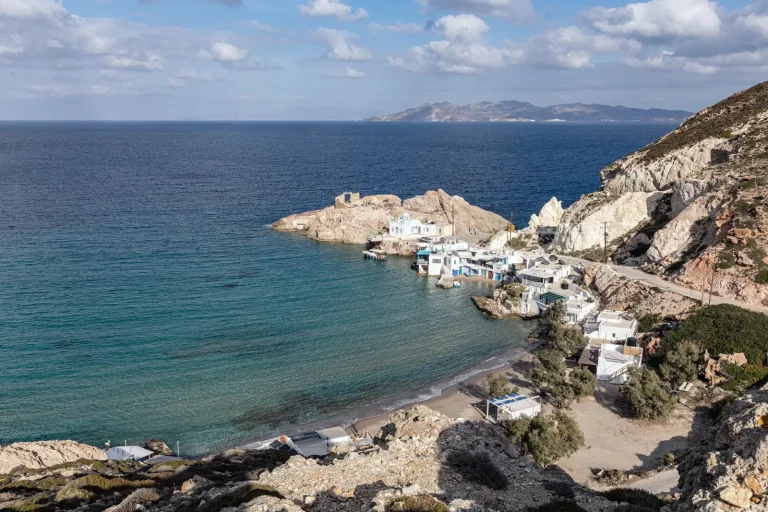
- Mandrakia (north): a tiny fishing harbour with rocky sides, stays calm when the wind is up, taverna on the quay.
- Papafragas (north): the narrow inlet with a tunnel cave; steep path down, clear water, needs calm seas.
- Sarakiniko (north): the white moonscape, with a sheltered inlet for easy snorkeling and a cargo ship wreck on the rocks east of the main cove that you can snorkel around on a calm day.
None of these match the boat-only spots for clarity or drama, but they are a good warm-up.
What you will see underwater
Typical Aegean rocky-reef life, in good numbers because so much of the coast is inaccessible:
- Octopus, usually tucked into holes in the boulder fields, spotted by the pile of shells outside the den.
- Moray eels, heads poking out of cracks in the walls at Kleftiko and Gerontas.
- Saddled bream, two-banded bream, salema in schools over the rocks; wrasse and damselfish along the walls; parrotfish (the Mediterranean species, arrived from the south) increasingly common.
- Sea urchins on every rock at the waterline, which is why you wear fins or water shoes.
- Loggerhead turtles occasionally, more often seen from the boat than underwater.
- Monk seals at Poliegos, rarely, and always to be left alone.
Best time of year and water temperature
| Month | Sea temperature (approx.) | Conditions |
|---|---|---|
| May | 19 to 21 °C | Clear, quiet, a shorty wetsuit helps |
| June | 22 to 24 °C | Warm enough for most, meltemi starts |
| July to August | 25 to 26 °C | Warmest water, strongest afternoon wind, busiest |
| September | 24 to 25 °C | The sweet spot: warm, calmer, fewer boats |
| October | 22 to 23 °C | Best visibility of the year, shorter days |
Sea temperatures are typical ranges for the Milos coast; check a live reading before you travel. The meltemi, the dry north wind of the Aegean summer, is the factor that actually decides your day. It builds through the afternoon from June to early September, roughing up the north coast and the exposed west. The rule is simple: snorkel in the morning, be on the sheltered side by 2 pm, and ask our team at the dock which side that is today.
Snorkeling from a rental boat: how it works
A boat turns snorkeling from a beach activity into an island tour. The rhythm of a good day:
- Leave Agia Kiriaki early, at 9 or 10, while the sea is glassy.
- First stop within 10 to 15 minutes, usually Gerontas or Firiplaka, for the first swim.
- Main destination by late morning: Kleftiko and Sykia, 20 to 30 minutes further west, or a second south coast bay if you want to keep it short.
- Anchor on sand, never on seagrass (posidonia meadows are protected and the anchor drags on them anyway). Put the ladder down before anyone jumps.
- Snorkel in pairs, stay within sight of the boat, and keep one person aboard if the boat is not anchored in a fully enclosed cove.
- Start the return by early afternoon so you are on the sheltered side before the wind peaks.
Our comparison of half-day vs full-day boat trips in Milos shows exactly what fits into each format.
Which boat to rent for snorkeling
- Compass 150cc (30 hp, 5 people, no licence needed): ideal for the south coast coves, Gerontas, Firiplaka, Tsigrado, Paleochori, all within 15 minutes of our base, and Kleftiko on a calm morning (40 to 50 minutes each way, ask us). If you have never driven a boat, this is the one; see renting a boat in Milos without a licence.
- Compass 165cc (115 hp, 6 people, licence or our skipper): fast enough for Kleftiko and Sykia on a calm day, and for Kimolos and Prassa. Bring your own mask and fins or ask us at booking.
- Compass 7s (250 hp, 8 people, always with our captain): the snorkeling boat. The all-inclusive package covers snorkeling equipment, towels, drinks, snacks, local wine and GoPro footage of your swims. The captain picks the spots for the day’s conditions, which on Milos is worth more than any guide.
Gear and safety
- Mask, snorkel, fins. Fins matter more here than in most places because the best spots have no beach: you enter from the boat and swim over rock and urchins.
- Rash vest or T-shirt. The Aegean sun on your back during an hour of floating is the most common injury on the island.
- Reef-safe sunscreen, applied 20 minutes before you get in.
- A surface marker or bright swim cap if you snorkel away from the boat; tour boats and other rentals pass through the same coves.
- Life vests for children and weak swimmers, provided on every boat.
- Never snorkel inside a cave with swell, and never under a boat that has its engine running.
- Look, do not touch. Urchins hurt, morays bite when cornered, and octopus dens are more interesting left intact.
Ready to get in the water?
Pick the Compass 150cc for the south coast coves, the Compass 165cc for Kleftiko and Kimolos, or the Compass 7s for the full all-inclusive snorkeling day. Contact us with your dates and we will match the route to the forecast.
FAQs
Where can I go snorkeling in Milos?
The best spots are boat-only: Kleftiko, Sykia cave, Gerontas and the island of Poliegos. From the beach, Firopotamos, Mandrakia, Papafragas and the sheltered inlet at Sarakiniko are the best options, and Paleochori has volcanic gas bubbling through the sand.
Can you swim in Milos, Greece?
Yes, from May to October. The water reaches 25 to 26 °C in August and stays above 22 °C into October. Most beaches and all the boat-only coves are safe for swimming in calm weather; the north coast gets choppy when the meltemi blows in the afternoon.
Which Greek island is best for snorkelling?
Milos is consistently among the top choices because its volcanic rock gives exceptional clarity, often 20 to 30 metres of visibility, and a coastline of arches, caves and walls that hold far more fish than sandy islands. Crete and Zakynthos are the usual alternatives, but for variety within a single day by boat, Milos is hard to beat.
What is the best boat tour in Milos?
For snorkeling, a private full-day trip on the Compass 7s to Gerontas, Kleftiko and Sykia. It is all-inclusive, the captain chooses spots for the day’s wind, and snorkeling gear is on board. If you want the north coast and Poliegos instead, book the same boat in the other direction.
Is it better to stay in Plaka or Adamas?
For boat days with us, anywhere on the south or central part of the island: our base at Agia Kiriaki beach is a 15-minute drive from both Adamas and Plaka. Adamas is the port and the practical base with shops and the day cruises; Plaka is the prettier hilltop village for evenings and sunsets, about 10 minutes from Adamas by car.
Which is nicer, Paros or Milos?
For beaches, snorkeling and boat exploration, Milos. Paros has more nightlife, windsurfing and a larger town. Milos has the volcanic coastline, Kleftiko, the sea caves and far clearer water, which is why it attracts people who want to be in the sea rather than beside it.
Which is better, Milos or Mykonos?
They are opposites. Mykonos is beach clubs, nightlife and crowds; Milos is landscape, coves and quiet. If your idea of a good day is a boat, a mask and a cave, Milos wins without a contest.
Sources
- Beaches for Kings, The Best Snorkelling Beaches in Milos: https://beachesforkings.com/milos/snorkelling/
- My Greece Tours, Milos Diving and Snorkeling: https://mygreecetours.org/milos-diving-and-snorkeling/
- Wikipedia, Polyaigos: https://en.wikipedia.org/wiki/Polyaigos
- Greeka, Sea Caves in Milos: https://www.greeka.com/cyclades/milos/sightseeing/caves-milos/
Ready to explore Milos by boat?
Rent the no-licence Compass 150cc or book a skippered boat, and discover Kleftiko, Polyaigos and the beaches only the sea can reach.
 by
by 