Categories
Guides

Milos Sea Caves by Boat: Sykia, Kleftiko, Papafragas & Poliegos

Milos is a volcanic island, and the sea has spent a few million years carving its soft white rock into arches, tunnels and caverns. The most spectacular of these sea caves, Sykia with its collapsed roof, the pirate caves of Kleftiko, the hidden coves of uninhabited Poliegos, have no road, no path and no ticket booth. The only way in is from the water. This guide covers every cave worth your fuel, where it sits on the map, how long it takes from our base at Agia Kiriaki, and which boat from our fleet gets you there safely.

Key Takeaways

  • Sykia and Kleftiko sit side by side on the south-west coast, about 3 nautical miles apart, and both are boat-only. They are the two caves you should not leave Milos without seeing.
  • Papafragas and the Glaronisia basalt islets are on the north coast, near Pollonia. Poliegos, the largest uninhabited island in the Aegean, is 15 minutes by fast boat from Pollonia.
  • A half-day rental (5 hours) covers one cluster. To see the south-west caves and Poliegos in one trip you need a full day, and ideally the Compass 7s with our captain.
  • Wind decides everything. Check the forecast with us the morning of your rental: the west coast is exposed to the summer meltemi, the east and north coasts are usually calmer.
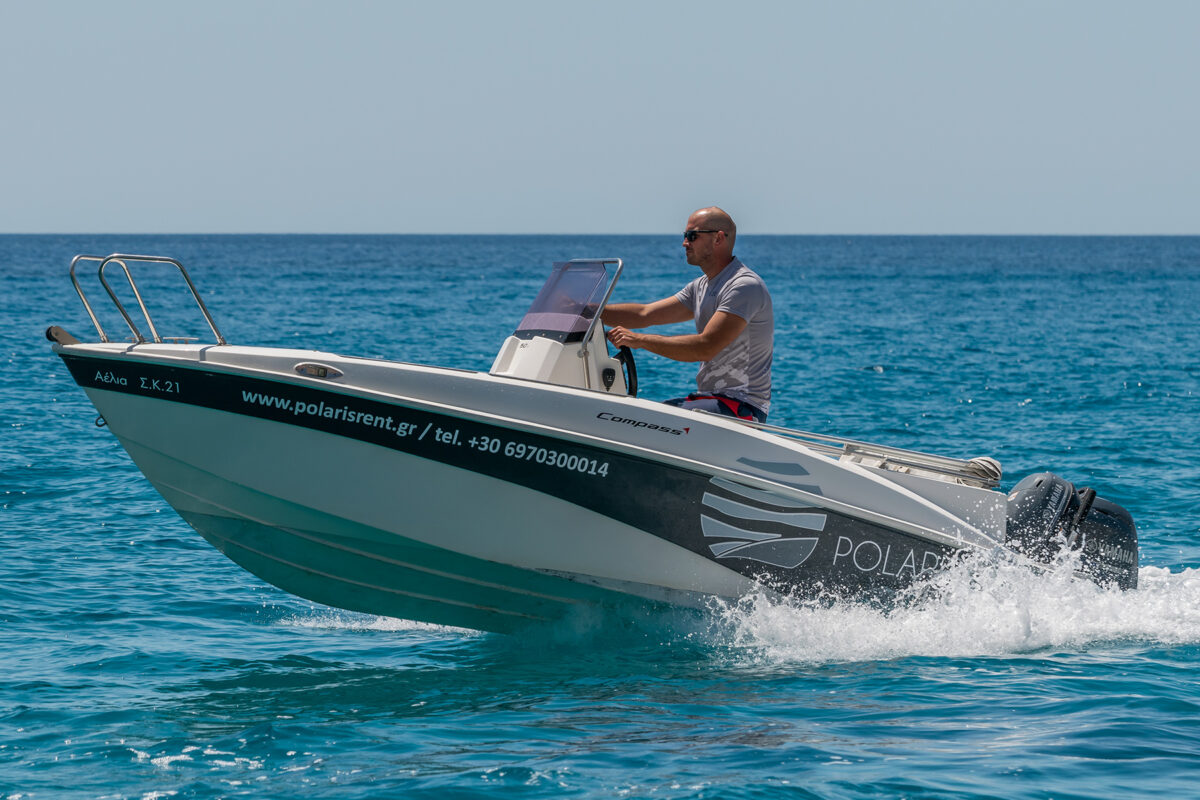
  • You do not need a licence for the Compass 150cc (30 hp). For the 165cc you need a speedboat licence or one of our skippers.

Why Milos has so many sea caves

Milos is the product of volcanic activity, and most of its coastline is made of tuff, pumice and other light volcanic rock. This rock is soft enough for waves to hollow out, but firm enough to hold an arch or a ceiling in place for centuries. Add the chemical action of seawater, winter storms from the south and west, and you get a coastline riddled with caves, natural bridges and collapsed chambers.

The same geology explains the colours. White Kleftiko, the rust reds and yellows of Poliegos, the black basalt of Glaronisia, all within a few miles of each other, all visible from the deck of a small boat. It is why renting a boat here is not a nice extra but the main event. Our guide to the best beaches in Milos you can only reach by boat covers the sandy side of that story; this one is about the rock.

Sykia Cave: the cave with no roof

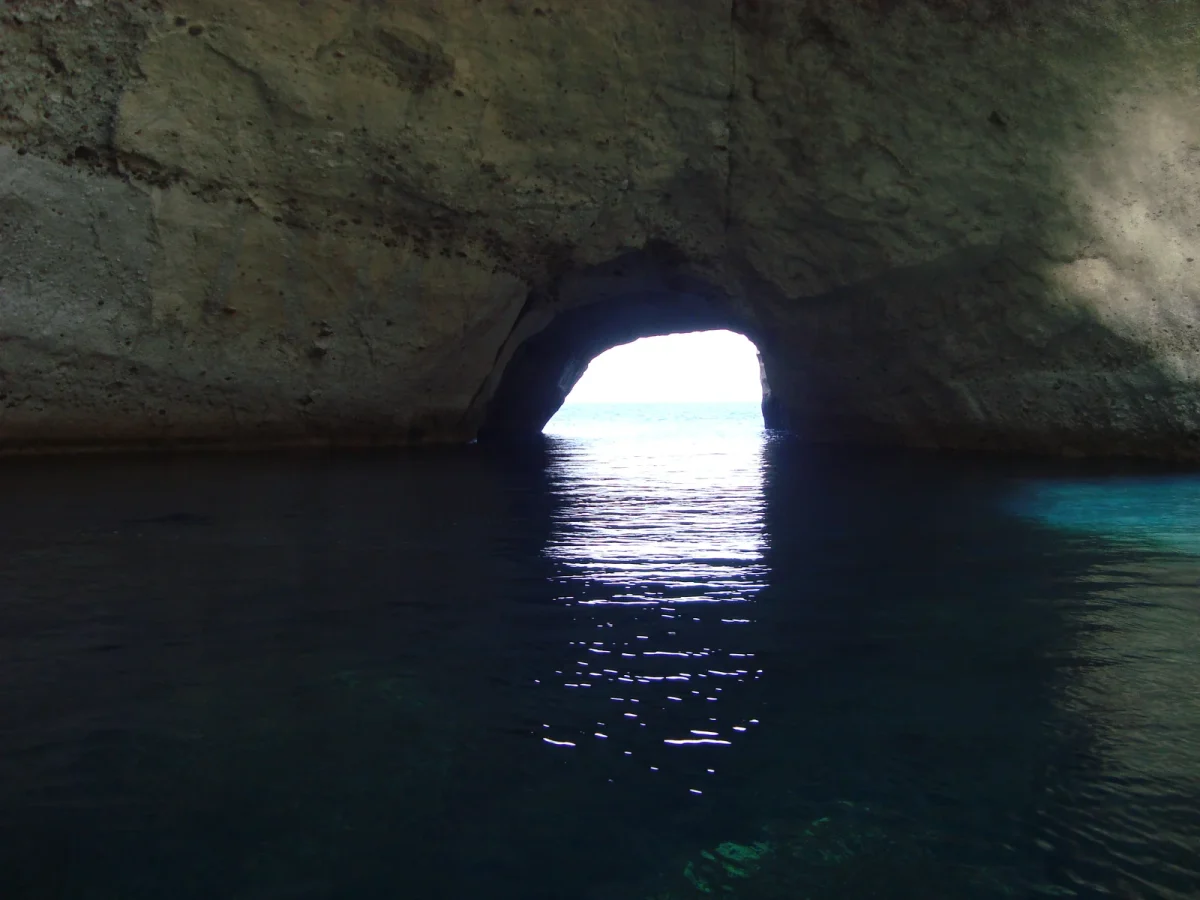
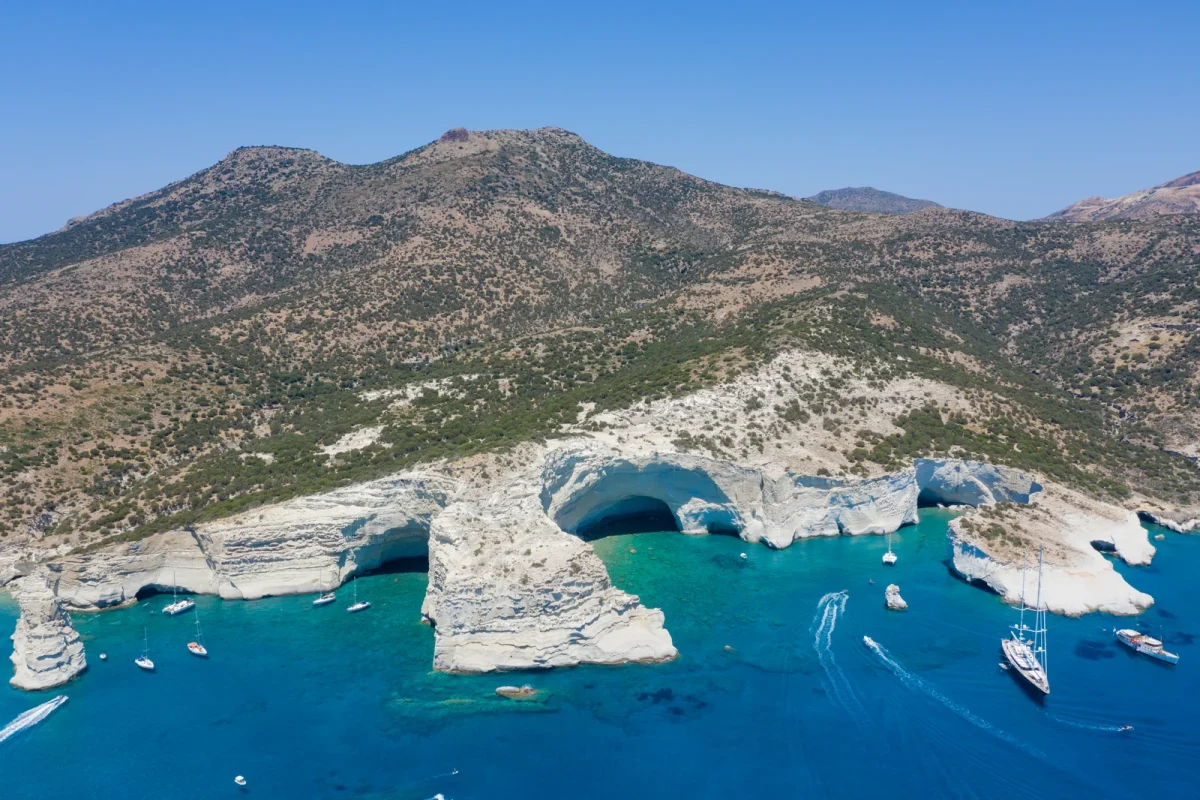
Sykia (also written Sikia) is the cave that appears on every Milos postcard, even if people do not know its name. It is a large circular chamber on the south-west coast whose ceiling collapsed long ago, leaving a round opening to the sky. Sunlight pours through the hole, hits the water inside and turns the whole cavern emerald green, which is why some locals call it the Emerald Cave.

Key facts:

  • Location: south-west coast, roughly 3 nautical miles north of Kleftiko, about 30 to 40 minutes from our base at Agia Kiriaki beach. There are no roads or footpaths, access is by sea only.
  • Entrance: a natural arch about 20 metres wide and 5 metres high. Small boats can enter on a calm day; inside, the chamber rises over 30 metres to the open top.
  • Inside: a tiny pebble beach at the back where you can step off and swim. The water is noticeably colder than outside.
  • Best light: late afternoon, when the sun angles through the opening. Mornings are calmer for the crossing, so most people choose calm over colour.

With the Compass 7s, our captain will take you in, let you swim, and position the boat for photos. With a self-drive Compass, idle at the entrance, assess the swell, and only enter if the water inside is flat. Never enter with the engine off.

Kleftiko: arches, tunnels and pirate history

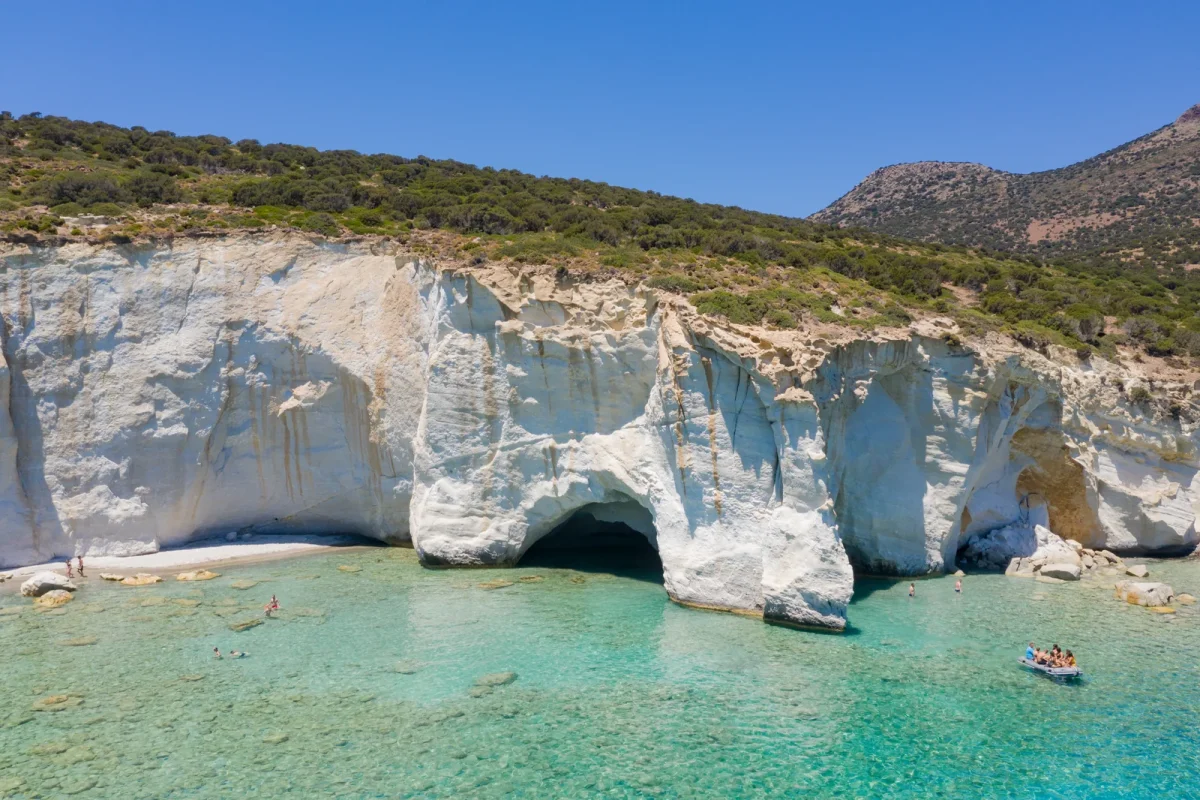
Kleftiko sits on the south-west tip of Milos, a cluster of white volcanic cliffs pierced by arches and tunnels you can swim or kayak through. The name comes from “kleftis”, thief: the coves hid pirate ships in medieval times, out of sight of the Venetian and Ottoman patrols.

We have written a dedicated complete guide to Kleftiko with timings, what you will see and the best time of day, so here is the short version that matters for cave hunters:

  • From our base at Agia Kiriaki beach on the south coast it is about 6 nautical miles west: 20 to 30 minutes in the Compass 165cc or 7s, 40 to 50 minutes in the 30 hp Compass 150cc. Tour boats from Adamas take 1.5 to 2 hours.
  • The main attractions are the large arch, the two swim-through tunnels and the big cave on the western side. Visibility underwater often exceeds 20 metres.
  • Kleftiko and Sykia are almost always done together. Leave Agia Kiriaki early, reach Kleftiko while the tour boats from Adamas are still en route, then continue to Sykia and come back along the south coast.

Gerontas and the south coast arches

Between Agia Kiriaki and Kleftiko the south coast is lined with smaller formations that tour boats skip. Gerontas is the best of them: a wide beach backed by white cliffs, with a natural stone arch standing in the water off its western end. Further along you pass the white cliffs of Tsigrado and Firiplaka, where the rock has been eroded into overhangs and shallow grottos you can nose the boat under.

These are the “free” caves of a Kleftiko day. They cost no extra time because they sit on the route, and on a calm morning they give you a preview of what is waiting further west.

Papafragas: the narrow inlet on the north coast

Papafragas is on the north coast near the ancient city of Phylakopi, a few minutes east of Pollonia by boat. It is not a single cave but a narrow, fjord-like inlet cut deep into the cliffs, with a strip of sand at the far end and dark sea caves opening off both sides. From the sea it looks like a crack in the rock; from the top of the cliffs it looks like a natural swimming pool.

On land there is a steep path down and a small parking area, so it is one of the few caves you can also reach on foot. By boat you get the opposite view: you approach the mouth of the inlet, and the three smaller caves beside it, with the cliffs towering overhead. Do not take a boat inside the inlet itself, it is too narrow and swimmers use it. Anchor outside and swim in.

Glaronisia: basalt columns in the sea

Just off the north coast near Pollonia, the Glaronisia (“seagull islands”) are four small islets made entirely of hexagonal basalt columns, around 20 metres high, formed when lava cooled and cracked into prisms. They look like a Greek version of the Giant’s Causeway rising straight out of the sea. There is a sea cave on the largest islet that you can swim into, and the vertical walls are home to the seagulls that give the place its name.

Glaronisia pairs naturally with Papafragas and Poliegos into a north coast day.

Poliegos: caves and the Blue Bay of an empty island

Poliegos is the wild card of the Milos group. At about 18 square kilometres it is the largest uninhabited island in the Aegean, protected under Natura 2000, owned mostly by the Church and inhabited only by goats (the name means “many goats”) and a colony of Mediterranean monk seals that breed in its sea caves.

It lies 2 km south-east of Kimolos and about 6 km east of Milos. From Pollonia a fast boat reaches the first bay in around 15 minutes. What you find:

  • Blue Bay (Galazia Nera): a shallow cove of white sand and turquoise water enclosed by limestone cliffs, the most photographed spot on the island.
  • Mersini: the largest beach, on the sheltered south side, with calm water and good anchoring.
  • Sea caves: dozens of them along the cliffs, several with collapsed ceilings that act as natural skylights. Some are monk seal habitat: look from the boat, do not enter caves where you see seals.
  • Cliffs: volcanic mineral deposits colour the rock red, green, yellow and orange, very different from white Milos.
  • Lighthouse: on the island’s highest point, reachable by a narrow footpath if you anchor below and have the legs for it.

Poliegos is usually combined with a circuit of Kimolos. Our Kimolos island guide covers the beaches on that side.

Map and sample routes

Two clusters, two different days. Trying to do both in one half-day rental does not work.

Route Caves covered From Agia Kiriaki Recommended boat
Kleftiko and Sykia Gerontas, Kleftiko arches and tunnels, Sykia Half day (165cc/7s) or full day with more swim time Compass 7s with captain; Compass 165cc; Compass 150cc on a calm morning, ask us
South coast short Gerontas arch, Firiplaka and Tsigrado overhangs Half day, 5 to 15 minutes between stops Compass 150cc or 165cc
West coast and caves Kleftiko, Sykia, Kalogries, the roadless west coast Full day Compass 7s with captain, Compass 165cc
Kimolos and Poliegos Karras cave, Poliegos caves, Blue Bay, Mersini Full day from Agia Kiriaki (45 to 60 min each way), or half day with pick-up at Pollonia on request Compass 165cc or 7s
North coast Papafragas, Glaronisia Full day, or with pick-up at Pollonia Compass 7s with captain

Geography is the reason. Our base at Agia Kiriaki is on the south coast, which puts Kleftiko and Sykia 20 to 40 minutes to the west and the south coast coves minutes away. Pollonia, Kimolos and Poliegos are on the opposite, north-east side of the island, 45 minutes to an hour by fast boat, which is why we can arrange pick-up at Pollonia or Psathi (Kimolos) on request for those routes. Read our half-day vs full-day comparison if you are deciding between the two formats.

Which boat for which caves

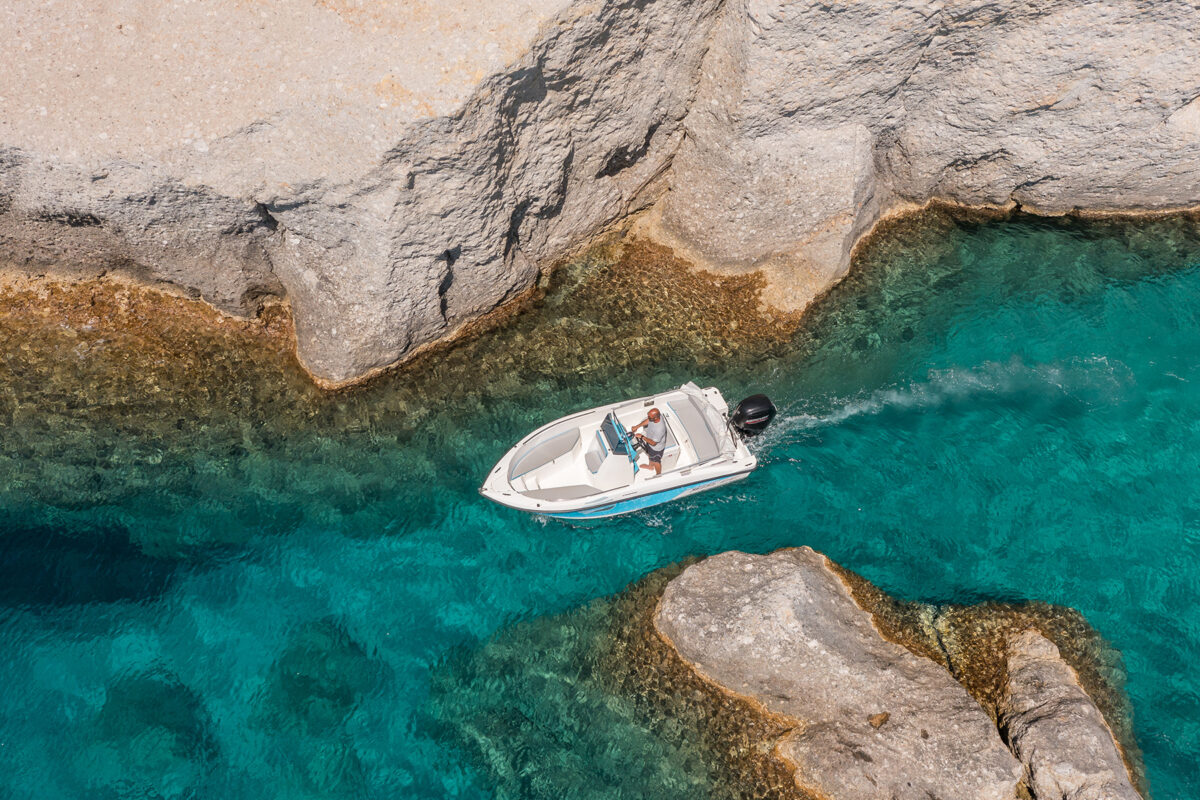
  • Compass 150cc (30 hp, 5 people, no licence): perfect for the south coast coves within minutes of Agia Kiriaki, and on a calm morning it reaches Kleftiko and Sykia in 40 to 50 minutes; ask us on the day. Poliegos and the north coast are too far for it from the south coast. Read more on renting a boat in Milos without a licence.
  • Compass 165cc (115 hp, 6 people, licence or skipper): fast enough for Kleftiko and Sykia on a calm day, and for the Kimolos and Poliegos circuit. If you do not hold a speedboat licence we provide a skipper.
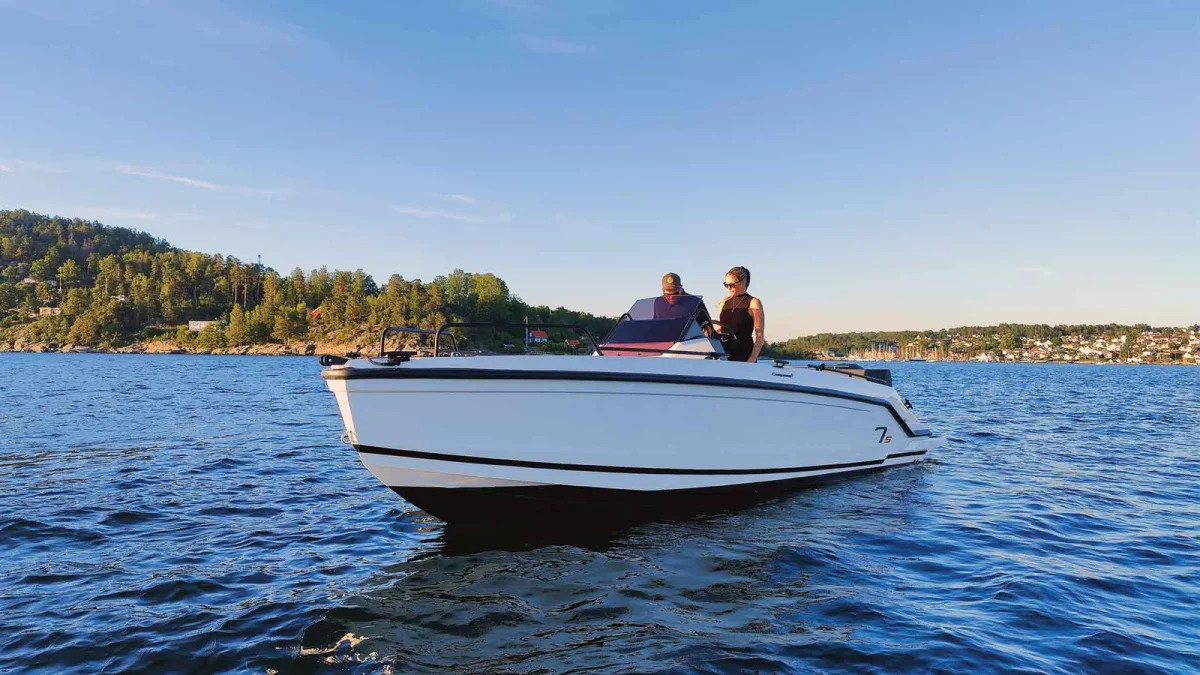
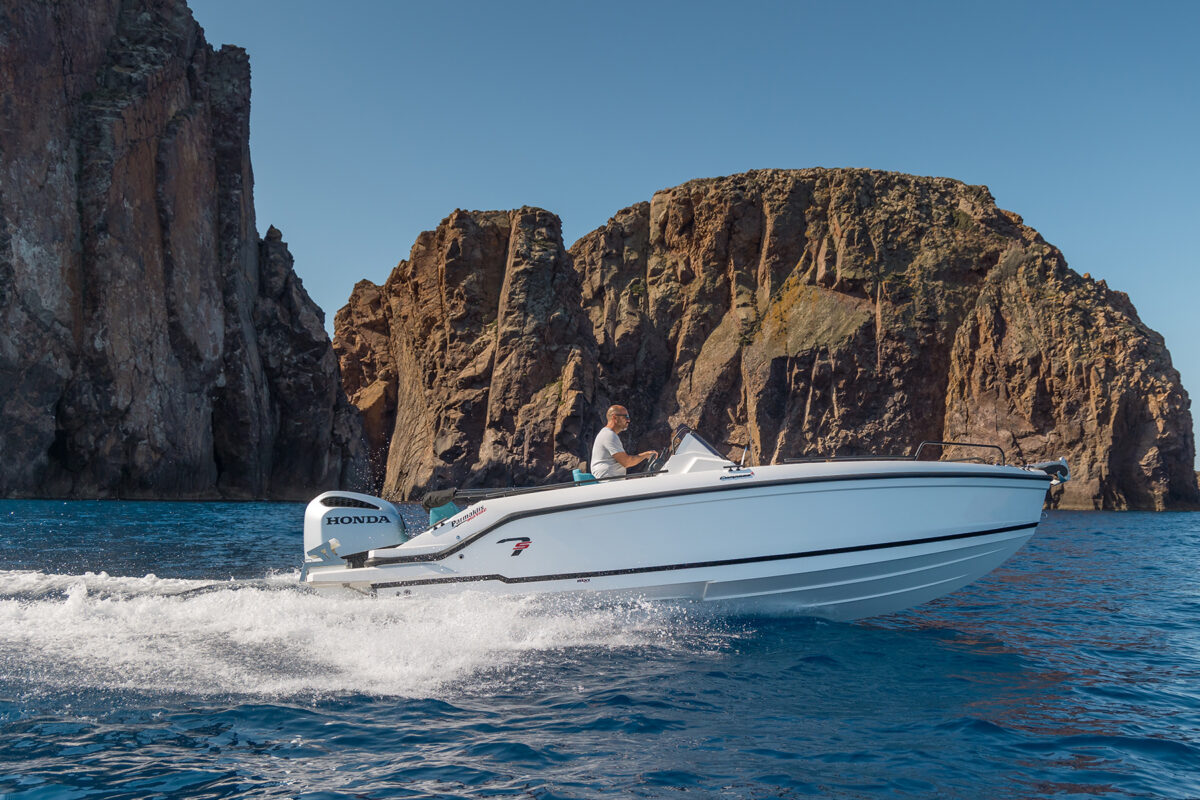
  • Compass 7s (250 hp, 8 people, always with our captain): the cave boat. The captain knows every entrance, handles the swell, and the all-inclusive package (snorkelling gear, GoPro footage, drinks, snacks, local wine) means you do nothing but swim.

Safety inside and around caves

  • Wind first. The summer meltemi blows from the north and wraps around the west coast in the afternoon. Leave early, plan to be back on the sheltered side by mid-afternoon, and ask our team at the dock for the day’s forecast before you commit to a route.
  • Never enter a cave with the engine off or with swimmers in the water next to the hull. Idle in, assess, idle out.
  • Swell inside a cave is bigger than outside. If the water at the entrance is moving, stay out and swim in instead.
  • Anchoring: sandy bottoms only, never on seagrass (posidonia) meadows, which are protected and hold the anchor badly anyway.
  • Monk seals: Poliegos caves are a breeding area. A seal on a beach or in a cave means you back off quietly.
  • Fuel: caves are at the far ends of the island. The 150cc carries 50 litres, the 165cc 90 litres. Fuel is not included in the rental, so plan the return leg before you leave.

Ready to see them from the water?

Compare the Compass 150cc, Compass 165cc and Compass 7s, or contact us with your dates and group size and we will suggest the right route for the forecast.

FAQs

What are the sea caves in Milos, Greece?

The best-known are Sykia (a collapsed-roof cave on the south-west coast), the arches and tunnels of Kleftiko, Papafragas inlet on the north coast, the basalt sea cave at Glaronisia, and the dozens of caves on the uninhabited island of Poliegos. Sykia, Kleftiko and Poliegos are accessible only by boat.

Why are there so many caves in Milos?

Milos is a volcanic island made largely of soft tuff and pumice. Winter storms and seawater erode this rock quickly, carving arches and chambers, while the firmer layers hold the ceilings in place for centuries until they collapse, as at Sykia.

Is Kleftiko worth it?

Yes. It is the single most impressive stretch of coastline on Milos, with swim-through tunnels, a huge arch and 20-metre underwater visibility. From our base at Agia Kiriaki it is only 20 to 30 minutes by fast boat, so it fits a half day; tour boats from Adamas need 1.5 to 2 hours each way.

Can I take a boat trip to Kleftiko on Milos?

Yes, either a skippered Compass 7s private tour, a self-drive Compass 165cc if you hold a speedboat licence, or the no-licence Compass 150cc on a calm morning (40 to 50 minutes from Agia Kiriaki). Organised day cruises also run from Adamas.

Is Papafragas beach located on Milos, Greece?

Yes. Papafragas is on the north coast of Milos, next to the archaeological site of Phylakopi and a short run east of Pollonia. It is a narrow inlet with a small sandy strip and sea caves, reachable both by a steep footpath and by boat.

Is Polyaigos a Greek island?

Yes. Polyaigos (Poliegos) is the largest uninhabited island in the Aegean, part of the Milos group in the Cyclades, 2 km south-east of Kimolos. It is a Natura 2000 protected area with sea caves, the Blue Bay, a lighthouse and a colony of Mediterranean monk seals.

What is the best boat tour in Milos?

For caves specifically, a private full-day trip on the Compass 7s covering Gerontas, Kleftiko and Sykia is the one our guests rate highest. If you want the north coast and Poliegos, book the same boat for the opposite direction. Both are all-inclusive with snorkelling gear and a captain who knows the cave entrances.

Categories
Guides

Renting a Boat in Milos Without a Licence: The First-Timer’s Guide

“Can I really drive a boat with no licence?” It is the question we hear most, and in Greece the answer is a clear yes. Boats with engines up to 30 horsepower can legally be rented and driven without any boating licence, by any adult, after a safety briefing. That single rule turns a Milos holiday into a sea-exploration holiday, even if you have never held a tiller in your life. This guide covers the law, which boat qualifies, exactly what happens in the briefing, where a 30 hp boat can and cannot take you, what it costs, and the safety rules we actually enforce.

Key Takeaways

  • Greek law: engines up to 30 hp need no licence. Above 30 hp you need a speedboat licence or a skipper. The Hellenic Coast Guard checks.
  • In our fleet the no-licence boat is the Compass 150cc: 4.55 m, Yamaha 30 hp, 5 people, 180 € half day, 250 € full day plus fuel.
  • The Compass 165cc (115 hp) and Compass 7s (250 hp) need a licence or come with our skipper or captain.
  • Our base is on the south coast at Agia Kiriaki beach, so a 30 hp boat comfortably covers the south coast coves (Gerontas, Firiplaka, Tsigrado, Provatas, Paleochori) within minutes, and Kleftiko and Sykia on a calm morning (40 to 50 minutes each way). It does not do Kimolos, Polyaigos or the north coast.
  • The briefing takes 15 to 20 minutes with you at the controls. First-timers consistently tell us it is easier than driving a scooter.
  • If the wind is wrong we tell you, swap the route, or rebook or refund. Nobody goes out in weather we would not take our own families into.

The law: the 30 hp rule

Greek maritime regulations allow recreational boats with an engine of up to 30 hp to be operated without a licence. This is the rule that every “no licence needed” rental in Greece is built on, from Corfu to Crete. Above 30 hp, the driver needs a valid speedboat (powerboat) licence, Greek, EU or recognised international, as an original document, not a photo. The Hellenic Coast Guard does patrol the popular anchorages and does check paperwork, so a rental company that offers you a bigger engine “without a licence” is putting you, not itself, in the wrong.

The rule is sensible. A 30 hp boat is small, slow to react, sits flat in the water and forgives mistakes. It is the right size for a first day at sea.

Which boat qualifies

In our fleet, one boat is licence-free and two are not:

Compare Licence Capacity Engine Half day Full day
Compass 150cc Not required 5 people Yamaha 30 hp 180 € 250 €
Compass 165cc Speedboat licence, or our skipper 6 people Mercury 115 hp 250 € 450 €
Compass 7s Always with our captain 7 guests 250 hp 550 € 950 € all-inclusive

The Compass 150cc is a 4.55-metre open boat with a sunshade, a cooler, a 50-litre tank and room for five. It is the boat most first-time visitors rent, and for good reason: the throttle is gentle, it turns slowly, and there is nothing on it that can surprise you.

If you have no licence and want the bigger boat, the 165cc comes with our skipper, and the 7s always comes with a captain and an all-inclusive package. Our guide to which boat to rent in Milos compares all three.

Who can drive

  • The driver must be an adult, 18 or over, with ID or passport.
  • No experience is required. The briefing assumes zero.
  • One person signs the agreement and is responsible for the boat; anyone aboard can take the wheel under their supervision.
  • Children are welcome with life vests, which we provide in all sizes.
  • If you have any doubts about your confidence on the water, say so. A skipper for the day costs less than you think and turns the trip into a private tour.

How the briefing works

Before you set off we spend 15 to 20 minutes together on board, with you at the controls:

  1. Starting, steering and stopping. Throttle, tiller or wheel, neutral, reverse. You drive out of the harbour with us aboard.
  2. Anchoring and mooring. Dropping on sand, checking it holds, raising it cleanly. Why you never anchor on seagrass.
  3. Reading the day. Where the wind is coming from, which side of the island is sheltered, what the sea will do by mid-afternoon.
  4. The chart. Fuel range, safe anchorages, the swim stops for today’s forecast, and the no-go zones.
  5. Safety kit. Life vests, the phone and VHF contact, the flares, what to do if the engine stops, and the one rule above all: if anything feels wrong, call us.

By the time you leave the bay you have driven, anchored and turned the boat yourself. First-timers consistently tell us it feels easier than they expected, closer to a scooter than a car.

Where a no-licence boat can take you

The south coast either side of our base at Agia Kiriaki is the Compass 150cc’s home water, and it is superb:

  • Agia Kiriaki and Provatas: long sandy beaches, shallow, the warm-up swim.
  • Firiplaka: coloured cliffs and a long beach, anchor off and swim in.
  • Tsigrado: the tiny cove reached on land by ropes and a ladder; from the water you just drop anchor.
  • Gerontas: 10 minutes west, the stone arch and the best snorkeling within easy range, octopus and moray eels along the rocky walls. See snorkeling in Milos.
  • Paleochori: 10 to 15 minutes east, hot springs bubbling through the sand in the shallows.
  • Kleftiko and Sykia: on a calm morning, 40 to 50 minutes west. Leave early, be back before the afternoon wind, and let us confirm at the dock that the day is right.

Three or four of these make a half day; a full day lets you go further east or simply linger. Our guide to the beaches you can only reach by boat ranks them all, and half-day vs full-day boat trips turns them into routes.

Where it cannot, and what to do instead

  • Kleftiko on a windy day. If the forecast is not calm, the 150cc stays east of Gerontas. For Kleftiko in anything but a flat sea, take the skippered Compass 7s, the 165cc with a licence or skipper, or a day cruise. See the complete Kleftiko guide.
  • Kimolos and Polyaigos. Too far for the tank and the speed from Agia Kiriaki. The 165cc or 7s, or arrange delivery to Pollonia or Psathi in advance. See the Kimolos island guide.
  • Round-island. Not in a 30 hp boat.
  • The west coast beyond Sykia. Kalogries, Agathia and Arkoudes are a full-day run for the bigger boats. The caves within the 150cc’s range are Gerontas, the overhangs at Tsigrado and Firiplaka and, on a calm morning, Kleftiko and Sykia; all of them are in the sea caves of Milos.

The good news: the licence-free routes are sheltered, close, and on a windy day they are the only routes anyone is doing anyway.

What it costs

  • Compass 150cc: 180 € half day (09:00 to 14:00 or 14:30 to 19:30), 250 € full day (10:00 to 19:00). Same price May to October.
  • Fuel: not included, charged on actual use at the end. A south coast half day is a small top-up.
  • Included: safety equipment and life vests, the briefing, sunshade, cooler, and route advice on the day.
  • Deposit: taken at the start, returned at the end.
  • Skipper: available on request for any boat if you change your mind.

Per person, five people sharing a full day on the 150cc pay about 50 € each for a private boat. A group cruise seat is 80 to 150 €.

Safety, honestly

Milos is a volcanic island with a serious coastline, and we treat it with respect.

  • Wind. The meltemi builds through the afternoon from June to September. We tell you on the morning which routes are open, and we will move or refund your booking rather than send you out in weather we would not take our own families into.
  • Stay in range. The 150cc’s tank and speed are sized for the south coast. Kleftiko on a calm morning is fine; the west coast beyond Sykia is not, and the afternoon will not be as calm as the morning.
  • Anchor on sand. Check it holds before anyone swims. Keep one adult aboard if the boat is not in a fully enclosed cove.
  • Engine off around swimmers. Always.
  • Caves. Swell inside is bigger than outside. Idle in, assess, idle out, or anchor outside and swim in.
  • Call us. A phone on board, our number saved, and zero hesitation to use it. An engine that will not start is a ten-minute problem if you call, and an afternoon problem if you do not.

No licence does not mean no rules. It means the boat is small and forgiving enough that a careful adult can master it in one briefing.

A first-timer's day, hour by hour

  • 08:45 Arrive at our platform on Agia Kiriaki beach, sign, deposit, life vests fitted.
  • 09:00 to 09:20 Briefing on board, you drive away from the platform.
  • 09:30 Firiplaka, five minutes east. First swim, anchor on sand, confidence up.
  • 10:30 Tsigrado. Anchor off the cove, swim in, photos from the water.
  • 11:30 Gerontas, back west past the base. Snorkel the walls and the arch, lunch from the cooler.
  • 13:15 Start back, wind still light.
  • 14:00 Platform, refuel, deposit returned, lunch at the beach bar with stories.

That is the 09:00 to 14:00 half day. The afternoon slot (14:30 to 19:30) is the same route with the sunset on the way home.

Ready to be captain for a day?

Check the Compass 150cc for your dates, or contact us if you want a skipper or the bigger boats. Summer dates fill fast.

FAQs

Do you need a driving license for a boat in Greece?

Only for engines over 30 hp. Up to 30 hp, no licence of any kind is required; you need to be an adult and complete the rental company’s briefing. Above 30 hp you need a speedboat licence (original document) or a skipper.

What boats can you rent without a license?

In Greece, any recreational boat with an engine of 30 hp or less. In our fleet that is the Compass 150cc, a 4.55-metre boat for five people with a Yamaha 30 hp. Most no-licence rentals across the Greek islands are boats of this size.

What boat can I drive without a licence in Greece?

A boat with an engine up to 30 hp, typically 4 to 5 metres long, open, with a sunshade and room for four to six people. Enough to cover the sheltered coast within an hour of port, not enough for long or exposed passages.

Do I need any experience at all?

None. The briefing assumes zero experience and you drive, anchor and turn the boat yourself before leaving the bay. If you can ride a scooter you can drive a 30 hp boat.

Can I take a licence-free boat to Kleftiko?

No, and we do not recommend trying. The west coast run is long and exposed and the afternoon wind makes the return difficult. For Kleftiko choose the skippered Compass 7s, the 165cc with a licence, or a day cruise.

What is the minimum age to rent a boat in Milos?

The driver must be 18 or over with ID or passport. Children of any age can come aboard with life vests, which we provide.

What happens if the weather is bad on my day?

We swap the route to the sheltered side if that is enough, and if it is not we rebook you free of charge or refund you. Nobody goes out in weather we would not take our own families out in.

Sources

  • Hellenic Coast Guard, recreational craft regulations: https://www.hcg.gr/
  • Polaris Rent boat pages, Compass 150cc, 165cc and 7s specifications and price lists
  • Hellenic National Meteorological Service, marine forecasts: https://www.emy.gr/
Categories
Guides

Milos Boat Trips: Half-Day vs Full-Day Routes, Prices and What You Will Actually See

A boat trip is not one of the things to do in Milos, it is the thing to do. The island’s greatest sights face the sea, and several of them, Kleftiko above all, cannot be reached any other way. The real question is not whether to go but how: half day or full day, which route, and your own boat or a seat on a cruise. This is the honest breakdown we give our own guests at the dock, with times, swim stops, prices and the wind rules that decide the day.

Key Takeaways

  • Our boats leave from Agia Kiriaki beach on the south coast, 20 to 30 minutes from Kleftiko by fast boat. A half day (5 hours, 09:00 to 14:00 or 14:30 to 19:30) covers the south coast coves, or Kleftiko and Sykia in the 165cc or 7s. Two to three swim stops.
  • Full day (10:00 to 19:00) is for Kimolos, Polyaigos, the far west coast, or Kleftiko with no clock. Four to six swim stops. Pick-up at Pollonia or Psathi can be arranged in advance for the north-east routes.
  • Self-drive prices: Compass 150cc (no licence) 180 € half day, 250 € full day; Compass 165cc (licence or skipper) 250 € and 450 €. Skippered all-inclusive Compass 7s 550 € and 950 €. Fuel is extra on all.
  • Group cruises to Kleftiko run 80 to 150 € per person; a private boat shared by five or six usually costs less per head.
  • Wind decides the route, not the brochure. North wind (meltemi): south coast and Kimolos channel. South wind: north coast. Morning is always calmer than afternoon.

Half day or full day: the short answer

Half day if you want a relaxed taste of the coastline, are travelling with small children, it is your first time at the wheel, or you want Kleftiko and Sykia without the rest. Full day if Kimolos or Polyaigos is on your list, if you want Kleftiko plus the roadless west coast, or you simply do not want to watch the clock. The reason Kleftiko fits a half day with us is geography: our base at Agia Kiriaki is on the south coast, 20 to 30 minutes from the arches, whereas the cruises from Adamas need 1.5 to 2 hours each way.

Half-day routes

Route A: the south coast coves

Straight from our platform at Agia Kiriaki: Provatas and Firiplaka with its coloured cliffs to the east, tiny Tsigrado (anchor and swim in, no rope ladder), and Gerontas with its stone arch and the best snorkeling within ten minutes of the base. Three or four swim stops, all within 15 minutes of each other, sheltered from the north wind. The classic first-timer route in the no-licence Compass 150cc.

Route A+: Kleftiko and Sykia in a half day

In the Compass 165cc or Compass 7s, Kleftiko is 20 to 30 minutes west of Agia Kiriaki. Leave at 9, two hours among the arches before the cruise boats arrive, Sykia cave on the way round, Gerontas for a last swim, back by 2. On a calm morning the 150cc can do it too (40 to 50 minutes each way); we decide at the dock.

Route B: the Kimolos channel (Pollonia pick-up)

If you arrange in advance for us to deliver the boat to Pollonia port, or to Psathi on Kimolos, the channel is a half-day route: the Karras sea cave, the painted boat garages of Goupa, a long swim in the shallow turquoise at Prassa, and a coffee at Psathi if you like. Short hops, sheltered water, huge reward per mile. Details in our Kimolos island guide.

Route C: Paleochori and the south-east (south wind days)

East from Agia Kiriaki past Provatas to Paleochori, where hot springs bubble through the sand in the shallows, then on towards the cliffs of Agia Kiriaki’s eastern neighbours. Ten to twenty minutes between stops, and the best option when a south wind makes Kleftiko uncomfortable.

Full-day routes

Route D: Kleftiko, Sykia and the west coast

The classic, with no clock. Kleftiko in 20 to 30 minutes, two unhurried hours among the arches, tunnels and pirate caves, into the collapsed cave-lagoon of Sykia, then on up the roadless west coast to Kalogries and the empty coves towards Arkoudes, and a last swim at Gerontas on the way home. This is the route the postcards are printed from. Full details, costs and timing in the complete Kleftiko guide, and the caves themselves in the sea caves of Milos.

Boat: Compass 7s with our captain, or Compass 165cc with a licence. The 150cc does Kleftiko and Sykia on a calm morning but not the full west coast.

Route E: Kimolos and Polyaigos

Our connoisseur’s pick and the route almost nobody else offers. From Agia Kiriaki it is 45 to 60 minutes around the east coast to Kimolos, or 15 minutes if we deliver the boat to Pollonia. Circle Kimolos (Goupa, Prassa, Monastiria, the west coast coves), then cross to uninhabited Polyaigos for the Blue Bay, the coloured cliffs, the sea caves and lunch at Mersini. The clearest water in the Cyclades, and you will share it with goats.

Boat: Compass 7s, or Compass 165cc with licence or skipper.

Route F: the north coast

Papafragas from the sea, the basalt columns of Glaronisia, Sarakiniko’s white rocks from the water, the mining jetties of Thiorichia. Best with a Pollonia pick-up, and usually combined with a Kimolos or Polyaigos leg.

Side by side

Compare Half day Full day
Hours on the water 5 9
Swim stops 2 to 3 4 to 6
Kleftiko and Sykia Yes, in the 165cc or 7s (150cc on calm mornings) Yes, plus the west coast
Kimolos circuit / Polyaigos Channel only, with Pollonia pick-up Yes
Best for Families with small kids, first-time drivers, afternoon people Kleftiko, Polyaigos, photographers, groups
Compass 150cc (no licence) Ideal South coast only
Compass 165cc Yes Yes, licence or skipper
Compass 7s Yes Ideal
From 180 € 250 €

Rent your own boat or join a cruise?

Organised cruises (sailing boats, catamarans and speedboats, almost all from Adamas) are right if you want lunch cooked for you, zero decisions and zero responsibility. You share the boat with 20 to 50 people, leave when the schedule says and swim where the captain stops.

Renting your own boat means your schedule: leave before the fleet, stay longer where you love it, skip what you do not. Two of our boats are self-drive, and the no-licence Compass 150cc means anyone can be captain for a day; see renting a boat in Milos without a licence.

The skippered Compass 7s sits between the two: private, flexible, but with a captain who knows every cave entrance and an all-inclusive package (drinks, snacks, wine, snorkeling gear, towels, GoPro footage). For groups of five to seven it is often the best value of the three.

Our guide to which boat to rent in Milos compares all three in detail.

Prices in 2026

Option Half day Full day Notes
Compass 150cc, self-drive, no licence 180 € 250 € 5 people, fuel extra
Compass 165cc, self-drive with licence 250 € 450 € 6 people, fuel extra, skipper available
Compass 7s, skippered all-inclusive 550 € 950 € 7 guests, fuel and VAT extra, food and drinks included
Group sailing cruise to Kleftiko 80 to 150 € per person Lunch usually included
Group speedboat to Kleftiko 60 to 100 € per person Shorter swim

Prices are flat from May to October. Fuel is charged on actual use at the end of the day.

How the wind picks your route

The meltemi, the dry north wind of the Aegean summer, builds through the afternoon from June to early September. It decides more than any brochure:

  • North wind (normal summer): south coast coves and the Kimolos channel are sheltered. Kleftiko is possible in the morning if the forecast is light, with an early return.
  • Strong north wind: south coast coves only, morning slot. Kleftiko is off.
  • South wind (less common): the south coast gets lumpy; Paleochori and the east, or the north coast with a Pollonia pick-up. Kleftiko is off.
  • Calm: anything goes. This is the Polyaigos day.

We advise every guest on the morning of the rental and we swap routes, reschedule or refund rather than send anyone out in weather we would not take our own families into.

What to bring

Sunscreen (reef-safe), hat, rash vest, water, snacks, swimwear, a light windbreaker for the ride back, swim shoes for the pebble coves, a dry bag for phones, and your camera. Mask and snorkel are on board the 7s; bring your own or ask us for the self-drive boats. Life vests for children are provided in all sizes.

Undecided?

Send us your dates and crew and we will match the route to the forecast: Compass 150cc for the coves, Compass 165cc for range, Compass 7s for the all-inclusive day. Contact us. Our 3, 5 and 7-day Milos itinerary shows where each boat day fits.

FAQs

What is the best boat tour in Milos?

For a private day, the skippered Compass 7s to Kleftiko and Sykia, or to Kimolos and Polyaigos on a calm day. For a group option, the morning sailing cruises from Adamas with lunch. The best tour is always the one that matches the day’s wind, and from our base at Agia Kiriaki, Kleftiko is 20 to 30 minutes away rather than two hours.

Is Milos boat tour worth it?

Yes, more than on almost any other Greek island, because a third of the coastline including Kleftiko has no road access. A boat day is the only way to see the island’s best sights, and the water clarity is exceptional.

How long is a half day boat tour?

Our half-day slots are five hours: 09:00 to 14:00 or 14:30 to 19:30. Group speedboat tours are typically four to five hours including the transfers.

What is the best half-day boat tour on Milos?

From our base at Agia Kiriaki: the south coast coves (Firiplaka, Tsigrado, Gerontas) in a self-drive boat, or Kleftiko and Sykia in the 165cc or 7s, 20 to 30 minutes away. With a Pollonia pick-up, the Kimolos channel. All are sheltered, close and packed with swim stops.

How long does it take to sail around Milos?

Milos has about 125 km of coastline. A full circuit in a fast motorboat is 5 to 7 hours of driving in calm weather, which leaves little time to swim, so most people pick a side. Under sail it is a two-day trip.

Can you do a day trip from Milos to Kimolos?

Yes, by ferry from Pollonia (10 to 25 minutes) or in a rental boat. A Compass 165cc or 7s from Agia Kiriaki makes it a full-day circuit (45 to 60 minutes each way); with a Pollonia pick-up arranged in advance, the channel is a half-day route.

What should I bring on a Milos boat trip?

Reef-safe sunscreen, hat, water, snacks, swimwear, a windbreaker, swim shoes, a dry bag and your camera. Snorkeling gear is included on the Compass 7s. Everything else, including life vests, is on board.

Sources

Categories
Guides

Best Beaches in Milos You Can Only Reach by Boat

Milos claims more than 70 beaches, the most of any Cycladic island. Volcanic minerals paint them white, red, ochre and grey, and the coastline hides arches, caves and coves that look designed by a set decorator. Here is the catch: the very best of them cannot be reached by car at all. The whole western third of the island is roadless, the south coast’s finest coves sit below cliffs, and two of the three islands in the group have no roads to their beaches whatsoever. This is our local guide to the beaches of Milos, Kimolos and Polyaigos that you will only ever see from the deck of a boat, ranked, with times from our base at Agia Kiriaki beach and the boat that gets you to each one.

Key Takeaways

  • Boat-only beaches on Milos: Kleftiko, Sykia cave, Gerakas, Kalogries and the whole west coast. Far easier by boat than on land: Tsigrado, Firiplaka, Gerontas.
  • Polyaigos (Blue Bay, Mersini) and Monastiria on Kimolos are boat-only and have the clearest water in the group.
  • Our base is on the south coast at Agia Kiriaki, so a half-day rental covers the south coast coves and, in the 165cc or 7s, Kleftiko and Sykia (20 to 30 minutes west). Polyaigos, Kimolos and the far west coast need a full day, or a pick-up at Pollonia arranged in advance.
  • The 30 hp Compass 150cc (no licence) is perfect for the south coast; the 165cc and the skippered 7s are for Kleftiko, Kimolos and Polyaigos.
  • Drive-to beaches worth a swim on a no-boat day: Sarakiniko, Firopotamos, Paleochori, Provatas, Papafragas.

Why the best beaches are boat-only

Milos is a horseshoe around a huge central gulf, with Adamas at the inner end and our base at Agia Kiriaki on the outer south coast. The eastern half has the airport, the villages, the roads and most of the drive-to beaches. The western half is mountain and mining land with a handful of dirt tracks that stop well short of the coast. Everything on that coast, from the Arkoudes sea stacks at the mouth of the gulf round to Kleftiko on the south-west tip, is reached from the water or not at all.

The south coast is different again: the road runs inland and the beaches sit below cliffs, reached by steep paths, ropes or ladders. From a boat you anchor in the bay and swim in. And then there is Polyaigos, 18 square kilometres of uninhabited island with no roads, no houses and some of the clearest water in the Aegean.

The boat-only beaches of Milos, ranked

1. Kleftiko

The postcard of Milos: white pinnacles, swim-through arches and pirate caves at the island’s south-west tip. No road, no trail to the water, boat only. There is barely a beach, a strip of pebbles, but nobody comes for the sand. Go in the morning for the best light and the calmest sea, and from our base at Agia Kiriaki it is only 20 to 30 minutes by fast boat. Our complete Kleftiko guide covers routes, costs and timing.

2. Sykia cave

Three nautical miles north of Kleftiko, a sea cave whose roof collapsed centuries ago, creating an open-air lagoon with a small pebble beach inside. Sunbeams hit the emerald water through the opening, and small boats can slip right in on a calm day. Always combined with Kleftiko. More in our guide to the sea caves of Milos.

3. Gerakas

On the wild south coast west of Agia Kiriaki: a secluded strip of grey sand beneath crumbling volcanic cliffs striped in ochre and white. Named after the falcons that nest in the cliffs. No path down; by boat you anchor in the bay and usually have it to yourself.

4. Kalogries and the west coast

From Arkoudes, the sea stacks that guard the entrance to Milos bay, the west coast runs south as a sequence of empty coves, red-and-white cliffs and caves. Kalogries is the largest of the coves, a pale beach below a stack of coloured rock. You pass it on the way to Kleftiko; on a calm day it is worth a stop on the way back.

5. Agathia and the inner west

Smaller coves between Kalogries and Arkoudes, 50 to 60 minutes from Agia Kiriaki round the south-west tip, with sand, shallow water and nobody there. A full-day extension of the Kleftiko run on a calm day.

Beaches that are far easier by sea

Tsigrado

Technically reachable on land, if you are happy descending a rope-and-ladder chute through a crack in the cliff, then queueing to climb back up. From the water you anchor in the tiny bay and swim 20 metres to the sand. Next door, Firiplaka, with its long beach and coloured cliffs, looks its dramatic best from the sea too.

Gerontas

A wide bay backed by white cliffs with a natural stone arch standing off its western end. There is a rough track and a steep path on land; from a boat it is the obvious first swim stop, 10 minutes west of Agia Kiriaki on the way to Kleftiko, with deep clear water and rocky walls full of fish. See our guide to snorkeling in Milos.

Papafragas

A narrow inlet on the north coast with a strip of sand at the end and caves on both sides. The path down is steep and the beach vanishes at high tide. From a boat you anchor outside the inlet and swim in.

Polyaigos and Kimolos: the other islands

Blue Bay and Mersini, Polyaigos

The largest uninhabited island of the Aegean sits just east of Kimolos: no houses, no roads, only goats, monk seals in the sea caves, and the clearest water many of our guests have ever swum in. The Blue Bay on the north side is a shallow sandy cove enclosed by pale cliffs; Mersini on the south is the largest beach with good anchoring. Boat only, 15 to 20 minutes from Pollonia or Kimolos, 60 to 75 minutes from Agia Kiriaki. A full day, or a half day with a Pollonia pick-up.

Monastiria, Kimolos

A wild chalk-white cove on the north side of Kimolos, facing the islet of Agios Andreas. On land it is a long walk on a rough track; by boat it is ten minutes from Prassa. Part of our favourite half-day circuit in the Kimolos island guide.

Prassa, Kimolos

Not boat-only, there is a road, but the best way to arrive is to drop anchor on the sand in two metres of electric-blue water over the chalk seabed. The finest white-sand beach in the group.

Map and times from Agia Kiriaki

Beach Coast Time from Agia Kiriaki (165cc / 7s) Format
Provatas, Firiplaka, Tsigrado South 5 to 10 min Half day
Gerontas South 10 min Half day
Paleochori South-east 10 to 15 min Half day
Gerakas South 15 to 20 min Half day
Kleftiko South-west tip 20 to 30 min Half or full day
Sykia cave South-west 30 to 40 min Half or full day
Kalogries, Agathia West 45 to 60 min Full day
Prassa, Kimolos North-east 45 to 60 min (or 10 min with Pollonia pick-up) Full day
Monastiria, Kimolos North-east 55 to 70 min Full day
Polyaigos Blue Bay East of Kimolos 60 to 75 min Full day

Times are for the Compass 165cc or 7s in calm conditions; the 30 hp Compass 150cc takes roughly double and should stay on the south coast, with Kleftiko only on a calm morning. Pick-up at Pollonia or Psathi (Kimolos) can be arranged in advance for the north-east routes. Our comparison of half-day vs full-day boat trips turns this table into routes.

Which boat for which beaches

  • Compass 150cc (30 hp, 5 people, no licence, 180 € half day): Gerontas, Firiplaka, Tsigrado, Provatas, Paleochori, all minutes from the base, and Kleftiko on a calm morning. Three or four coves in a half day, swim, move on, repeat. The boat most first-timers should rent; see renting a boat in Milos without a licence.
  • Compass 165cc (115 hp, 6 people, licence or our skipper, 250 € half day, 450 € full day): Kleftiko and Sykia in a half day, the west coast, Kimolos, Prassa and Monastiria in a full day. The range boat.
  • Compass 7s (250 hp, 7 guests, always with our captain, 950 € full day all-inclusive): every beach on this page, including Polyaigos, with someone else handling the anchoring while you swim.

The full comparison is in which boat to rent in Milos.

Drive-to beaches for your no-boat day

Not every day is a boat day, and Milos has superb beaches you can drive to:

  • Sarakiniko (north): the white moonscape, with a sheltered inlet for swimming. Go at sunrise or after 6 pm.
  • Firopotamos (north): a sheltered cove with syrmata boat garages and calm, clear water, good for children.
  • Paleochori (south-east): long beach with coloured cliffs, hot springs bubbling through the sand in the shallows, and a taverna that cooks in the hot volcanic sand.
  • Provatas (south): sandy, shallow, family-friendly, with tavernas.
  • Plathiena (north-west): a sandy cove near Plaka, the local sunset swim.
  • Agia Kiriaki (south): long, sandy, with a beach bar, and home to our floating platform, so you can swim here before or after your boat day.

Our 3, 5 and 7-day Milos itinerary slots these around the boat days.

Practical tips

  • Leave early. The meltemi builds through the afternoon from June to September. Be on the sheltered side by 2 pm.
  • Anchor on sand. Seagrass (posidonia) meadows are protected and the anchor drags on them anyway.
  • No facilities. None of the boat-only beaches have shade, water or toilets. Bring everything; take everything back.
  • Fuel. Not included in any rental. The 150cc carries 50 litres, enough for the south coast; a Kleftiko run in the 165cc is a full refuel.
  • Season. May to October. June and September give warm sea, settled weather and fewer people.

String them into a day

Pick the Compass 150cc for the south coast coves, the Compass 165cc for Kleftiko or Kimolos, or the Compass 7s for the full run. Contact us with your dates and we will match the beaches to the forecast.

FAQs

Which is the best beach in Milos?

Kleftiko for drama, Sarakiniko for the landscape, Prassa on Kimolos for sand and colour, Tsigrado for the postcard cove. If you can only do one boat day, Kleftiko with Sykia cave on the way back.

What is the most famous beach on Milos?

Sarakiniko, the white volcanic moonscape on the north coast, is the most photographed and the easiest to reach. Kleftiko is the most famous of the boat-only sites.

Does Milos, Greece have sandy beaches?

Yes, plenty. Provatas, Paleochori, Agia Kiriaki, Firiplaka, Achivadolimni and Plathiena are all sand. Prassa on Kimolos has the whitest sand in the group. The boat-only sites (Kleftiko, Sykia) are rock and pebble; you go for the water, not the sand.

Which Milos beaches are not accessible by car?

Kleftiko, Sykia cave, Gerakas, Kalogries and the entire west coast, plus everything on Polyaigos and Monastiria on Kimolos. Tsigrado and Gerontas are reachable on land but far easier by sea.

What is the best way to see the beaches of Milos?

From the water. A boat lets you visit four or five beaches in a day, escape the crowds, and see the volcanic coastline, the island’s real masterpiece, from the angle it was meant to be seen. Two drive-to days plus one or two boat days is the ideal mix.

Where to stay in Milos for the best beaches?

Adamas or the south coast (Agia Kiriaki, Provatas) if you plan boat days with us; our platform at Agia Kiriaki is a 15-minute drive from Adamas and Plaka. Pollonia for the north coast, the Kimolos ferry and a quieter base. Plaka for views and evenings rather than beach access.

Is 7 days in Milos too much?

Not if you use the sea. Seven days allows a Kleftiko day, a Kimolos and Polyaigos day, a south coast coves day, the drive-to beaches, the villages and a rest. People who find it long are the ones who stayed on land.

Sources

Categories
Guides

Kleftiko Milos: The Complete Guide to Visiting the Sea Caves by Boat

Kleftiko is the image that made Milos famous: colossal white volcanic cliffs rising out of turquoise water, pierced by arches, tunnels and caves that you can swim straight through. It sits on the remote south-west tip of the island, and here is the fact that shapes every plan: there is no road and no path down to the water. You reach Kleftiko by boat or you do not reach it. This guide covers how to get there, what it costs, self-drive versus organised cruise, what you will actually see, when to go, and how the wind decides whether you go at all.

Key Takeaways

  • Kleftiko is boat-only. A rough hiking trail ends on the cliffs high above; the arches, caves and swimming are reachable only from the sea.
  • From our base at Agia Kiriaki beach on the south coast it is about 6 nautical miles: 20 to 30 minutes in the Compass 165cc or 7s, 40 to 50 in the 30 hp Compass 150cc. That makes Kleftiko possible in a half day. Tour boats from Adamas need 1.5 to 2 hours each way.
  • Your options: a skippered Compass 7s (all-inclusive, 550 € half day or 950 € full day for up to 7 guests), a self-drive Compass 165cc if you hold a speedboat licence (250 € half day, 450 € full day plus fuel), the no-licence Compass 150cc on a calm morning (180 € half day), or a seat on a group sailing cruise from Adamas (typically 80 to 150 € per person).
  • Go in the morning. The light on the white rock is best before noon, the sea is calmer, and you beat the tour boats that arrive around midday. Sykia cave is on the way back.
  • Kleftiko faces south-west and is exposed to the meltemi. On a windy day the smart alternative is the Kimolos channel, and any honest rental company will tell you so.

What is Kleftiko?

Kleftiko is a cluster of white volcanic rock formations on the south-west tip of Milos, sculpted by wind and sea into towers, arches and caves. Locals sometimes call it the “Sea Meteora” of Milos. The name comes from kleftes, thieves: for centuries pirates hid their ships in its coves and caves, out of sight of the Venetian and later Ottoman patrols, and ambushed merchant vessels passing between the islands. Today the only invaders are swimmers and snorkelers.

The rock is soft volcanic tuff, which is why the sea has been able to carve it so dramatically, and why the water around it is so clear: there is no sand or silt to stir up, just pale rock and seagrass below you.

Where it is and why you cannot drive there

Kleftiko is on the far south-west corner of Milos, at the end of the south coast, about 6 nautical miles west of our base at Agia Kiriaki beach. The island’s western half has no roads to the coast. A dirt track leads part of the way and a hiking trail continues to a lookout on the cliffs above Kleftiko, a demanding walk in summer heat with no shade and no water, and it ends a long way above the sea with no safe way down to the arches.

So for practical purposes Kleftiko is reached by sea: from the south coast (Agia Kiriaki, where our floating platform is, is the closest departure point on the island) or from Adamas, the main port inside the gulf, where the day cruises leave from.

How to get to Kleftiko: three ways

1. Rent your own boat

The most flexible option. You set the pace, leave before the fleet, stay as long as you like and stop at every cove that catches your eye on the way. The trade-offs are distance and wind: the west coast is a proper passage.

  • Compass 165cc (115 hp, 6 people): fast enough to make Kleftiko a comfortable full day with plenty of swim time. Bareboat requires a speedboat licence; without one, we provide a skipper.
  • Compass 7s (250 hp, 7 guests, always with our captain): the easy way. The captain knows the entrances, holds the boat under the arch for photos, takes you into Sykia, and the all-inclusive package covers drinks, snacks, wine, snorkeling gear, towels and GoPro footage.
  • Compass 150cc (30 hp, no licence): yes, on a calm morning. From Agia Kiriaki it is 40 to 50 minutes each way at its speed, so leave early and be back before the afternoon wind. We will tell you at the dock whether the day is right for it.

2. Join a day cruise

Traditional sailing boats and catamarans leave Adamas daily in season, usually 9 or 10 in the morning, with lunch on board and one to two hours of swimming at Kleftiko. Some continue to Sykia and the south coast. You give up flexibility and share the cove with 20 to 50 other people, but you also hand over every decision and get fed.

3. Speedboat tour

Half-day speedboat trips run from Adamas to Kleftiko and back with a shorter swim stop. Faster and cheaper than the sailing cruises, less time in the water.

The comparison of half-day vs full-day boat trips in Milos goes through the formats stop by stop.

What the trip costs

Option Price Notes
Compass 7s private 550 € half day, 950 € full day, for up to 7 guests, plus fuel and VAT Captain, drinks, snacks, wine, snorkel gear, GoPro footage included
Compass 165cc self-drive 250 € half day, 450 € full day, plus fuel Speedboat licence required, or add our skipper
Compass 150cc self-drive, no licence 180 € half day, 250 € full day, plus fuel Calm mornings only, ask us on the day
Group sailing cruise 80 to 150 € per person Lunch usually included, 20 to 50 guests
Speedboat group tour, half day 60 to 100 € per person Shorter swim stop

Divided by the group, a private boat is often cheaper per head than the cruise, and you decide where it goes. Our guide to which boat to rent in Milos compares the three boats in detail.

The route from Agia Kiriaki, stop by stop

  1. Leave Agia Kiriaki by 9:00 to 9:30. West along the south coast, past Provatas and the white cliffs of Firiplaka and Tsigrado.
  2. Gerontas, 10 minutes out. The stone arch and the first swim, or save it for the way back.
  3. Kleftiko, by 9:30 to 10:00. Two unhurried hours among the arches and caves before the first tour boats from Adamas arrive around midday.
  4. Sykia cave. Three nautical miles north of Kleftiko, round the south-west tip: a circular cave whose roof collapsed, leaving an open skylight and emerald water inside. Enter only if the sea at the mouth is flat. Our guide to the sea caves of Milos covers it in detail.
  5. Back along the south coast. Tsigrado or Firiplaka for a last swim before Agia Kiriaki.

Total: a half day covers Kleftiko and Sykia in the 165cc or 7s; a full day adds the west coast beyond Sykia and as much swimming as you want.

What you will see at Kleftiko

  • The arches. Natural stone gateways you can swim, paddle or, in the biggest one, take a small boat through.
  • The tunnels. Two swim-through passages cutting through the rock; bring a mask, the light inside is unreal.
  • The pirate caves. Deep openings in the cliffs on the western side, some large enough for a boat to nose into.
  • The water. Visibility regularly exceeds 20 metres over white rock and seagrass. Octopus in the boulder fields, moray eels in the wall cracks, schools of bream everywhere. See our guide to snorkeling in Milos.
  • The towers. White pinnacles rising sheer out of deep water, the view that ends up on every postcard.

There is no beach to speak of, a strip of pebbles at most, and no facilities at all.

Best time to visit

  • Time of day: morning, without question. Calmer sea, better light on the white rock, fewer boats. From Agia Kiriaki you are there by 9:30; by 12:30 the cove can hold a dozen tour boats from Adamas.
  • Season: June and September are the sweet spot, warm water and settled weather without the August crowds. July and August are busiest and windiest. May and October are quiet and beautiful but the water is cooler and the weather less predictable.
  • Weather: a calm morning with a light north wind is ideal. Anything from the south or west, or a strong meltemi, and Kleftiko is off.

Wind, safety and the honest warning

Kleftiko is exposed. The south-west corner of Milos catches the meltemi as it wraps around the island, and there is no shelter on the west coast if conditions deteriorate. This is why:

  • We never send guests west in unsuitable weather, and we will tell you plainly on the morning if the route is off.
  • The 30 hp boat goes only on calm mornings, and we decide that at the dock, not in the booking.
  • The return leg should start by early afternoon, before the wind peaks.
  • Inside the caves, swell is bigger than it looks from outside. Idle in, assess, idle out; never with swimmers beside the hull.
  • Anchor on sand, not on seagrass, and not in the swim-through channels where other boats pass.

On a windy day the Kimolos channel is sheltered and just as beautiful in its own way; see the Kimolos island guide. A good day at Kimolos beats a bad day at Kleftiko every time.

What to bring

There are no facilities at Kleftiko: no beach bar, no shade, no jetty. Bring water, snacks, a hat and a rash vest. Pack mask, snorkel and fins (included on the 7s, bring your own or ask us for the 165cc). Swim shoes help on the pebbles and rock. Reef-safe sunscreen applied before you leave. A dry bag for phones. On the 7s, everything except your swimwear is on board.

Ready for the icon of Milos?

Tell us your dates and group size and we will suggest the right boat and route for the forecast. Book the Compass 7s for the all-inclusive day, the Compass 165cc if you hold a licence, or contact us and we will plan it with you.

FAQs

What is Kleftiko in Milos?

Kleftiko is a formation of white volcanic cliffs, arches, tunnels and sea caves on the south-west tip of Milos, once a pirate hideout (the name means “place of thieves”). It is the island’s most famous sight and is accessible only by boat.

Is Kleftiko worth it?

Yes. It is the single most spectacular stretch of coastline on Milos and among the best in Greece, with swim-through arches and 20-metre visibility. The only caveats are the distance (a full day) and the wind, which can cancel the trip.

How long is the Kleftiko hike?

The trail from the end of the dirt track to the lookout above Kleftiko is several kilometres each way over rough ground with no shade, typically two to three hours return in summer heat, and it ends on the cliffs with no safe access to the water. It is a viewpoint walk, not a way to visit Kleftiko.

Can I take a boat trip to Kleftiko on Milos?

Yes: a private skippered Compass 7s, a self-drive Compass 165cc with a speedboat licence, the no-licence Compass 150cc on a calm morning, all from our base at Agia Kiriaki 20 to 50 minutes away, or a seat on one of the daily sailing cruises or speedboat tours from Adamas.

How do I get to Kleftiko from Milos?

By boat only. From our base at Agia Kiriaki beach on the south coast it is 20 to 30 minutes by fast boat, 40 to 50 in the 30 hp boat; from Adamas port the cruises take 1.5 to 2 hours each way. There is no road or ferry. Rent a boat, book a skippered trip, or join a cruise.

What is the best Kleftiko boat tour in Milos?

For a private trip, the skippered Compass 7s from Agia Kiriaki: it is at Kleftiko in 20 minutes, includes Sykia cave, and everything (drinks, food, snorkeling gear, photos) is on board. A half day is enough; a full day adds the west coast. For a group option, the morning sailing cruises from Adamas with lunch are the classic choice.

Is Kleftiko suitable for children?

In calm weather, yes. The coves are sheltered and the shallower edges are fine for confident young swimmers with life vests, and children love the caves. From Agia Kiriaki the ride is short, 20 to 30 minutes, which makes it one of the easiest boat days on the island for families.

Sources

Categories
Guides

Kimolos Island Guide: Beaches, Villages & How to Explore by Boat

Kimolos sits one nautical mile off the north-east tip of Milos, close enough that the ferry from Pollonia takes 20 minutes, far enough that most visitors to Milos never make the crossing. That is the whole appeal. About 36 square kilometres, fewer than a thousand permanent residents, one hilltop village, a ring of white-sand and chalk-cliff beaches, and the uninhabited island of Polyaigos next door. This guide covers the beaches worth your time, the village of Chorio, how to get there, and the boat routes that show Kimolos from the side it was designed to be seen.

Key Takeaways

  • Kimolos is a day trip or a slow overnight from Milos: ferries from Pollonia to the port of Psathi run many times a day in summer and take 10 to 25 minutes depending on the boat.
  • Prassa (Agios Georgios) is the beach everyone comes for: fine white sand and shallow, almost fluorescent water over a chalk seabed. Bonatsa, Kalamitsi and Aliki are the easy family beaches on the south coast.
  • The best of Kimolos, the Goupa boat garages, the Karras sea cave, Monastiria and the coloured cliffs of Polyaigos, is only properly seen from the water.
  • A Compass 165cc or 7s reaches Kimolos from our base at Agia Kiriaki in 45 to 60 minutes, or we can deliver the boat to Pollonia or Psathi on request, which puts you 15 minutes from Prassa; the 30 hp Compass 150cc stays on the Milos south coast. The Kimolos channel is sheltered from the north wind, which makes it the smart route on a meltemi day.
  • Chorio, two kilometres above the port, has a fortified medieval Kastro, whitewashed lanes and the best sunset on the island. Go up in the evening after a day at sea.

Why visit Kimolos

Kimolos is what Milos was twenty years ago. The name comes from kimolia, Greek for chalk, after the bright white deposits that colour its cliffs and turn the shallows at Prassa an electric blue. The island has no resort hotels, no beach clubs and no traffic. What it has is a coastline of white rock and clear water, a village that closes its shutters at siesta, and tavernas where the fish came off a boat you can see from your table.

It is also the quietest way to see the wildest water in the Milos group. Polyaigos, the largest uninhabited island in the Aegean, is two kilometres off its south-east coast, and the channel between them is where our guests see the clearest sea of their holiday.

How to get to Kimolos

  • From Milos by ferry: small open ferries, traditional caiques and a speedboat taxi connect Pollonia (north-east Milos) with Psathi, the port of Kimolos, many times a day in season. Crossing time is 10 to 25 minutes depending on the vessel. Cars can be taken on the open ferry.
  • From Milos by rental boat: the flexible option. From our base at Agia Kiriaki on the south coast it is 45 to 60 minutes around the east side of Milos in a Compass 165cc or Compass 7s; on request and subject to availability we deliver the boat to Pollonia port, or to Psathi on Kimolos itself, so the crossing is minutes. You arrive on your own schedule and explore the coast as you go.
  • From Athens: ferries from Piraeus take 4.5 to 7.5 hours depending on stops (Kythnos, Serifos, Sifnos, Milos). Kimolos is 87 nautical miles from Piraeus.
  • By air: the nearest airport is Milos, then the ferry from Pollonia. Pollonia is about 12 km from Adamas and the airport.

The best beaches in Kimolos

Kimolos has a dozen named beaches on 38 km of coastline. These are the ones that justify the crossing, grouped by how you reach them.

By road or on foot from the village

  • Prassa (Agios Georgios), north-east, 5 km from Chorio. The famous one. Fine white sand, shallow water that stays turquoise for fifty metres out, a small canteen in summer and thermal springs bubbling in the rocks at one end. By boat you anchor on the sand in two metres of water and swim in.
  • Bonatsa, south, 3 km. Long, sandy, family-friendly, with tavernas and a view straight across the channel to Milos. Usually the calmest water on the island.
  • Kalamitsi, south, 3 km. Next to Bonatsa, long and sandy, a little busier in August.
  • Aliki, south, 2 km. Sandy, clean, walkable from Psathi, with a few rooms and a taverna behind it.
  • Psathi. The port beach, shallow and sheltered, fine for a swim while you wait for the ferry.
  • Klima, north, 2 km. Pebbles over a rocky seabed, popular with locals, good snorkeling along the edges.

Better by boat

  • Monastiria, north coast. A wild chalk-white cove beneath the islet of Agios Andreas, reachable on foot only by a long rough track. From the water it is ten minutes from Prassa and you will usually have it to yourself. Snorkel the volcanic rock between the cove and the islet.
  • Mavrospilia, west, 6 km. A long sandy beach at the end of a dirt track, remote and empty, named after the dark sea caves in the cliffs beside it.
  • Dekas and Ellinika, west. Quiet pebble and sand coves facing Milos, with submerged ruins of the ancient town off Ellinika that you can snorkel over on a calm day.
  • Goupa and Karras. Not beaches exactly but the best swimming on the east coast, between sculpted rock and the boat garages described below.

For the Milos side of the same story, see our guide to the beaches of Milos you can only reach by boat.

Chorio, Psathi and the Kastro

Chorio is the only village, two kilometres uphill from Psathi and served by a small bus and taxis. Its core is the Kastro, a fortified medieval quarter where the outer houses form a defensive wall and the lanes inside are barely wide enough for two people. Much of it is still lived in. Around it spread the whitewashed alleys of the newer village, the church of Panagia Odigitria, a folk museum, a handful of tavernas and cafes, and two working windmills on the ridge above.

Go up at the end of a boat day. The light on the white walls an hour before sunset, and the view over the channel to Milos, are the reason people who come for one night stay for three.

Psathi itself is a working harbour with a strip of fish tavernas on the quay. It is where the ferries and most rental boats arrive, and where you eat if you do not want to climb the hill.

Goupa, Karras and the sea caves

Goupa is a tiny fishing settlement on the east coast where the houses are syrmata: boat garages cut into the soft white rock at the waterline, with painted wooden doors and living quarters above. Milos has its famous version at Klima; Goupa is smaller, rougher and almost unvisited. Between the garages the rock has been sculpted into natural pools where you can swim.

A few hundred metres along the coast is the Karras sea cave, a deep opening in the cliff that small boats can enter in calm weather. Further south the coast towards Psathi is lined with smaller caves and overhangs. None of this is visible from the road; it is the first stop on any boat circuit of the island and the reason the circuit exists.

Our guide to the sea caves of Milos covers the bigger caves across the channel.

Polyaigos: the island next door

Polyaigos (“many goats”) lies two kilometres south-east of Kimolos. At about 18 square kilometres it is the largest uninhabited island in the Aegean, a Natura 2000 protected area owned mostly by the Church, grazed by goats and ringed by cliffs in red, yellow, green and white. Its sea caves shelter Mediterranean monk seals.

What you come for: the Blue Bay on the north side, a shallow sandy cove enclosed by pale cliffs; Mersini beach on the sheltered south; the cave-riddled cliffs between them; and the lighthouse on the summit if you anchor below and have the legs for the footpath. There are no facilities, no shade and no mobile signal in places. Bring everything, take everything back.

Polyaigos is boat-only. From Psathi or Prassa it is 15 to 20 minutes in a fast boat; from Pollonia on Milos about the same.

Exploring Kimolos by boat: two routes

Half day: the Kimolos circuit (4 to 5 hours)

Psathi or Pollonia, then clockwise: Goupa and the Karras cave, Prassa for a long swim, Monastiria and the islet of Agios Andreas for snorkeling, then back down the west coast past Mavrospilia and Ellinika to Bonatsa for a last swim. Sheltered water most of the way, short hops between stops, the best reward-per-mile in the Milos group.

Full day: Kimolos and Polyaigos (7 to 9 hours)

The Kimolos circuit in the morning, then the crossing to Polyaigos for the Blue Bay, the coloured cliffs and lunch at Mersini. Return via the south coast of Kimolos. This is the route almost nobody else offers and the one our captain rates above Kleftiko on a calm day.

Which boat:

  • Compass 150cc (30 hp, no licence): stays on the Milos south coast. The run from Agia Kiriaki is too long for it; with a Psathi delivery arranged in advance it can do the Kimolos circuit.
  • Compass 165cc (115 hp, licence or our skipper): the right boat for the Kimolos circuit and, on a calm day, Polyaigos.
  • Compass 7s (250 hp, with our captain, all-inclusive): the full Milos, Kimolos, Polyaigos triangle in one day, with snorkeling gear, drinks and lunch on board.

See which boat to rent in Milos for the full comparison, and half-day vs full-day boat trips for how the routes fit the two rental slots.

Kimolos vs Milos: which one, or both?

Both, in that order of priority. Milos has the catacombs, Sarakiniko, Kleftiko, the villages and the infrastructure, and it deserves the bulk of your time. Kimolos is the day you will talk about afterwards: emptier beaches, clearer water, a village that has not changed, and Polyaigos. If you have three days, give Kimolos half of one. With five or more, give it a full day by boat or a night in Chorio. Our 3, 5 and 7-day Milos itinerary shows where it fits.

Practical information

  • Season: May to October. Many tavernas and rooms open only June to September.
  • Getting around on the island: a bus between Psathi, Chorio and the main beaches in summer, a few taxis, and scooter and car hire at the port. Roads to the west coast beaches are dirt tracks.
  • Money: one ATM in Chorio. Bring cash for the smaller tavernas and the canteen at Prassa.
  • Wind: the channel between Milos and Kimolos is sheltered from the summer meltemi, which is why it is our standard alternative when Kleftiko is blown out. The north coast (Monastiria, Klima) gets choppy in the afternoon.
  • Anchoring: sandy patches at Prassa, Bonatsa and Mersini; avoid seagrass meadows, which are protected.

See Kimolos from the water

The Compass 165cc covers the Kimolos circuit; the Compass 7s adds Polyaigos with our captain and everything on board. Contact us with your dates and we will match the route to the forecast.

FAQs

Is it worth going to Kimolos?

Yes, especially if you are already on Milos. It is 20 minutes away by ferry, has the best white-sand beach in the group at Prassa, a medieval village, almost no crowds, and it is the gateway to Polyaigos. Most people who skip it regret it once they see it from the ferry.

How do you get to Kimolos island?

From Milos, take the ferry, caique or speedboat taxi from Pollonia to Psathi (10 to 25 minutes, many daily departures in summer), or cross in a rental boat. From Athens, ferries from Piraeus take 4.5 to 7.5 hours. The nearest airport is on Milos.

Can you do a day trip from Milos to Kimolos?

Easily. Take an early ferry from Pollonia or a rental boat, spend the morning at Prassa and Goupa, eat at Psathi or Chorio, and be back on Milos by evening. With a Compass 165cc or 7s you can add Polyaigos and still return the same day.

Can you stay on Kimolos?

Yes. There are rooms, small hotels and apartments in Chorio, Psathi, Aliki and Bonatsa, nothing large. Book ahead for July and August; the island has limited capacity and fills up.

How many days do you need in Kimolos?

One full day covers Prassa, Goupa, Chorio and a swim or two. Two days let you do the boat circuit, Polyaigos and the west coast beaches without rushing. More than three is for people who want to do nothing, which Kimolos is very good at.

Is Kimolos similar to Milos?

Geologically yes, both are volcanic with white rock and sea caves. In feel, no. Milos has towns, nightlife, an airport and tour boats; Kimolos has one village, a handful of tavernas and empty beaches. Think of it as the quiet annex of Milos.

What is the best beach in Kimolos?

Prassa (Agios Georgios) for sand and colour. Monastiria for solitude, by boat. Bonatsa for families. If you are on a boat, the Blue Bay on Polyaigos beats all three.

Sources