
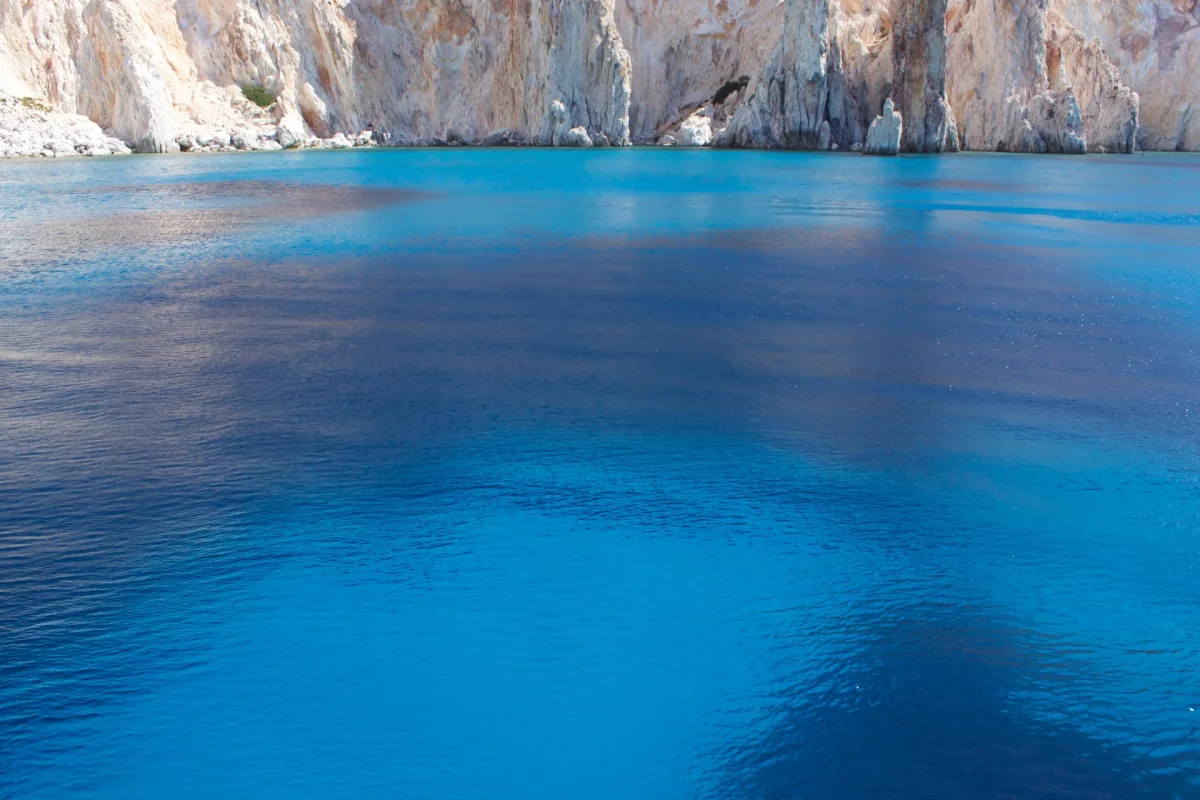
Polyaigos has no port, no road, no taverna and no ferry. It has eighteen square kilometres of cliffs, goats and some of the clearest water in Greece, and it sits just across the channel from Kimolos, within a day’s reach of Milos. That combination, spectacular and empty, is exactly why it is worth the trip, and also why the only way to see it is from a boat. This guide covers what is there, when to go, and how we get you there from Milos.
Key Takeaways
- Polyaigos (“many goats”) is the largest uninhabited island of the Aegean, about 18 km² of cliffs, coves and sea caves, 1.1 nautical miles south-east of Kimolos and part of the Milos group. It is a Natura 2000 site and a refuge for the Mediterranean monk seal.
- There is no ferry, no accommodation and nothing to buy. You reach it only by boat: from Pollonia on Milos or Psathi on Kimolos in about 15 minutes by fast boat, or from our base at Agia Kiriaki in 60 to 75 minutes.
- The highlights are Blue Bay with its white seabed and turquoise water, the rust and yellow cliffs of the south coast, the sea caves, the 1898 lighthouse at Cape Maskoula and the ruined 17th-century monastery.
- It is a full-day trip in the Compass 165cc (licence or our skipper) or the skippered, all-inclusive Compass 7s. The no-licence Compass 150cc does not have the range. A Pollonia pick-up, arranged in advance, turns it into a half day.
- Calm days only: the channel is exposed to the meltemi. Go in the morning, carry everything you need, and keep clear of the caves where seals rest.
Contents
What Polyaigos is
Polyaigos (also written Poliegos or Polyegos) is an uninhabited island of the Western Cyclades, administratively part of the community of Kimolos. With about 18 km² and roughly 17 km of coastline it is the largest island in the Aegean with no permanent residents. The name means “many goats”, and goats are still the only inhabitants, along with the wild birds and the Mediterranean monk seals that use its sea caves. The island is protected under the Natura 2000 network and in 2025 was declared an archaeological site to safeguard its prehistoric and Classical remains.
What draws boats is the coast. The north and west shores are pale limestone and white pebble coves over a sandy floor, which is why the water looks Caribbean; the south and east are volcanic, with cliffs in rust, ochre and yellow, carved into caves at sea level. Because nobody lives there, there is no light at night, no music, no sunbeds and, on a weekday morning, often no other boat.
How to get to Polyaigos
There is no scheduled ferry to Polyaigos and no place to land a car. Every visitor arrives by private or chartered boat.
- From Pollonia (Milos) or Psathi (Kimolos): the closest departure points. Polyaigos is about 15 minutes by fast boat from either, across the Kimolos channel. Day-cruise operators leave from both harbours in summer.
- From our base at Agia Kiriaki (south coast of Milos): 60 to 75 minutes by fast boat around the east of the island, usually combined with a circuit of Kimolos. This is the full-day version.
- With a pick-up at Pollonia or Psathi: on request and subject to availability, we can deliver the boat to Pollonia port or to Psathi so that Polyaigos becomes a half-day trip. Ask when you book and we will confirm for your date.
From Milos the classic combination is a full day: Kimolos in the morning, the crossing to Polyaigos at midday, and home in the afternoon. Our Kimolos island guide covers the first half of that day in detail.
What to see: beaches, caves and the lighthouse
- Blue Bay (Galazia Nera). The famous anchorage on the north-west coast: a wide bay over white sand where the water shades from pale green to deep turquoise. The main swim stop on almost every visit.
- Mersini. A sheltered cove on the north side with a small pebble beach, the usual lunch anchorage and the calmest water on a north-wind day.
- Ammoura, Vromolimnos and Panagia. Smaller coves on the northern and western shores, empty even in August. Panagia takes its name from the ruined Monastery of the Dormition, built in 1622 on the north-western side of the island.
- The coloured cliffs and sea caves. Along the south and east coast the volcanic rock rises straight from the sea in bands of red, orange and yellow, cut with caves you can look into from the boat. Some of these caves are monk seal resting places, so we look from a distance and do not enter. Our guide to the sea caves of Milos puts them in context with Kleftiko and Sykia.
- Cape Maskoula lighthouse. On the southern tip, a stone lighthouse built in 1898, still standing above the cliffs. A landmark on the circuit and a good photograph from the water.
- Snorkelling. The shallows off Blue Bay and the rocky edges of the coves have the best visibility in the Milos group; see snorkelling in Milos for what you will see and how to do it safely.
A day around Kimolos and Polyaigos
A typical full day in the Compass 7s with our captain, or the Compass 165cc with a licence:
| Time | Where | Notes |
|---|---|---|
| 09:00 | Agia Kiriaki | Briefing and departure from the platform |
| 10:00 | Kimolos south coast | Goupa boat garages, Karras sea cave, first swim |
| 11:00 | Prassa, Kimolos | White sand and turquoise water, coffee at the beach bar |
| 12:00 | Crossing to Polyaigos | 15 minutes across the channel |
| 12:30 | Blue Bay | The main swim and snorkel stop |
| 13:30 | Mersini | Lunch at anchor, calm water |
| 14:30 | South and east coast | Coloured cliffs, caves from a distance, the lighthouse |
| 15:30 | Return | Along the east of Milos, back at Agia Kiriaki around 17:00 |
With a Pollonia pick-up the day shrinks to a half day slot with the same Polyaigos stops and less driving. Timings for every route are in Milos boat trips: half day vs full day.
Which boat
- Compass 7s, 250 hp, up to 7 passengers, always with our captain, all inclusive: 950 € for the full day. The right boat for Polyaigos: the range, the speed for the crossing, snorkelling gear and drinks on board, and someone else reading the sea. Details on the Compass 7s page.
- Compass 165cc, 115 hp, up to 6 people, boat licence or one of our skippers: 450 € for the full day, fuel extra. Reaches Polyaigos from Agia Kiriaki in 60 to 75 minutes on a calm day, or in minutes with a Pollonia pick-up. See the Compass 165cc.
- Compass 150cc, the no-licence boat: not for this trip. Its 30 hp and 50-litre tank are sized for the south coast coves, not for the crossing to Polyaigos.
The full comparison is in which boat to rent in Milos, and the three ways of seeing the islands, shared cruise, private skippered boat or self-drive, in our guide to Milos boat tours.
Weather, seals and rules
- Wind. The Kimolos channel and the west side of Polyaigos are open to the meltemi. On a strong north-wind day the crossing is uncomfortable and Blue Bay loses its shelter; that is the day for the south coast of Milos instead. Check the marine forecast the evening before and let us advise on the morning.
- Seals. Polyaigos is one of the most important refuges of the Mediterranean monk seal in the Cyclades. If you see one, keep the boat at a distance, do not follow it and stay out of the caves. It is a legal protection, and the seals are why the island is still wild.
- No facilities. There is no water, no shade beyond the cliffs and no bin. Whatever you bring comes back with you.
- Anchoring. Sand at Blue Bay and Mersini, not seagrass. We show you where on the briefing.
Polyaigos or Kleftiko?
The question we hear most. Kleftiko is 20 to 30 minutes from our base, has the white arches and tunnels, and fits into a half day. Polyaigos is a full day, further and wilder, with fewer boats and clearer water. If you have one boat day, take Kleftiko. If you have two, the second is Polyaigos, and it is the one people describe afterwards as the best swim of their holiday. Our Milos itinerary shows where each fits in a 3, 5 or 7-day trip.
What to bring
- Water, food and everything you would normally buy at a beach bar; there is none.
- Reef-safe sunscreen, hat and a rash vest for long snorkelling sessions.
- Mask and snorkel, or use the gear on board the Compass 7s.
- A windbreaker for the crossing home in the afternoon breeze.
- A dry bag for phones and cameras.
Ready for Polyaigos? Tell us your dates and group and we will suggest the boat, the pick-up point and the best day of your week for the crossing. See our Milos boat tours and prices, or contact us.
FAQs
Is Poliegos worth visiting?
Yes, if you have more than one boat day on Milos. Kleftiko is closer and more dramatic; Polyaigos is wilder, emptier and has the clearest water in the group, with Blue Bay, coloured cliffs, sea caves and a good chance of having an anchorage to yourselves. Most guests who do both name Polyaigos as the best swim of their holiday.
How to get to Polyaigos island?
Only by boat. From Pollonia on Milos or Psathi on Kimolos it is about 15 minutes by fast boat across the channel. From our base at Agia Kiriaki on the south coast it is 60 to 75 minutes in the Compass 165cc or the skippered Compass 7s, usually as a full day with a circuit of Kimolos. A pick-up at Pollonia, arranged in advance, makes it a half day.
Is there a ferry to Polyaigos island?
No. Polyaigos has no port, no residents and no scheduled service of any kind. Ferries connect Milos with Kimolos, whose harbour at Psathi is the nearest to Polyaigos, but the last stretch across the channel is always by private or chartered boat, either a day cruise or a rental boat like ours.
Are there hotels on Polyaigos island?
No. The island is uninhabited and protected under Natura 2000, so there are no hotels, rooms, campsites or tavernas. Visitors stay on Milos or Kimolos and come for the day by boat. Pollonia on Milos and the village on Kimolos are the closest bases; our guide to Kimolos covers both.
What is the best Polyaigos beach?
Blue Bay on the north-west coast, a wide anchorage over white sand where the water is turquoise and shallow enough to see the bottom from the deck. Mersini, a small pebble cove on the north side, is the calmest lunch stop, and Ammoura, Vromolimnos and Panagia are smaller coves along the same shore. All of them are reached only by boat.
Why are there goats on Polyaigos?
The name means “many goats” and the island has been grazed for centuries; when the last inhabitants left, the goats stayed. They are the only land animals of any size on the island and you will see them on the cliffs above the coves. Along with the monk seals and the nesting seabirds they are part of why Polyaigos is protected.
Is there food on Polyaigos?
No. There is no taverna, no kiosk and no water on the island. Bring everything you need for the day, including water, food and shade, and take your rubbish back with you. On the Compass 7s drinks and snorkelling gear are included; on the self-drive Compass 165cc you provision yourselves before leaving Agia Kiriaki or Pollonia.
Sources
- Polaris Rent boat pages, Compass 165cc and 7s price lists
- Wikipedia, Polyaigos: https://en.wikipedia.org/wiki/Polyaigos
- Municipality of Kimolos, Island of Polyaigos: https://kimolos.gr/en/information-identity-of-kimolos/island-of-polyaigos
- Greece Is, Polyaigos declared an archaeological site: https://www.greece-is.com/news/polyaigos-declared-an-archaeological-site-protecting-the-island-of-many-goats/
- Hellenic National Meteorological Service, marine forecasts: https://www.emy.gr/
Ready to explore Milos by boat?
Rent the no-licence Compass 150cc or book a skippered boat, and discover Kleftiko, Polyaigos and the beaches only the sea can reach.
 by
by 
One reply on “Polyaigos: How to Visit the Largest Uninhabited Island in the Aegean by Boat”
[…] By private boat. A boat opens up everything the ferry cannot: the beaches of Kimolos that have no road, such as Prassa with its white sand, and the island of Polyaigos opposite, which has no inhabitants, no roads and no ferry at all. Polyaigos has some of the clearest water in the Cyclades, sea caves and coves you share with a handful of boats. Read our guide to visiting Polyaigos by boat. […]