
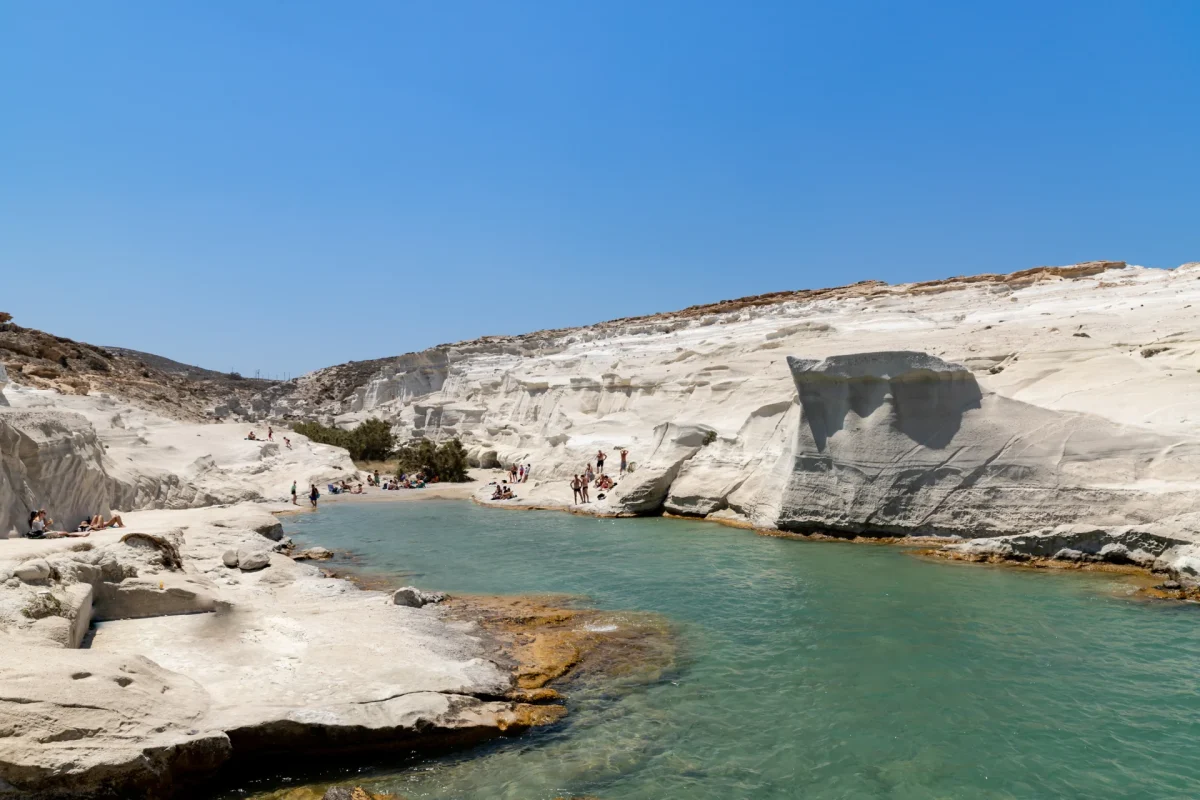
Sarakiniko is the photograph that sells Milos: bone-white rock rolling down to a slot of turquoise water, no plants, no sand, no colour except the sea. It is the most visited place on the island and, unusually for Milos, one of the easiest to reach, a few kilometres from Adamas on a paved road. This guide covers what the rock is, how to get there, where to swim, when to go to avoid the crowd, and something most guides skip: what Sarakiniko looks like from the water, and when a boat day along the north coast makes sense.
Key Takeaways
- Sarakiniko is on the north coast of Milos, about 3.5 to 5 km from Adamas and 5 km from Plaka, on a paved road with a bus in summer. It is free, open all day, and has no sunbeds; parking is limited.
- The white “moonscape” is soft volcanic rock, ash and pumice laid down by the island’s volcano and polished by north-wind waves, which is why it is bright white and smooth.
- Swimming is in the narrow sheltered inlet at the centre and off the flat rocks around it. On a calm day you can snorkel past the inlet to the small cargo ship wreck on the rocks to the east.
- It is exposed to the meltemi: on a strong north-wind day the inlet is fine but the open rocks are rough. Go at sunrise or after 17:00 for empty rock and soft light; midday in July and August is crowded and shadeless.
- From the sea, Sarakiniko is part of our north coast route with Papafragas and the basalt columns of Glaronisia, a full day from Agia Kiriaki in the Compass 165cc or 7s, or a shorter run with a Pollonia pick-up. On a meltemi day, choose the south coast instead.
Contents
What Sarakiniko is and why it is white
Sarakiniko is not a beach in the usual sense. It is a stretch of the north shore where the volcanic bedrock, a pale mix of ash, pumice and silica-rich deposits from the eruptions that built Milos, reaches the sea with almost no soil on top. Nothing grows on it, so nothing hides the colour. Wind and waves from the north have rounded every edge into domes, gullies and ledges, and the sun bleaches the surface until it reads as white against the blue. The name comes from the Saracen pirates who are said to have used the inlets along this coast as a hideout.
The result is the most photographed landscape on Milos and one of the most unusual shorelines in Greece. At the centre a narrow inlet cuts inland, with a small patch of sand at its head, which is where most people swim. Either side the rock spreads out in flat terraces you can walk across for a few hundred metres, with small caves and overhangs at the waterline.
How to get to Sarakiniko
- By car, scooter or ATV. From Adamas follow the road north towards Plaka and take the signed turn to Sarakiniko; it is a short drive on asphalt. The parking area at the end is small and fills by mid-morning in July and August, with cars then lining the approach road.
- By bus. In summer the local bus connects Adamas with Sarakiniko, Plaka and Pollonia. Timetables change by month, so check the current one at the port.
- On foot. From the car park it is a two-minute walk down to the inlet. The rock is smooth and can be slippery when wet, so shoes with grip are better than flip-flops if you plan to explore the terraces.
- By boat. Sarakiniko is on the north coast, opposite side of the island from our base at Agia Kiriaki, so from the sea it is part of a north coast route rather than a quick stop. Details below.
For where to stay so that Sarakiniko, Plaka and the port are all close, see our guide to where to stay in Milos.
Swimming, the inlet and the wreck
The inlet is the place to swim. It is narrow, sheltered from most wind, shallow at its head and deep and clear towards the mouth, with white rock on both sides that makes the water glow. It is popular, so early and late are calmer. Around the inlet the flat rocks drop straight into deeper water; people swim and jump from them on calm days, but there are no ladders or steps, so pick a spot where you can climb out.
Snorkelling is better than you would expect from a landscape with no seagrass. The white bottom makes the water exceptionally clear, and on a calm day you can swim out of the inlet and along the rocks to the east, where the rusting remains of a small cargo ship sit on the shore; it is a favourite spot with a mask. Our snorkelling in Milos guide covers the conditions and the other north coast spots.
There are no sunbeds, umbrellas or showers on the rock. The shade is whatever you carry.
Best time of day and wind
Sarakiniko faces north, which decides everything. In a meltemi, the north wind that blows most July and August afternoons, waves break over the outer rocks and the open sea is rough; the inlet usually stays swimmable but the walk on the terraces is windy and spray-soaked. On those days the south coast beaches are flat and warm.
Timing matters as much as wind. Sunrise at Sarakiniko is famous for a reason: the rock is pink and gold, the car park is empty, and you can photograph the inlet with nobody in it. By 11:00 in high season the terraces are busy and the white rock throws the heat back at you; there is no shade at all. Late afternoon after 17:00 the crowd thins and the light softens again. Our best time to visit Milos guide covers the months; June and September give you Sarakiniko with a fraction of August’s numbers.
Sarakiniko from a boat
From the water Sarakiniko is a white wall with the inlet as a dark slot in the middle, and it is one of the sights of our north coast route: out of Pollonia or around from Agia Kiriaki, past the mining jetties at Thiorichia, Sarakiniko, then the narrow inlet of Papafragas and the basalt columns of Glaronisia. On a calm day you can anchor off the rocks and snorkel where the day visitors cannot reach.
Two things to know:
- It is a full day from our base, or a short run from Pollonia. Agia Kiriaki is on the south coast, so the north coast circuit is a full day in the Compass 165cc (licence or our skipper, 450 €) or the skippered, all-inclusive Compass 7s (950 €). With a pick-up at Pollonia arranged in advance and subject to availability, Sarakiniko and Papafragas become a half-day trip. The no-licence Compass 150cc stays on the south coast.
- It needs a calm or southerly day. In a meltemi the north coast is the exposed side and we route boats to the south coast and Kleftiko instead. Ask us the evening before; the forecast picks the coast.
Half-day versus full-day timings for every route are in Milos boat trips: half day vs full day, and the three ways of seeing the coast are compared in Milos boat tours.
What to bring and what to avoid
- Water, a hat and reef-safe sunscreen: white rock, no shade, strong reflection.
- Shoes with grip for the terraces; the rock is smooth and slippery near the water.
- Mask and snorkel for the inlet and the wreck.
- A rash vest if you plan a long swim in the reflected sun.
- Do not jump without checking the depth and an exit, do not carve or paint the rock, and take everything back with you; there are no bins on the terraces.
Sarakiniko and the rest of Milos
Sarakiniko is the land highlight of Milos; the sea highlights are on the other coasts. Kleftiko, the white arches and caves of the south-west, is reached only by boat and is 20 to 30 minutes from our base. Tsigrado, the tiny cove between cliffs on the south coast, is famous for its ladder and simple from the sea. The collapsed roof of Sykia and the other sea caves of Milos complete the set. A good Milos plan has Sarakiniko at sunrise on a land day and Kleftiko on a boat day; our 3, 5 and 7-day itinerary shows how they fit.
Ready for the boat day? Tell us your dates and group and we will match the coast to the forecast. See our Milos boat tours and prices, or contact us.
FAQs
How can I get to Sarakiniko Beach on Milos?
By road: it is a few kilometres north of Adamas on a paved road, signposted off the Plaka road, with a small car park and a two-minute walk to the inlet. In summer the local bus from Adamas stops there. By sea it is on the north coast, part of our north coast boat route from Pollonia or, as a full day, from Agia Kiriaki on calm days.
Can you swim at Sarakiniko Beach?
Yes. The narrow inlet at the centre is sheltered, shallow at its head and clear towards the mouth, and it is where most people swim. Around it the flat rocks drop into deep water for swimming and snorkelling on calm days. There are no ladders, so choose a spot with an easy way out, and avoid the open rocks when a strong north wind is blowing.
Why is Sarakiniko beach so white?
The rock is volcanic: pale ash, pumice and silica-rich deposits from the eruptions that formed Milos, with almost no soil or vegetation on top to hide the colour. Waves driven by the north wind have rounded it into smooth domes and terraces, and the sun bleaches the surface, so the whole shoreline reads as brilliant white against the blue sea.
Why is Sarakiniko Beach so unique?
Few places in Europe have a bare white volcanic shoreline you can walk across, with a swimmable turquoise inlet cut into it and no sand, plants or buildings in sight. The combination of the lunar landscape, the clear water and the easy access from Adamas makes it the most photographed spot on Milos and one of the most recognisable beaches in Greece.
Is there a fee to visit Sarakiniko beach?
No. Sarakiniko is a free public beach, open all day, with no entrance ticket and no organised sunbeds or umbrellas to rent. Parking in the small car park is free as well. What you save in fees you should spend on water, a hat and sunscreen, because there is no shade and nothing to buy on the rock itself.
Is there parking at Sarakiniko beach in Milos?
Yes, a small free car park at the end of the access road, a two-minute walk from the inlet. It fills by mid-morning in July and August, after which cars park along the approach road. Arriving at sunrise or after 17:00 avoids the problem, and the summer bus from Adamas is a good alternative on peak days.
Can you go cliff jumping at Sarakiniko beach?
People do jump from the lower rocks around the inlet on calm days, but there are no marked spots, no lifeguard and no ladders back out. Check the depth and the exit before every jump, never jump in a north wind or swell, and skip it entirely if you are unsure. From a boat, a swim ladder makes the same water far safer to enjoy.
Sources
- Polaris Rent boat pages, Compass 165cc and 7s price lists
- Wikipedia, Sarakiniko Beach: https://en.wikipedia.org/wiki/Sarakiniko_Beach
- Discover Greece, Sarakiniko beach: https://www.discovergreece.com/experiences/landing-lunar-landscape-sarakiniko-beach
- Hellenic National Meteorological Service, marine forecasts: https://www.emy.gr/
Ready to explore Milos by boat?
Rent the no-licence Compass 150cc or book a skippered boat, and discover Kleftiko, Polyaigos and the beaches only the sea can reach.
 by
by 
One reply on “Sarakiniko Beach, Milos: The Moonscape by Land and by Boat”
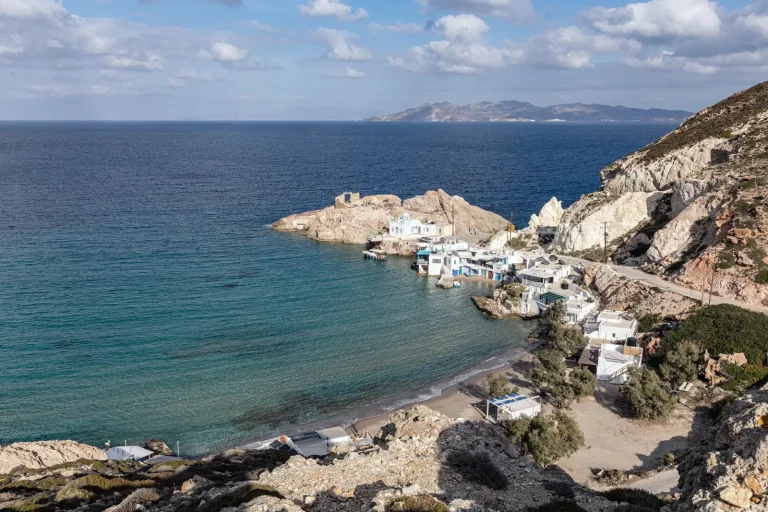
[…] out, the north coast of Milos has some of the most famous beaches on the island, including Sarakiniko with its white lunar rock, the fishing coves of Firopotamos and Papafragas. For the rest of the […]