
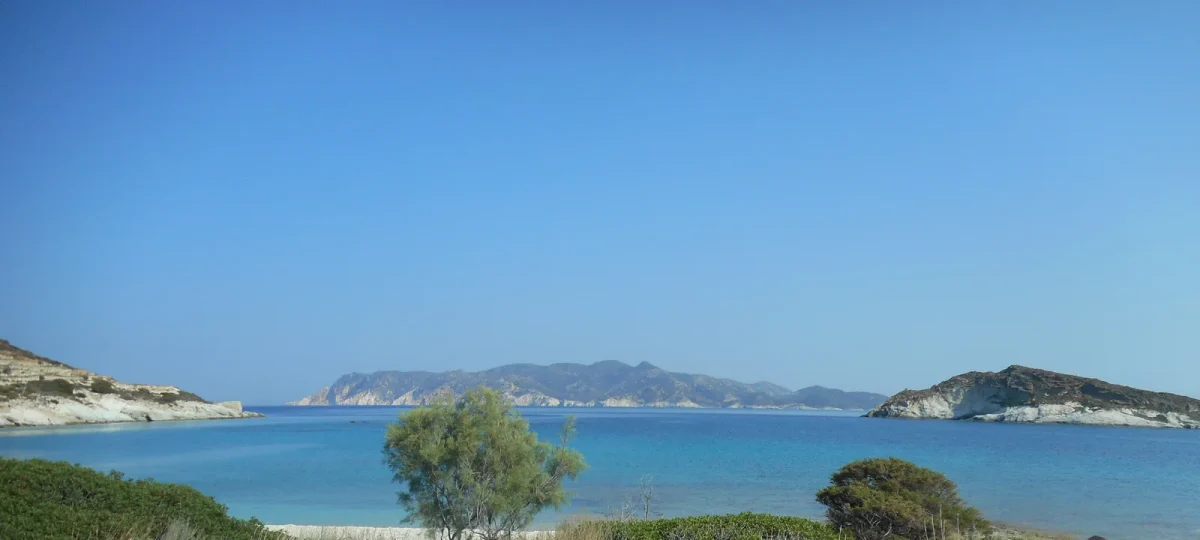
Kimolos sits one nautical mile off the north-east tip of Milos, close enough that the ferry from Pollonia takes 20 minutes, far enough that most visitors to Milos never make the crossing. That is the whole appeal. About 36 square kilometres, fewer than a thousand permanent residents, one hilltop village, a ring of white-sand and chalk-cliff beaches, and the uninhabited island of Polyaigos next door. This guide covers the beaches worth your time, the village of Chorio, how to get there, and the boat routes that show Kimolos from the side it was designed to be seen.
Key Takeaways
- Kimolos is a day trip or a slow overnight from Milos: ferries from Pollonia to the port of Psathi run many times a day in summer and take 10 to 25 minutes depending on the boat.
- Prassa (Agios Georgios) is the beach everyone comes for: fine white sand and shallow, almost fluorescent water over a chalk seabed. Bonatsa, Kalamitsi and Aliki are the easy family beaches on the south coast.
- The best of Kimolos, the Goupa boat garages, the Karras sea cave, Monastiria and the coloured cliffs of Polyaigos, is only properly seen from the water.
- A Compass 165cc or 7s reaches Kimolos from our base at Agia Kiriaki in 45 to 60 minutes, or we can deliver the boat to Pollonia or Psathi on request, which puts you 15 minutes from Prassa; the 30 hp Compass 150cc stays on the Milos south coast. The Kimolos channel is sheltered from the north wind, which makes it the smart route on a meltemi day.
- Chorio, two kilometres above the port, has a fortified medieval Kastro, whitewashed lanes and the best sunset on the island. Go up in the evening after a day at sea.
Contents
Why visit Kimolos
Kimolos is what Milos was twenty years ago. The name comes from kimolia, Greek for chalk, after the bright white deposits that colour its cliffs and turn the shallows at Prassa an electric blue. The island has no resort hotels, no beach clubs and no traffic. What it has is a coastline of white rock and clear water, a village that closes its shutters at siesta, and tavernas where the fish came off a boat you can see from your table.
It is also the quietest way to see the wildest water in the Milos group. Polyaigos, the largest uninhabited island in the Aegean, is two kilometres off its south-east coast, and the channel between them is where our guests see the clearest sea of their holiday.
How to get to Kimolos
- From Milos by ferry: small open ferries, traditional caiques and a speedboat taxi connect Pollonia (north-east Milos) with Psathi, the port of Kimolos, many times a day in season. Crossing time is 10 to 25 minutes depending on the vessel. Cars can be taken on the open ferry.
- From Milos by rental boat: the flexible option. From our base at Agia Kiriaki on the south coast it is 45 to 60 minutes around the east side of Milos in a Compass 165cc or Compass 7s; on request and subject to availability we deliver the boat to Pollonia port, or to Psathi on Kimolos itself, so the crossing is minutes. You arrive on your own schedule and explore the coast as you go.
- From Athens: ferries from Piraeus take 4.5 to 7.5 hours depending on stops (Kythnos, Serifos, Sifnos, Milos). Kimolos is 87 nautical miles from Piraeus.
- By air: the nearest airport is Milos, then the ferry from Pollonia. Pollonia is about 12 km from Adamas and the airport.
The best beaches in Kimolos
Kimolos has a dozen named beaches on 38 km of coastline. These are the ones that justify the crossing, grouped by how you reach them.
By road or on foot from the village
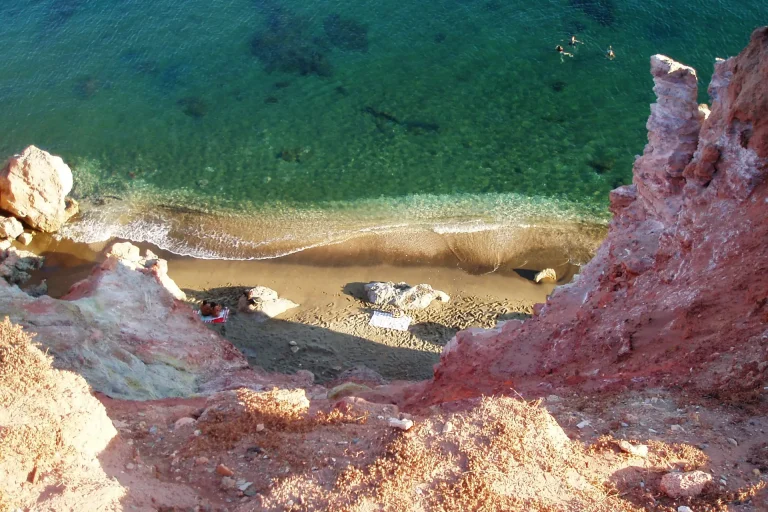
- Prassa (Agios Georgios), north-east, 5 km from Chorio. The famous one. Fine white sand, shallow water that stays turquoise for fifty metres out, a small canteen in summer and thermal springs bubbling in the rocks at one end. By boat you anchor on the sand in two metres of water and swim in.
- Bonatsa, south, 3 km. Long, sandy, family-friendly, with tavernas and a view straight across the channel to Milos. Usually the calmest water on the island.
- Kalamitsi, south, 3 km. Next to Bonatsa, long and sandy, a little busier in August.
- Aliki, south, 2 km. Sandy, clean, walkable from Psathi, with a few rooms and a taverna behind it.
- Psathi. The port beach, shallow and sheltered, fine for a swim while you wait for the ferry.
- Klima, north, 2 km. Pebbles over a rocky seabed, popular with locals, good snorkeling along the edges.
Better by boat
- Monastiria, north coast. A wild chalk-white cove beneath the islet of Agios Andreas, reachable on foot only by a long rough track. From the water it is ten minutes from Prassa and you will usually have it to yourself. Snorkel the volcanic rock between the cove and the islet.
- Mavrospilia, west, 6 km. A long sandy beach at the end of a dirt track, remote and empty, named after the dark sea caves in the cliffs beside it.
- Dekas and Ellinika, west. Quiet pebble and sand coves facing Milos, with submerged ruins of the ancient town off Ellinika that you can snorkel over on a calm day.
- Goupa and Karras. Not beaches exactly but the best swimming on the east coast, between sculpted rock and the boat garages described below.
For the Milos side of the same story, see our guide to the beaches of Milos you can only reach by boat.
Chorio, Psathi and the Kastro
Chorio is the only village, two kilometres uphill from Psathi and served by a small bus and taxis. Its core is the Kastro, a fortified medieval quarter where the outer houses form a defensive wall and the lanes inside are barely wide enough for two people. Much of it is still lived in. Around it spread the whitewashed alleys of the newer village, the church of Panagia Odigitria, a folk museum, a handful of tavernas and cafes, and two working windmills on the ridge above.
Go up at the end of a boat day. The light on the white walls an hour before sunset, and the view over the channel to Milos, are the reason people who come for one night stay for three.
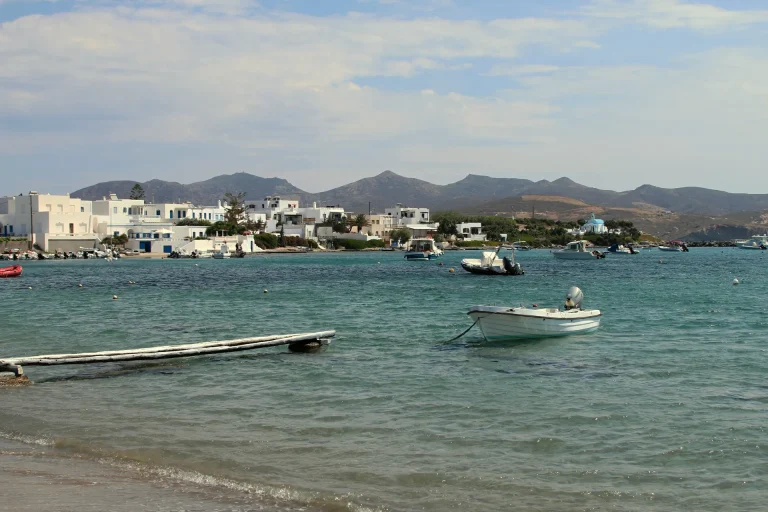
Psathi itself is a working harbour with a strip of fish tavernas on the quay. It is where the ferries and most rental boats arrive, and where you eat if you do not want to climb the hill.
Goupa, Karras and the sea caves
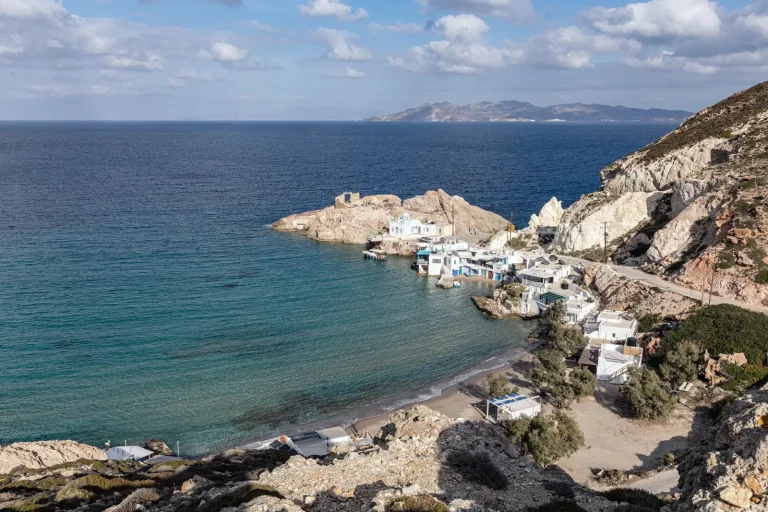
Goupa is a tiny fishing settlement on the east coast where the houses are syrmata: boat garages cut into the soft white rock at the waterline, with painted wooden doors and living quarters above. Milos has its famous version at Klima; Goupa is smaller, rougher and almost unvisited. Between the garages the rock has been sculpted into natural pools where you can swim.
A few hundred metres along the coast is the Karras sea cave, a deep opening in the cliff that small boats can enter in calm weather. Further south the coast towards Psathi is lined with smaller caves and overhangs. None of this is visible from the road; it is the first stop on any boat circuit of the island and the reason the circuit exists.
Our guide to the sea caves of Milos covers the bigger caves across the channel.
Polyaigos: the island next door
Polyaigos (“many goats”) lies two kilometres south-east of Kimolos. At about 18 square kilometres it is the largest uninhabited island in the Aegean, a Natura 2000 protected area owned mostly by the Church, grazed by goats and ringed by cliffs in red, yellow, green and white. Its sea caves shelter Mediterranean monk seals.
What you come for: the Blue Bay on the north side, a shallow sandy cove enclosed by pale cliffs; Mersini beach on the sheltered south; the cave-riddled cliffs between them; and the lighthouse on the summit if you anchor below and have the legs for the footpath. There are no facilities, no shade and no mobile signal in places. Bring everything, take everything back.
Polyaigos is boat-only. From Psathi or Prassa it is 15 to 20 minutes in a fast boat; from Pollonia on Milos about the same.
Exploring Kimolos by boat: two routes
Half day: the Kimolos circuit (4 to 5 hours)
Psathi or Pollonia, then clockwise: Goupa and the Karras cave, Prassa for a long swim, Monastiria and the islet of Agios Andreas for snorkeling, then back down the west coast past Mavrospilia and Ellinika to Bonatsa for a last swim. Sheltered water most of the way, short hops between stops, the best reward-per-mile in the Milos group.
Full day: Kimolos and Polyaigos (7 to 9 hours)
The Kimolos circuit in the morning, then the crossing to Polyaigos for the Blue Bay, the coloured cliffs and lunch at Mersini. Return via the south coast of Kimolos. This is the route almost nobody else offers and the one our captain rates above Kleftiko on a calm day.
Which boat:
- Compass 150cc (30 hp, no licence): stays on the Milos south coast. The run from Agia Kiriaki is too long for it; with a Psathi delivery arranged in advance it can do the Kimolos circuit.
- Compass 165cc (115 hp, licence or our skipper): the right boat for the Kimolos circuit and, on a calm day, Polyaigos.
- Compass 7s (250 hp, with our captain, all-inclusive): the full Milos, Kimolos, Polyaigos triangle in one day, with snorkeling gear, drinks and lunch on board.
See which boat to rent in Milos for the full comparison, and half-day vs full-day boat trips for how the routes fit the two rental slots.
Kimolos vs Milos: which one, or both?
Both, in that order of priority. Milos has the catacombs, Sarakiniko, Kleftiko, the villages and the infrastructure, and it deserves the bulk of your time. Kimolos is the day you will talk about afterwards: emptier beaches, clearer water, a village that has not changed, and Polyaigos. If you have three days, give Kimolos half of one. With five or more, give it a full day by boat or a night in Chorio. Our 3, 5 and 7-day Milos itinerary shows where it fits.
Practical information
- Season: May to October. Many tavernas and rooms open only June to September.
- Getting around on the island: a bus between Psathi, Chorio and the main beaches in summer, a few taxis, and scooter and car hire at the port. Roads to the west coast beaches are dirt tracks.
- Money: one ATM in Chorio. Bring cash for the smaller tavernas and the canteen at Prassa.
- Wind: the channel between Milos and Kimolos is sheltered from the summer meltemi, which is why it is our standard alternative when Kleftiko is blown out. The north coast (Monastiria, Klima) gets choppy in the afternoon.
- Anchoring: sandy patches at Prassa, Bonatsa and Mersini; avoid seagrass meadows, which are protected.
See Kimolos from the water
The Compass 165cc covers the Kimolos circuit; the Compass 7s adds Polyaigos with our captain and everything on board. Contact us with your dates and we will match the route to the forecast.
FAQs
Is it worth going to Kimolos?
Yes, especially if you are already on Milos. It is 20 minutes away by ferry, has the best white-sand beach in the group at Prassa, a medieval village, almost no crowds, and it is the gateway to Polyaigos. Most people who skip it regret it once they see it from the ferry.
How do you get to Kimolos island?
From Milos, take the ferry, caique or speedboat taxi from Pollonia to Psathi (10 to 25 minutes, many daily departures in summer), or cross in a rental boat. From Athens, ferries from Piraeus take 4.5 to 7.5 hours. The nearest airport is on Milos.
Can you do a day trip from Milos to Kimolos?
Easily. Take an early ferry from Pollonia or a rental boat, spend the morning at Prassa and Goupa, eat at Psathi or Chorio, and be back on Milos by evening. With a Compass 165cc or 7s you can add Polyaigos and still return the same day.
Can you stay on Kimolos?
Yes. There are rooms, small hotels and apartments in Chorio, Psathi, Aliki and Bonatsa, nothing large. Book ahead for July and August; the island has limited capacity and fills up.
How many days do you need in Kimolos?
One full day covers Prassa, Goupa, Chorio and a swim or two. Two days let you do the boat circuit, Polyaigos and the west coast beaches without rushing. More than three is for people who want to do nothing, which Kimolos is very good at.
Is Kimolos similar to Milos?
Geologically yes, both are volcanic with white rock and sea caves. In feel, no. Milos has towns, nightlife, an airport and tour boats; Kimolos has one village, a handful of tavernas and empty beaches. Think of it as the quiet annex of Milos.
What is the best beach in Kimolos?
Prassa (Agios Georgios) for sand and colour. Monastiria for solitude, by boat. Bonatsa for families. If you are on a boat, the Blue Bay on Polyaigos beats all three.
Sources
- Municipality of Kimolos, Access and beaches: https://www.kimolos.gr/en
- Greeka, Kimolos beaches: https://www.greeka.com/cyclades/kimolos/beaches/
- Wikipedia, Kimolos: https://en.wikipedia.org/wiki/Kimolos
- Wikipedia, Polyaigos: https://en.wikipedia.org/wiki/Polyaigos
Ready to explore Milos by boat?
Rent the no-licence Compass 150cc or book a skippered boat, and discover Kleftiko, Polyaigos and the beaches only the sea can reach.
 by
by 
8 replies on “Kimolos Island Guide: Beaches, Villages & How to Explore by Boat”
[…] The largest uninhabited island in the Aegean, and the wildest water in the group. The Blue Bay on the north side is a shallow, sandy cove with turquoise water that beginners love; the cliffs around it and the south coast near Mersini are where the bigger fish are. The island is a Natura 2000 site and its sea caves shelter Mediterranean monk seals, so admire them from a distance. Poliegos is around 15 minutes by fast boat from Pollonia and pairs naturally with a circuit of Kimolos, covered in our Kimolos island guide. […]
[…] is usually combined with a circuit of Kimolos. Our Kimolos island guide covers the beaches on that […]
[…] If your boat is based at Pollonia, or you are happy to start there, cross the channel to Kimolos: the Karras sea cave, the painted boat garages of Goupa, a long swim in the shallow turquoise at Prassa, and a coffee at Psathi if you like. Short hops, sheltered water, huge reward per mile. Details in our Kimolos island guide. […]
[…] A wild chalk-white cove on the north side of Kimolos, facing the islet of Agios Andreas. On land it is a long walk on a rough track; by boat it is ten minutes from Prassa. Part of our favourite half-day circuit in the Kimolos island guide. […]
[…] and on request and subject to availability we can deliver a boat to Pollonia port; see our Kimolos island guide. For Kleftiko and the south coast, you drive to Agia Kiriaki in the […]
[…] Kimolos and Polyaigos. The blue-water islands to the north-east: Prassa and Rema on Kimolos, then the empty coves of uninhabited Polyaigos. A full day, or a half day with a Pollonia pick-up. Start with the Kimolos island guide. […]
[…] day: Kimolos in the morning, the crossing to Polyaigos at midday, and home in the afternoon. Our Kimolos island guide covers the first half of that day in […]
[…] a windy day the Kimolos channel is sheltered and just as beautiful in its own way; see the Kimolos island guide. A good day at Kimolos beats a bad day at Kleftiko every […]